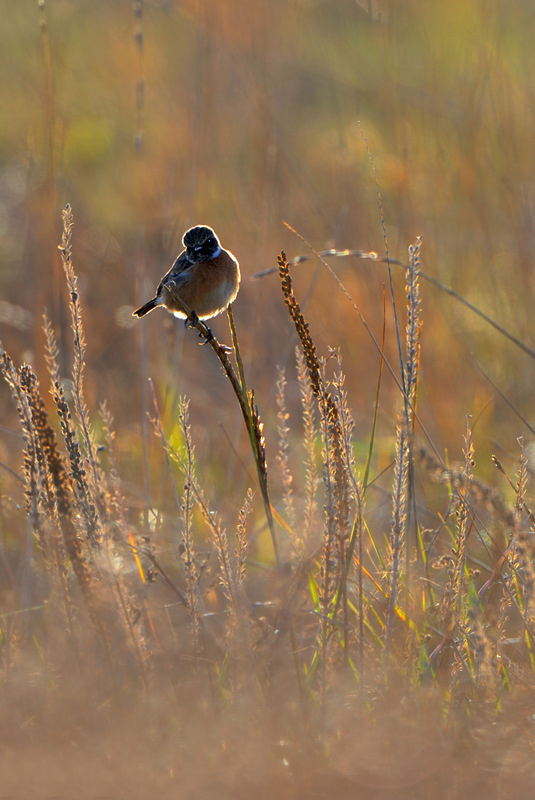
Following on from my previous Wildlife Photographic tip ‘Back-Lighting’ which gives your subject a strong outline and adds a great atmosphere, with a great deal of impact to your image, it’s counterpart ‘Side Lighting’ emphasizes a great deal of texture from the use of light highlighting your subject from the side, and when put to use in your image carefully it can produce a wonderful and dramatic image again with bags of atmosphere, giving the image a three-dimensional feel. A word of warning though from my own personal experiences ‘Side Lighting’ gives you the best results when the sun is low in the sky eg. Sunset, Sunrise.
Side Lighting does not work very well if the background is really cluttered or messy with lots of detail and other things going on so keep it as clean as possible, the idea is to isolate the light against your subject with a clear background illuminating your subject from the side bringing out all the texture in the feathers or fur at the same time creating a great deal of depth to the image. Always expose for the sunlit side of your subject, even at the cost of losing some shadow detail.
The way you use light in Wildlife photography is very important for the overall effect you are wishing to capture, Side Lighting is really effective when shooting close up portraits of wild animals and birds. The contours of the face are really well revealed, the texture of the fur and feathers really stand out a great deal more due to this mode of lighting. Try when possible to use the widest aperture you can on your telephoto lens rendering the background blurred, creating a smooth backdrop to your image.
Use ‘Side Lighting’ alongside ‘Back lighting’ as a part of your everyday Wildlife Photography, from the garden to the air, creating two very different images through the use of natural light which is at its very best during sunrise and sunset, illuminating your chosen subject from the side or the back in the case of ‘Back Lighting’.
I hope my photographic tips on ‘Side Lighting’ has helped you understand just how important light can be and how it will change and effect your photography, should you have any questions or queries then please drop me a line here and I will be more than pleased to answer them. Lighting and how to use this to the best effect is one of many things I go through on my one to ones, where the sole aim is to improve your own wildlife photography. For more information on these days then please click here to be taken to my one to one page, many thanks.
Water voles are one of my favourite mammals in the UK, with their plump bodies and enduring mannerisms. Water voles are often mistaken for rats and the character called Ratty, in Kenneth Grahame’s ‘The Wind in the Willows’, was actually a Water vole. There has been many remakes of this wonderful children’s book which was a firm favourite of mine.
While waiting to see one of these animals show up you can often feel you are among a real life set of the wind in the willows, with the many insects and small creatures all going about their lives around you, with the continuous flow of moving water.
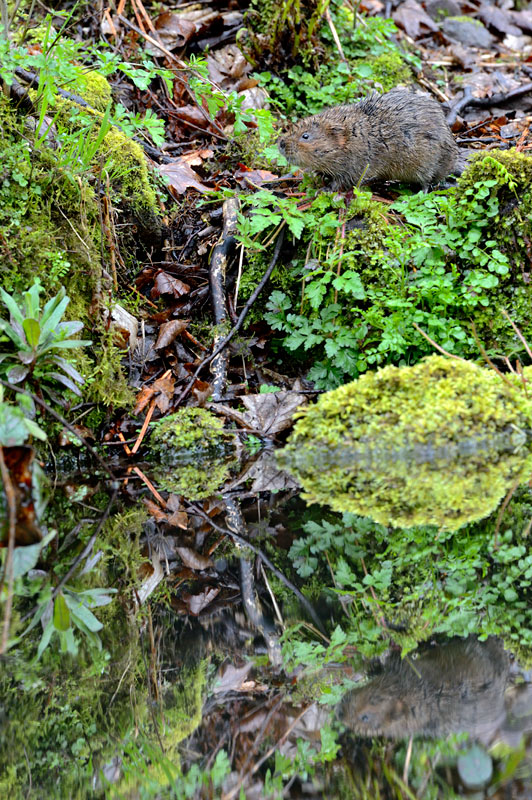
I’m always very vigilant when I’m around rivers and streams, just in case you see any sign of these fellows around. They leave characteristic tracks in mud, close to the water, their forefoot has four toes which leaves a distinctive star shaped pattern, while the hind foot has five toes. A great way to tell if water voles are about is to look for the tell tale signs they leave, such as footprints, burrows and droppings. They are active during the daytime and particularly in the early evening.
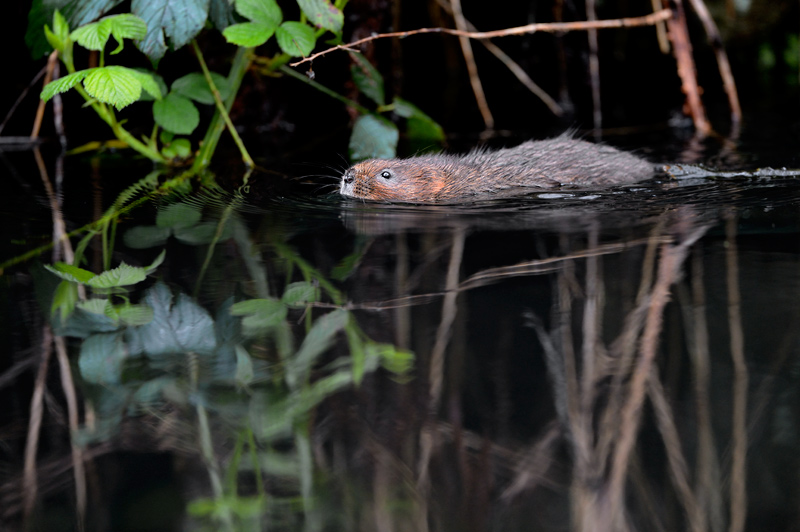
If you sit quietly and patiently you may hear the characteristic ‘plop’ of a diving water vole and then be rewarded by seeing it make its way, doggy-paddle, across the river as it patrols the banks searching for food. Water voles are affected by poor water quality another major clue in locating them, if the water isn’t clean and healthy then you won’t find them there.
Over the last several weeks I have spent alot of time watching a couple of pairs at different locations within the rivers of the Peak District and witnessed some amazing and unseen behaviour. Last year I was amazed to see one vole climbing small trees to reach and feed on fresh leaves, sitting suspended above the water casally eating without a care in the world.
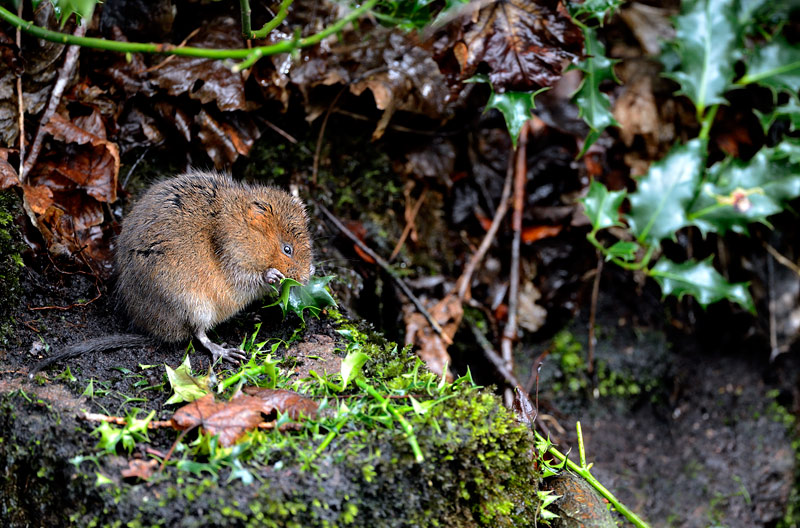
Water voles love to eat a wide range of vegetation, small fresh leaves and roots are their favourite but they will eat basically anything they can find. Recently I witnessed one vole eating holly leaves, nibbling around the sharp points consuming the juice centre parts then discarding the sharp bits aside.
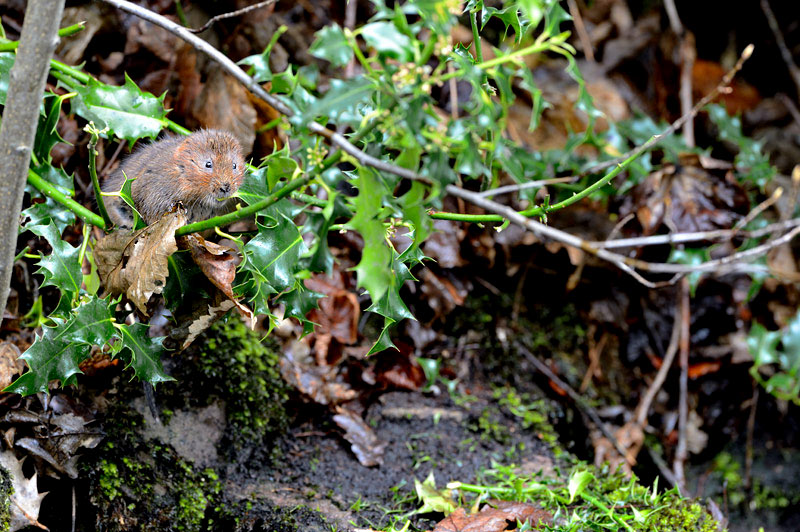
Once the lower leaves on this tree had been eaten I then witnessed him climbing up, sometimes falling off to continue eating these holly leaves. At times it was so comical, I didn’t know whether to laugh or cry with laughter as this was behaviour I had never witnessed within Water voles before.
He would slowly climb up, in between the sharp points of the leaves to reach them, bite and begin chewing. A couple of times he’d get to where he was trying to reach a leaf, only to fall off, make a massive plop, swim a shore and continue on.
“Nearly there” I was saying while pinned to my cameras viewfinder capturing this sequence, with his eye just peeking through. At this stage I was glued to him just not knowing what would happen next. I’ve never laughed so much while watching wildlife before. And as I watched through my viewfinder I really hoped he understood I was laughing with him not at him.
Streamlining his body shape and fur in order to squeeze around the sharp edges of the holly leaves, as seen in the photo below. Almost halving his size in order to get up and past these sharp obstacles.
For every climb that he succeeded there were many that failed, where he fell and plunged into the water beneath him.
He would come to the surface and swim to the shore and carry on, occasionally having a quick look around to see if anyone had witnessed his fall. Almost like when you see a person fall over or if you trip or fall yourself, you bounce straight back up and carry on red faced , just checking around to see if anyone witnessed your fall. If they did, it just made the whole experience just that bit harder to bear. But such was the determination of this enduring fellow and the pull of these leaves he carried on for several minutes.
They say a picture paints a thousand words, so I do hope these photos really convey what might have taken me many more words to express. Where the power of visualization is key for me. I still cannot believe what I witnessed and it clearly goes to show that no matter how long or how much you know about a subject, there will be always more to learn.
This is the beauty of wildlife photography, the fact I can show now what I witnessed rather than just trying to explain what magical wonders I saw that day. By just watching and listening and taking in whats around you can often result in these wonderful moments I get chance to see whilst among nature. This is the key to my work, many thanks.
Back lighting can give your subject a strong outline and add a great atmosphere to your image with a great deal of impact at the same time. Allow where possible you’re subject to be the main feature of your photograph with the use of simple composition with the sun directly behind it. The best times for back lighting to be at its best is dawn and dusk when the sun is low in the sky, creating the warm colours and glow from this wonderful time of the day. If the shape of the subject is easily recognizable through its strong outline it will make for a beautiful photo.
The correct exposure for backlit shots can be tricky so you will have to experiment with darker and lighter exposures in order to get the desired effect and overall feel and mood of the image you want. Use single selected focus point and spot metering where you can take a reading from the subject’s body and set the exposure in camera. Dealing with the ever unpredictable subject of wildlife though the subject may not allow you the time to take a reading for the perfect exposure. And always try to keep the affect of lens flare down by keeping out of direct sunshine as much as possible when taking the photo.
So in closing back lighting can transform an image, adding a beautiful atmosphere within the photograph with loads of impact to the main subject. Great care must always be shown not to point the lens directly at the setting or rising sun as it will damage your eyes. The lens must be clean and free from smears and dust, and sometimes the effects of flare can add a lot to the image so don’t throw the images away until you get them home and reviewed them on your computer. I hope that has helped you a little in understanding back lighting in wildlife photography, if you have an queries about anything I have mentioned then drop me a line here and I’d be pleased to answer them.
I will be presenting my presentation; Dawn to Dusk at Calumet’s spring open days in Manchester and London over the next couple of weeks. Click here for details and dates. I will be available all day to answer any questions or general help or advice you may need for your own wildlife photography. I also run one and two days seminars in conjunction with Calumet, for more details click on their seminars page.
Spring time for me is the best time of year. Wildlife is everywhere and bird song fills the air, even more so over the last several days, waking up to several inches of thick snow on the moors of the Peak District. I thought this maybe an April fools too far. During the last ten days or so I have enjoyed the very warm temperatures of spring whilst in Norfolk and other places around the UK running my one to ones and also my own project work.
Great Crested Grebes, Brown Hares, Barn owls and many more species all settling down, starting to pair up and begin a family at this wonderful time of year. I had a one to one in Norfolk and really enjoyed showing my client around. We captured some wonderful images of Barn Owls, Brown Hares and waders during the day and Ben wrote a lovely blog post with some great images which can be seen by clicking here
“You couldn’t make it up if you tried” first came to mind, as I had two one to ones booked in to photograph Red Grouse on the moors, the heavens opened and inches of snow fell. Some roads in and out of Buxton where closed so it was really touch and go on whether the days went ahead. I made contact with both clients as a blanket of thick snow in early April really is unheard of. Also very worrying for the wildlife sitting on eggs and trying to breed/mate while the weather was plunged into freezing, wintery conditions.
Both of my Red Grouse one to one clients where great sports and both days went ahead as planned. The first day was a little tougher due to the snow being at its highest from the previous day’s downfall. We had to walk in places knee deep in snow as we ascended in darkness to where the grouse live and play out their lives among the higher regions of the Peak District.
Walking through thick snow with heavy kit bags does get you warm. Full credit to Steve though who knuckled down and was rewarded for his efforts with some amazing encounters of both male and female Red Grouse, the words “you only get out what you put in” ringing around the place as we sat down and drank our cups of tea some 600 meters up above sea level.
I always tell clients that the best way to see and in turn take your photographs is just sit and watch, read and listen to nature, she will tell you what’s around and what is happening. Never force anything and never go with a shopping list of shots you wish to capture. Adopt this approach along with care and respect for your subject and you get some wonderful moments into a wild animals life. On both days both clients did just so and had some lovely encounters with this iconic moorland bird that is so at home within this sometimes unforgiving habitat.
Rival males posing to each other and fighting over their females, trying their luck. We even witnessed a grouse having a snow bath. Cleaning his feathers among the deep snow. Animal behaviour is amazing to see and capture and I showed some key techniques and fieldcraft which enabled both clients to read a little more into what was happening, in turn resulting in lovely moments where we came close to these birds on so many occasions, peering into their world through their eyes. This always has a deep and long lasting impact on me, making that contact with nature is priceless.
The weather on both days started well but became foggy on the second day but again the grouse came close and carried on with their lives around us which was magic and true, real wildlife photography for me. Blending in, using what’s around you and just watching and working the land. Thank you Steve,Nigel also Ben for your company over the last several days and I wish you well in your photography.
Little did I know when I first spoke with Helen Buckland, the UK president of the Sumatra Orangutan Society- SOS last year, offering my help and professional services in order to help and highlight the plight of this great ape and planning our trip to the jungles of Sumatra, that just over twelve months later an area and its Orangutans would be in grave danger of complete extinction at the hands of greed and shocking actions by the government there
Today after several weeks of legal wrangling to save an area of rainforest in Sumatra from burning the government there have refused to make a ruling on the case. Over the last week a man made firestorm has swept through a huge area of the remaining peat swamp forests of Tripa, devastating critically endangered Sumatran Orangutans to the very brink of extinction, possibly within months. To read the shocking ruling please click here. SOS’s website has the full story here.
Critically important, the Tripa peat swamp forests of Aceh, Indonesia, has long been recognized as a UNEP/UNESCO Great Ape Survival Partnership priority site for Great Ape Conservation. In the early 90’s these forests are estimated to have contained between 2,000 and 3,000 but today only a few hundred survive. If the current rate of forest destruction and burning continues, even these will be gone completely within a matter of months. The whole of the Tripa peat swamps lie within the Protected Leuser Ecosystem, a National Strategic Area for Environmental Protection in Indonesia’s National Spatial Plan established in 2008.
Sumatran Orangutans are heading towards extinction, and this latest story on Tripas Orangutan tragedy has circulated around the world –Time Magazine, Washington Post, Guardian, The Australian and many more in an out pouring of anger of such a shocking act. In an amazing response to the tragedy in Tripa, thousands of people all around the world have emailed the President of Indonesia and key stakeholders calling for the law to be enforced and upheld in Tripa. Click here to see the full story and several links in which will help also.
Spotlight Sumatra see’s me going to the island of Sumatra in mid September for two weeks. The principal focus of my trip will be the Orangutans, capturing them within their natural habitat, looking for behaviours to capture and so on while spending time sleeping and tracking them with my guides among the jungle. This shocking news and ongoing problems have brought home though just how important a trip it will be. Not only to capture the amazing Orangutans with photographs but also to report on the problems and issues facing the amazing wildlife that live on Sumatra.
On a personal level though it will be very rewarding helping SOS a charity I’m right behind in helping to show the world this Orangutan is in serious danger. But I am under no illusion I may witness things that will greatly upset me and touch deep inside my sole but I am determined to tell the story and help bring home the faces and stories of the wildlife that live there that I promise. This will help and highlight what’s going on at the same time show our closest living relative to a wider audience.
Helen along with myself are planning exhibitions, talks and much more to bring this great ape into more of the spotlight to help its survival. So hopefully I’ll be able to help so much on all levels, but in the meantime there is the ongoing problems in Tripa and SOS along with all the other agencies around the world are continuing the fight to stop these forests from burning as we speak. To keep up to date please visit SOS’s website and if you can sign the many petitions that are being passed around calling for an immediate stop to this clearance that that would be amazing and I thank you on behalf of the Orangtuans and the other wildlife that’s suffering there.
I cannot put into words my feelings towards the recent ruling and shocking things that are happening there as I speak. I can only help in the only way I know at this present time and that’s highlighting whats going on there on my blog. Once I am there I hope to do all I can to help and let my heart, eye and camera do the talking for me.
My perpetration’s have already begun, with me brushing up my climbing and abseiling skills, where below you can see an old image of myself as part of a rope access team, climbing on a historic building doing repairs to the windows and general maintenance which was my job before turning professional. I’m hoping these and my many other skills will come in good use once I’m on the ground in Sumatra.
Thank you for reading and if there is anything you can help with then please contact Helen at the Sumatra Orangutan Society, many thanks.
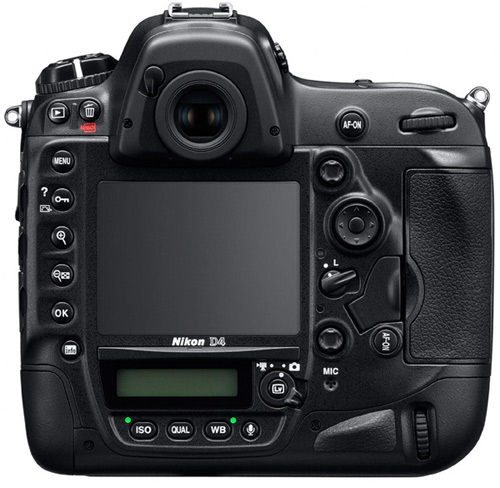
I’ve now had the Nikon D4 for just over a week and in that short time I’ve used the camera photographing my own work and also on one to ones, and I have to say the camera has performed very well. Having had the Nikon D3s now for two years, it was always going to be a hard act to follow. The improved ISO and added megapixels are nice, but what’s even better is the improved ergonomics, controls, speed, autofocus, metering, illuminated buttons, processing -EXPEED 3, and video capabilities with the full HD-SLR which are all improved from the D3S.
The overall shape of the camera has not changed much from the D3s, however, the controls and ergonomics are a bit different. The Nikon D4 now provides better control when the camera is used in the portrait orientation which is great if you shoot in this orientation a lot like me. The joystick and auto focus control is closer and easier to manage now when held vertically, with the D3s you had to really reach over with your thumb to get to the joystick. The Nikon D4 is about 5% lighter than the previous D3s and placed alongside each other this difference is clear to see.
Nikon has improved the auto focus system drastically. It can now operate in much lower light; this is a huge advantage, especially for wildlife and where I am depending on my auto focus system in low-light situations to capture what I’m witnessing. The D4’s auto focus has faster accuracy over the D3s from my first findings, performing brilliantly in poor or testing light. The image below of two Canada Geese taking off in the first rays off dawn light demonstrates this perfectly in very testing light conditions.
Clean, smooth and quick is how I’d best describe the auto focusing on the D4. The buffer is very big too compared to the D3S and starts to fill up while shooting in 14 bit Tiffs around 90-100 images when auto focus is engaged. But when using the new Sony XQD memory cards they fill back up very quickly and your able to carry on shooting. I have never been one to blast and hope for the best. I prefer to let a couple of shots go, recompose and see, always watching what the camera noise does to the subject, as I hate making the wildlife jump and scaring it into next week. The quiet mode as in the D3S has been retained on the D4 and seems more improved.
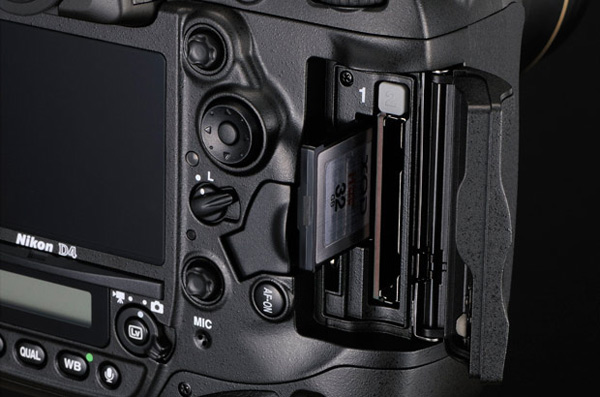
The D4 has two slots, one for the XQD card and one for the Compact Flash which is something I don’t like. For me they should have chosen two XQD cards as I believe this card from what you read is the future. Having two card readers is a pain, once your home you have to use two card readers to download your images which could have been averted by just picking one card for the camera only. Downloading is quick and I use Nikon software all the way- Nikon transfer, View NX then I do my processing in Nikon Capture NX2. All of which have a new version to accommodate the D4.
From my first images at higher ISO’s there does seem a more improved image from the D4, more so at the higher ranges. I don’t really push the ISO past 4000 alot of the time as I want to try and retain as much quality in the image as possible. But even at 4000 the performance of the D4 is better than the D3S at the same time there’s not a massive difference and I wouldn’t be selling my D3S as that camera has not missed a heart beat in over two years and has earned its brilliant reputation. The two images below from my Great Crested Grebes project were taken with my D3S clearly showing the quality of this camera.
The following images of Red Grouse were taken at high ISO’s, the sun’s light had started to warm the moors here, making conditions for auto focus tricky normally but here again the D4’s AF system locked on in tough and challenging light.
The D4 all round is a vast improvement on the D3S camera, it wont make you a better photographer though but what it will do is give you more options in various testing conditions that you may find yourself among while shooting wildlife. I am still learning about this brilliant camera as in just over a week does not do the camera justice. From what I have seen on the back of the camera and later on my large screen the improvements are good, very good. The auto focusing is one of its biggest pluses from the D3S and I cannot praise Nikon enough for the improvement they’ve done here. The video is good quality and I will be doing a separate blog post on that soon.
I am still learning about the D4 each time I take it out, but from these early stages all I can say is its “just brilliant”. The Internet will be a wash with reviews about this camera by more qualified people than myself all calming many different things. All I can say is make your own mind up like I have, the camera is a marked improvement on the D3S I know I have shot with the aforementioned camera for two years and still do. This post is not meant to be a whats right or wrong, its just about how this camera has worked for me on the ground, in the theatre of wildlife a place I live and breath.
Thank you to my clients over the last week or so who have seen me test out my new camera, really nice to meet you all. Steven from Ipswich sent me some lovely words below that can be seen on my testimonials page –
“Hi Craig I would just like to thank you for my two days one to one with you, it was fantastic on both days and I did really enjoy all of it. I love the way you had so much respect for the wildlife and how you put all this into your photography skills in which you was so kind to pass on to me. It has give me a better insight into the way I need to work , approach and take the final shot simply just by watching and listening to what was around me, like when you told me about the geese were going to take off before they even beat their wings, brilliant. Once again a big thanks and I would highly recommend anyone for your one to one it was agreat pleasure. Regards Steven”
Before I go I would like to thank Adam from my press agent for getting my Owl images out into the papers over the last week. Many months of hard work were put into these images, capturing moments I’ll never forget. Barn Owls flying towards me, Short-eared Owls flying feet away from where I was hidden, diving for food right in front of me, all just amazing moments. You can see the story and how much work and the lengths I went to here in the Daily Mail and also here in the Sun. I also made the Telegraph newspaper all the same week so again many thanks Adam as it’s always very nice when you see your work in print.
Also in April’s issue of Nikon’s N Photo magazine my Dartford Warbler image made their “In pictures :Inspirational Nikon photography from around the world” section. Click here to see the article and see one of my favourite photos of a male Dartford Warbler singing in the morning light, stunning birds.
Its an amazing time of year now with Spring well and truly awoken and the start of British Summer time at the weekend. Make sure you enjoy her beauty and capture it with your cameras, good luck.
Spotlight Sumatra see’s me going to the island of Sumatra alone in mid September for two weeks, staying with the locals in something called home stay. A small but comfortably home within the jungle landscapes. Alongside my guides and helpers for this trip we will venture into the jungles for up to three, four days at a time even longer if we are lucky, to track and photograph these Orangutans. Jungle life will be basic but great, a sort of rough camping but off the floor as you never sleep on the jungle floor for your own safety.
I am hoping to capture some amazing images of Orangutans that SOS can use to sell promote and help raise the plight of this great ape that maybe the first great ape to become extinct should continued trends contuie in the destruction of their forest homes. There will be more news of this amazing expedition that will take me deep into the jungles of Sumatra in due cause.
I have donated a Limited edition Barn Owl print which can be seen above along with a one to one wildlife photography day with myself to help rise some money towards Sumatran Orangutan Societies Jungle VIP auction. Joining the list of celebrities taking part in the auction, hoping to raise as much money as possible to help this charity in saving this great ape.
Thank you to all that have helped so far and many thanks to the lucky winner who won my one to one and signed print which can be seen here on ebay. The auction carries on until March 31st with new stuff being added all the time. To keep up to date on the latest items please visit the website of SOS here many thanks.
I will be posting more news over the coming months on my blog as interest in this expedition grows. Where the sole aim of this trip is to highlight the plight of this most beautiful of apes and our closests living relative. I will be showing you the kit I’m taking, clothing and equipment. Doing live updates for SOS’s blog and my own, hopefully transporting you to this rarely visited part of the world which will be amazing, the trip cannot come quicker enough. I look forward to taking you all there on this amazing journey to Sumatra.
I’ve just spent a great weekend leading my two day Beauty Of Wildlife workshop in conjunction with Calumet photographic, Manchester. My aim of these wildlife workshops I run throughout the year is to offer some fantastic practical one and two day seminars in some great locations where you will learn many tips and techniques, most of which I use in my own work as a wildlife photographer.
You can then put these into practise within your own work which will improve your photography, at the same time learning more about the wildlife that you see and capture with your camera. I enjoy sharing my vast accumulated experience of the natural world, at the same time I’m very passionate about helping each of my clients hone his or her photographic vision.
On the first day I went through a mixture of talks, slideshow presentations and photographic tips and advice all geared into inspiring everyone within their own photography while at the same time helping them understand more about their settings, cameras and most of all fieldcraft. This was all rounded off with a cup of tea and biscuits. After which I went through each client’s camera showing how to get the best from each make and model in readiness for the second day out on the moors.
The group was a great mix of people, from all over the UK at varying levels of competencies and were really good company. We met at 5am on the second day, in the pitch black of the morning. I had gone through some key elements to wildlife photography the previous day in my presentation to the group. One of those elements was ‘light’. Find it, work with, and create your image alongside what light you have. The weather was really kind to the group with a beautiful spring day which started with an amazing sunrise.
The group had a very nice surprise very early on during the day in the form of a couple of Mountain hares still in their winter coats. They stuck out very well against the heather which made them amazedly jumpy to approach I had touched on in the previous day’s presentations the importance of fieldcraft and your approach to wildlife so it was good to see everyone putting this into good use. The hares were very jumpy though due to their winter coats so were very hard to capture photographic wise.
Out in the wild, working with wild animals those tips could make all the difference to a well composed image so I made sure everyone had a better understanding of the key elements in order so they’d really benefit from their time with me. All the information and advice we discussed was contained in a handout I’d prepared for each client as seen above, this would help once the group had gone home to use as a reference guide.
After lunch the group were free to explore for themselves, put into practice skills and tips I embedded throughout those two days and it was really good to see them all going about their own work and capturing some lovely images with strong composition, good use of natural light and above all listening and watching wildlife to build a picture of whats happening around you.
Photographing wildlife in ‘the wild’ is the only real and true way of learning about behavior and fieldcraft, so it was very important for me to show the group on the second day how I work and go about getting the images that I achieve, while working with subjects that are free to come and go as they please and have fear for humans. Where you have to work the land and the environment to try and obtain an image, straight from the wild so to speak. The key to my photography is fieldcraft first and foremost, photography for me came much later in life.
On all my workshops, photo tours I have and do always stress the need to understand nature more and be able to work with her, alongside her in order to become part of their landscape and habitat without disturbing wildlife. The result is a better understanding of the wildlife and more importantly a greatly respect for the subjects around us all key ingredients in making better wildlife photographs in my eyes. My next wildlife workshops with Calumet can be viewed here
A big thank you to all the clients for your time and efforts during the two days. I really hope you got a lot from the days and learned something new. You were all great on the second day and looking back now you can see through the images you captured why the early start was so important to capturing lovely images of wildlife.
I recently judged the -New Beginnings Spring postcard competition 2012 where the first prize was a chance to see your image in print – over 50,000 times and also on Calumets invitation postcard for their customers for the Spring Open Days in our stores next month. Calumet had a phenomenal amount of entries for the competition. It was a tough decision for me to choose a winner, with so many outstanding images to choose from.
There was an excellent standard across the whole group where many could have won the first place. I chose this image because from the first moment I opened the image up it popping out of the screen at me with its beautiful and vibrate colours, clever use of depth of field and really nice out of focus areas giving the image a real soft and delicate appearance. The colours and the flower symbolize new life and the coming of spring for me, a wonderful image.
Congratulations to the winner Nigel Burkitt who’s winning image can be seen here and will represent Calumets Spring Open Days that can been seen by clicking on this link. The image can be seen above alongside the dates. I will be attending the Manchester and London stores to do a couple of wildlife talks and presentions during those days so hope you can come along.