Entries in the ‘Places Of Interest’

Sumatran Orangutan Expedition

Filed in Charities, Places Of Interest, Workshops on Dec.22, 2010

Months of planning have finally all come together now in the form of this unique and bespoke photo tour to the amazing wilderness that is Sumatra. I will be leading this amazing Photo-Tour alongside expert trackers on the ground in Sumatra, working with the brilliant Charity- Sumatran Orangutan Society.

This charity is dedicated to the conservation of Sumatran Orangutans and their forest home, where each person on this photo-tour will directly be helping the Orangutan and their habitat, with money from each person booked onto this trip going to the Sumatran Orangutan Society, whose work is to help protect and conserve this area for the future of our closest relative.
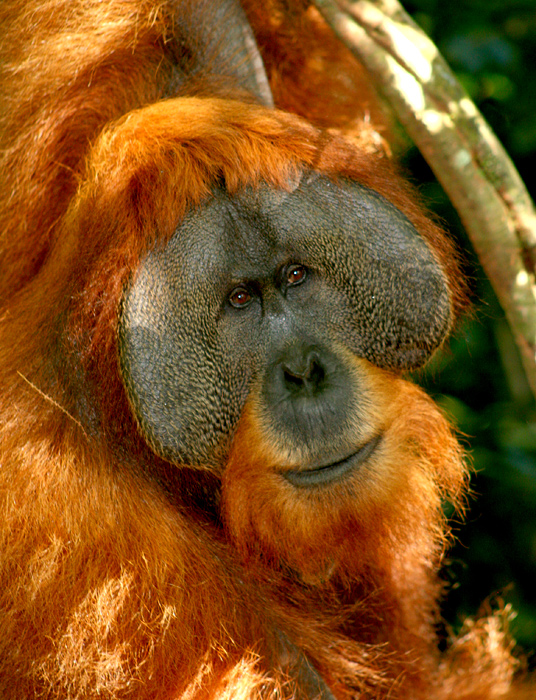
I have always been fascinated with these Great Apes for as long as I can remember and upon first seeing one of these amazing animals back in 2000 in a rehabilitation centre in Thailand I have always wanted to help them when and where I could.  I had a close encounter with a male Orangutan, an experience that touched deep into my sole, as I watched and looked into the eyes of these beautiful animals, it was something I have never forgot as I sat on the ground, mimicking their behaviour of picking up ants with a small stem.  A powerful male with pronounced cheeks denoting his age, was slowly moving towards me, closer and closer until I could hear him breathing.  He slowly and gently took the stem off me, his hand almost perfectly formed the same as a human, with dark nails, he then just slowly moved away and out of site, a moment I can see as I type these words.  

I was lost for words, an amazing moment that I can still see as if it was yesterday, such is the beauty, grace of this animal.  The principal focus of this photo tour will be the Orangutan, capturing them within their natural habitat, looking for behaviours to capture and so on, as we visit some of the most magnificent forests on Earth, which are also the domain of many other beautiful and stunning animals and birds, where some only live in this part of the world and nowhere else on the planet. Sadly the ‘Old Man of the forest’ has been subjected to relentless pressures which has reduced the world’s population by as much as 50% during the last 10 years. Hunting for meat and the demands of the pet trade have been contributory factors but the more significant issue has been the large-scale clearance of rain forest throughout this region leaving very few habitats left for these apes

There are surely few more enduring creatures in the world than the gentle giant of the rainforest’s, the Orangutan. With around 97% of an Orangutans genetic makeup being the same as a human and where such a close affinity to Homo sapiens is obvious upon gazing into their beautiful faces and watching their behaviour and how they conduct their lives. The evolutionary links with mankind are plain to see after such encounters with this amazing ape that now only live wild in two places in the world, Borneo and Northern Sumatra.

Across the Orangutans entire range, conversion of forests to oil palm plantations is occurring on a massive scale, logging continues even within protected areas, and planned road networks threaten to fragment the habitat of the last viable populations. These factors are responsible for the loss of over 80% of Orangutan habitat over the last 20 years. We have to save this amazing animal and during this tour I will also be photographing the story of the local people, the palm plants and conveying with moving and powerful photography what is happening to these amazing forests where I will be reporting back for SOS and updating their Blog alongside my own as and when I have wifi access out there.

We will also be planting new trees in areas that have been safeguarded and protected for the Orangutans and all the other wildlife that live here. With projects concentrating on teaching local communities about the benefits of reforestation and developing alternative livelihoods. SOS  distribute seedlings and have established organic forestry centres near degraded forest areas, providing training so that communities can produce their own seedlings for future replanting.

They have established a number of nursery and replanting sites in Aceh and North Sumatra, and have now planted over 570,000 seedlings an area we will visit so guests can have the chance to plant their own trees here, we will also work in the deforested regions around and within the Leuser Ecosystem, which is the most important remaining habitat for the Sumatran Orangutan.

The charity also works in restoring degraded areas inside the border of the Gunung Leuser National Park, working with local government and local communities to restore vital Orangutan habitat that has been damaged by illegal oil palm plantations established within the protected area. So much brilliant work is going on out there to save these animals.  This trip as you can see by the Itinerary will be truly amazing, covering different areas, sleeping in the jungle with its amazing noises and uniqueness all of its own. 

Along with the guides I will also be showing some interesting and key skills and survival techniques derived from my own experiences of working in these jungle habitats on different continents over the years while serving in HM armed forces.  The trip has it all and I am so passionate about helping these animals so if you would like to book or want more information then email me or contact SOS. And you can view the trip on the BBC Wildlife Magazine Website here

A big thank you to Helen- the  UK Director of the Sumatran Orangutan Society for all your help in making this trip happen, thank you to Different Travel for their help also, and lastly thank you to those who book on behalf of the Sumatran Orangutan, I look forward to seeing you all in Sumatra next September.


Read full post

Winter Waders- Norfolk

Filed in Places Of Interest, Workshops on Dec.04, 2010

The name of this workshop could not have been better named ‘Winter Waders’, as our three days there were christened with freezing temperatures, treacherous conditions and in parts gridlock on the roads but all and all we made the very best of our time there.  My group had travelled from all over the UK in the coldest snap for December since records began, with one guest having come from Ireland I was really happy that the 7am start time on the first day that all guests had made the slow and dangerous journey safely.

The biting temperatures cut through us all on the first day forcing us to move more rapidly between the various sites and beeches that I know, as the wind and penetrating temperatures worked against us, but the guys were great and we still were able to capture images on this cold introduction to Norfolk.

We had some good sightings on the first day using a mixture of fieldcraft and a touch of luck.  Thousands of Pink, Greylag, Brent geese filled the sky.  They were all over the place due to the strong, prevailing winds driving in from the coastline.  A lot of them were flying above the clouds which made it hard to see but their calls could be heard no matter what.  When the clouds did break briefly the sun came through and we were lucky, and had a few lovely encounters.

I can never predict or promise that the wildlife will turn up and my attuide has always been that there is always an image to be had or captured no matter what, so with the weather being so bad we still were able to capture some lovely images of waders and other wildlife that spend their time in Norfolk.  During our time there the weather was a mixed bag, with the snow not hitting this part of the UK on the first day or so.  However, the following morning we were scrapping the snow off our windowscreens and thats when we knew the snow had caught up with us. The Geese were on the move really early in the mornings and it became hard to capture clean shots of them flying over, but most of the guys had wide angles so we were all able to capture the Geese overhead.

I showed different technique’s to the group, panning, waiting until they were straight over head to add drama, low in the frame, minimal ground, slower shutter speed for the wing blur, capturing impending movement within the image, something I have always loved to do.

Daytime temperatures rarely broke past freezing point but as we moved around different sites it became less of a problem until you remained still, which happened mainly when we were photographing different waders and gulls low on the ground for some time, to obtain a more personal point of view. I love to capture behaviour within my style of wildlife photography and this image of an adult Herring Gull trying to stay upright in the strong winds was very funny to see.  Using the light available I composed him so that the image coveys an air of menace to the gull, which I really liked, with one side of him lit and the other in dark.

The wind was causing all sorts of problems and we saw many different waders in ones and twos, blown off course, struggling to land and stay on the ground as they were trying to feed on what ever they could find.

The pattern of events over the next few days were similar, anticipating what the weather had in store and if the wind would drop, watching and photographing the winter waders and migrants and also spending sometime with the Barn Owls.  We were also lucky that it never rained over the three days as this increased our chances of seeing Barn Owls, even though the ground was frozen.  The days are shorter and the light is less during the winter months and if the ground is permanently frozen the Barn Owls primary prey of fieldvoles and other rodents tend to stay huddled together during the coldest spells at night, only really venturing out during the day which makes for the best times to see Barn Owls hunting during really cold spells.

On most of the days we saw the Owls, hunting with real purpose, diving with such force as to break the covering of snow on the ground, at the same time capturing their prey.  The majority of the time they seemed to fail but on the odd occasion they stayed on the ground where they could have been eating their prize as quickly as possible, replenishing much needed supplies of energy to survive. They were hunting in fog, snow and windy weather, such was the need to feed.  I always feel uncomfortable seeing nature work at a pace which is dictated by the conditions, right on the line on survival but such is nature where they say only the strong survive, but for me still very uncomfortable to see.

On the final evening the clouds broke and we had a lovely sunset, the colours lit up the horizon, the sky full of geese, the sounds of which sounded almost like surroundsound as the geese were having their final feed, then heading off to their overnight roost sites.

Thank you to all my guests who came on my workshop, great company.  I hope you got a lot out of the three days and even with the the weather against us we were still able to capture lovely images and at the same time see this beautiful coastline.  I look forward to seeing a few of your images,  many thanks.


Read full post

Some Days You Just Get Lucky

Filed in Places Of Interest, Workshops on Nov.17, 2010

Over the last few days I have been really busy with One to Ones/Workshops and on all of them the weather and the conditions just came together perfectly and the sunrise was breathtaking with the wildlife showing up also making for an all round great few days for my clients. I guess you could say that some days you just get lucky.  Setting off for the higher peaks within the Peak District National Park, Derbyshire in total darkness gives a whole different feel to the experience as losing part of one of your major senses heightens the others you have. 

Making judgments with a narrow field of vision really makes you come alive, carefully placing your feet and focusing using the light from the moon, aided with the head touch that illuminated our path, we watched the frosty morning chill begin to warm with the upcoming spectacular sunrise.  Reaching the summit at nearly 2000 feet as the sun breaks the horizon, bathing the whole place in a warm, orange glaze.  Making you feel as though you are standing on top of the world with the mist and clouds beneath you sheltering the population from this hidden world you must work at to see.

My client Matthew from Wales wanted to see the Red Grouse in its natural habitat and I have several different sites with different levels of approach. The route we chose meant the ascent was in the dark using the moons light to illuminate our path alongside our head torches, carefully making our way to the summit as the sun came up. In all the years I have been visiting the Peak District I have rarely witnessed such a beautiful morning, the crunch of the morning frost under foot, the air chilled from the over night frost and the Red Grouse were everywhere feeding on the tender shoots the sun was thawing out. Their constant ‘bubbling’ calls echoing down the valley with the morning mist adding great drama.

As we made our way through this amazing landscape of Heath/Moorland the colours of the place were stunning and apart from the odd walker we had the whole place to ourselves which left a silence you’d only know if you find somewhere remote within nature and watch the world go by. I went through fieldcraft techniques which for me is a key competency in wildlife photography.  If you are to get close to a wild animal you need to watch and look for clues, behaviour, listen for calls, which vary in different pitch to suite the subjects mood, progressively getting higher in pitch once they see something they perceive as a threat. Breaking a animals virtual horizon is the key-  shape, shine, silhouette, you can look like a bush but approach without respecting the forementioned and off they go.

Red Grouse are very comical and display many different behaviours you rarely see from a distance when passing them on the narrow walkways carved into the landscape from years of walkers pounding these routes through this breathtaking landscapes.

The heaths and moors of the Peak District are an eerie exposure of peat covered moorland sitting about 600m (2000 ft) above sea level. Large wind carved eroded rocks sit among vast plateaus and rock formations supporting a healthy population of these amazingly hardy Red Grouse.  These iconic moorland birds make their home on these moors and are reliant on their camouflaged plumage to blend in to this habitat, where the only time you know they are around is when you stumble upon them when you are walking as they explode from the ground, taking flight with a unforgettable distress call.

I take everything with me on these One To One/Workshop days, packed lunches, large flask, cold drinks, first aid, in fact everything bar the kitchen sink is placed on my back in preparation for any event mother nature should throw at us in these changeable environments..

One of my favourite images from the two days with Matthew was this lone male Red Grouse below, perched on this prominent rock, his call echoing down into the valley beneath him, a truly beautiful picture to see and one I was privileged to capture with a wide angle, as I had crawled forward for some time to get closer, then all of a sudden he popped up onto this rock and began singing. 

A real mixture of luck, fieldcraft and timing coming together in one of those rare moments you are afforded within wildlife photography from time to time. We had some other lovely encounters with these beautiful birds I am very fond of, so a big thank you Matthew and I’ll see you in a few weeks on my Winter Waders  workshop at Norfolk. I have many One To Ones running throughout the Winter months now on the lead up to next years Spring/Summer time just have a look on my website under Workshops then click on One To One and take a look or send me an email should you wish me to meet you at a place of your choosing.

I will be presenting 3 x45 minute Wildlife Photography workshops at this years North West Birding Watching Fair at WWT Martin Mere .  Whatever the weather this Festival is an enjoyable and informative day out.  I will be going through simple techniques that I use, showing you how to improve your own photography accompanied with a few slide shows and a brief practical session going through anything you wish.  So if you are free on the Sunday please pop by to say hello many thanks.


Read full post

Mull In Autumn 2011

Filed in Places Of Interest, Workshops on Nov.10, 2010

Our wildlife workshops to the island of Mull, Scotland are getting more and more popular as the perfect trip to capture the true beauty of this amazing place, so we are adding another trip to the itinerary for next year. The aim of this second trip is to capture the stunning autumnal colours there at this time of the year, along with the beautiful Otters that live on Mull, and their cubs, also rutting Deer, White tailed Eagles and much more amazing wildlife. For wildlife photographers who are eager to bring their photography to the next level, or people wishing to see the beautuful wildlife this island has to offer, our photo trip really does cover everything.

The Isle of Mull lies on the west coast of Scotland and it has a breathtaking coastline of 300 miles, the climate is a mixture of rain and sunshine. From the moment you step onto this beautiful island the wildlife is everywhere and the scenery is stunning. The island is a wonderful place to see Golden Eagles, White-tailed Eagles, Otters, porpoises and a whole host of Hebridean Wildlife.  

Our base will be the picturesque village of Tobermory, with its brightly painted buildings. Overlooking the harbour of Tobermory and facing out to Calve Island and the sound of Mull is our Hotel, you’ll be treated to picturesque views over the harbour and as well as comfortable accommodation, you’ll enjoy fine cuisine in the restaurant, prepared from the best locally sourced ingredients to make your stay even more memorable, all of the rooms have a sea/harbour view. It will be a wonderful chance to show you the best places that I have found on my many trips to this amazing island and to pass my knowledge of these onto you so you can really enjoy ‘The Magic of Mull’.

This photo tour is for four people maxim, with two places having already gone such is the popularity and beauty of this island. I like to keep all my trip numbers down to around four people if I can as this gives everyone quality time with me while I show and teach everything I use myself within wildlife photography, fieldcraft, composition, camera skills and showing and pointing out photographic opportunities constantly during your time with me.

The dates of this trip are – Sunday 23rd October – Friday 28th October 2011, the price per person is £800.00, this includes all food, including packed lunch, all transport on the island, rooms with sea views, all guidance and expertise from myself.  They are on a first come first served basis, so if you would like to know more info or book then go to my Magic Of Mull page on my website and fill out the booking form or send me an email and I’ll answer any questions you may have many thanks.


Read full post

Masai Mara Migration Photo-Tour

Filed in Events, Places Of Interest on Oct.02, 2010

My Photo-Tour to the amazing Masai Mara Migration 2011 is now live on my workshops page, Paul McDougall who I work with in Kenya has secured me a great lodge in a private location on the Mara, where we will be close to action and have some amazing encounters. Paul who owns and runs his own wildlife company in Kenya is ideally placed to let me know whats happening and the best sites, so naturally as I always endeavor to give each client the very best I can, I will be working alongside Paul during our stay there in August 2011 getting you the best experiences from on the ground.

The 8 day trip will be amazing staying at one of the best traditional safari camps in the Masai Mara, this small camp will be a very special experience away from the normal hustle and bustle of other camps, where the private nature of our camp will be perfect for observing nature as we are perfectly placed to see the amazing wildlife in the Mara. Places are limited to a first come first served basis,  5 people max, so if you would like more information or would like to make a booking then send me an email here or go straight to my workshops page and fill in the booking form.  I am currently working on plans to also run a trip to Uganda for Mountain Gorillas and a ‘Wolves of Ethiopia’ photo-tour, capturing this beautiful animal high on the Sanetti Plateau of Ethiopia’s Bale Mountains,  only species of wolf found in Africa.

I am also working with a national charity, leading a tour to see the Orangutan.  I will update you with more details in a few weeks. The trip will be led by myself with expert guides on the ground, where we will be staying in the jungle overnight, being at one within the forests these animals live in.  Lots going on and all genuine trips enabling people to not only see but to capture beautiful images of these very different and stunningly beautiful animals in their natural habitats.

Habitats in which I have first hand, expert knowledge in having served in the armed forces for a number of years, working in these very different environments unitising all my climbing, abseiling, tracking, survival skills and many more, hopefully being able to show people the beauty of each one of these animals. I will update my blog in the next few weeks on these trips, giving a unique opportunity to visit these places on earth, learning about their different ecosystems.  What a year it plans to be, many thanks.


Read full post

Masai Mara Migration Photo-Tour

Filed in Events, Places Of Interest on Jun.13, 2010

I have been asked by Paul McDougall, Directer Of  Wild Connections to run this years August trip to Kenya, for the Breathtaking spectacular that is the ‘Masai Mara Migration’ which is so immense it is called the Great Migration.The Great Migration is one of the most impressive natural events worldwide, involving an immensity of herbivores some 1,300,000 wildebeests, 360,000 Thomson’s gazelles, and 191,000 zebras. These numerous migrants are followed along their annual, circular route by a block of hungry predators, most notably lions and hyena,which has to be one of the most spectacular events in the natural world.

Zerbra

From August 9th until the 16th August you have a chance to witness and photography this amazing event alongside myself as I am running a 8 day Photo-Tour,with7 days on the ground,with two private safari’s each day run by Pauls’ expert guides he employs.The workshop will be live next week on my Workshops page, and will have the detailed schedule for what will be a trip of a life time that I can promise you!!

_DSC2528[1]

For a little background to Pauls Company and what got him into these amazing trips he wrote these words;

“Wild Connection Safaris was formed in 2005. The idea came from sharing a safari with Isaac Kinyanjui in 2004.We both shared the same passion for Wildlife and Conservation and wanted to form a different type of Safari Business. We had an idea that we didn’t want people to just come and see the amazing Wildlife in Kenya, we wanted to educate people and wanted them to share in the experience of a safari. We also wanted them to go away and share information with other people not just the photographs that they had taken.

We try not to take anymore than 6 clients in a vehicle so that everyone gets a window seat. We also like to specialize in small group and photographic safaris.Anybody who has been on a safari with us always notices the unique individual experience that we try to offer. Isaac is a fantastic teacher and like a walking encyclopedia. Our other guides and drivers also share our same passionate values in educating and informing.We offer all sorts of tours to many different locations. We prefer to Tailor-make safari’s to suit the individual clients needs and requirements, whether this be a particular budget or a particular itinerary.We usually run 2 photographic safaris a year. These usually fall in the months of January and August.

 On these safaris we take photographers of all abilities and either get them in the best places to capture their desired images or provide them with handy hints and tips to improve their images.We also offer many other services. Car hire, flights, city tours to name a few. We have been taking clients to Tanzania since the company formed but have just started to take people to Uganda and Rwanda. The first of these tours in June 2008 was a huge success.For more information please take a look at www.wildconnectiontours.co.uk, or contact me directly.”

I cannot wait and we have spaces available for this amazing trip so what ever your background in Wildlife photography it doesn’t matter as I will teach and show you all my skills I have mastered over my time in regard to Wildlife Photography, pass on my amazing passion for Wildlife,with my brilliant and proven fieldcraft skills,and pass on my love for the natural world as so many have witnessed who have attended my workshops,trips,tours, here are just a few of the many I have received from very happy clients in my Testimonials .All the key ingredients for an amazing trip, so if you’d like more information on this trip then please drop me a line,or wait until the Photo-Tour comes out late next week in my Workshops page, I cannot wait for this trip,just amazing wildlife there!!

I hope to see you their,all the best. Craig

CJWP


Read full post

Roe Deer Workshop

Filed in Places Of Interest, Workshops on Jun.13, 2010

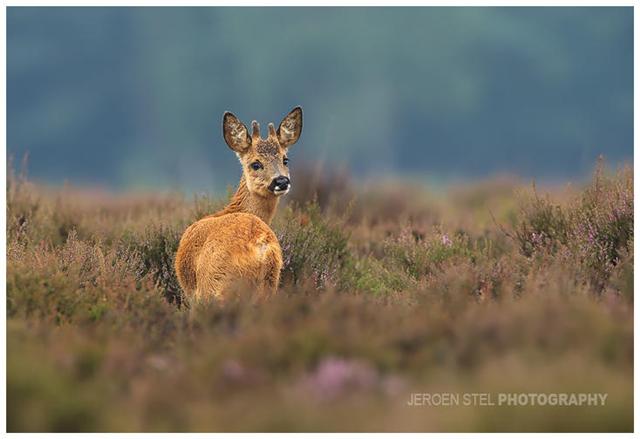
This Roe Deer workshop is being run by Jeroen Stel, alongside myself and it will be held in a heather moorland area in the center of the Netherlands from 23rd July until late evening of the 25rd July. Within this reserve there are around 60-80 Roe Deer which can be approached on foot up to around 10-20 meters where Jeroen has spent many,many years photographing these beautiful animals. There is also a corn field where we will be spending some time in and with good fieldcraft,which we will teach and show you, we will be able to get as close as 8-10 meters for some stunning cose up portraits of these creatures..

Roe Deer

Roe Deer

The workshop will coincide with the annual Roe deer rut so that’s perfect timing!
There is a lovely buffet restaurant nearby where we will be having our diners and lunch .We will be leaving the UK  early on the 23 July Traveling by Euro-Star then driving to meet up with Jeroen .The cost includes all travel costs.It promises to be a brilliant trip,with amazing encounters with this shy and elusive deer

Roe Deer

The cost per Person is;

£650.00 on a shared basis/Twin Bed, Single Supplement is available at an extra cost.
Cost Includes: Accommodation, Breakfast, Evening Meal, All Transport, Use Of Hides.
Cost Excludes: Alcohol/soft drinks and Sundry Items.

www.craigjoneswildlifephotography.co.uk in conjunction with www.jeroenstel.com

Roe Deer

So if you would like to photograph these animals and learn from two Wildlife photographers with a great passion and knowledge of nature then send me an email  or contact Jeroen Stel for more details on this amazing trip we have planned,Thank you.

Roe Deer

CJWP


Read full post

Contact With Nature

Filed in Advice On Wildlife, Places Of Interest on May.26, 2010

Humans have spent many thousands of years adapting to natural environments, yet have only inhabited urban ones for relatively few generations,Whilst those individuals living in an urban envoriment who seek out parks and gardens appear to understand the personal health and well-being benefits arising from a Contact With Nature’,tapping into this vital resource that nature provides.As more people survive to older age, and as patterns of living,working,feeding have changed,diseases such as coronary heart disease,diabetes and cancer have come to dominate our population.Where mental, behavioural and social health problems are increasing in this time of great change in the way we live our life’s.The answer for me is one I have benefited from since a small child and that is a ‘Contact With Nature’ .

Male Red Fox In Bluebells

Studies of ecology, biology, psychology and psychiatry have attempted to examine the human relationship within the natural world, some concluding that as well as being totally dependent on nature for material needs (food, water, shelter, etc.) humans also need nature for psychological, emotional and spiritual needs.Yet how dependent humans are on nature for psychological and well-being needs, and what benefits can be gained from interacting with nature are just beginning to be investigated by experts around the world.

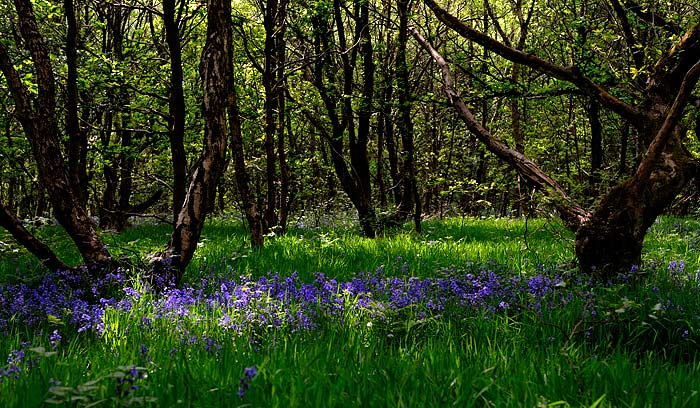
Bluebell Wood

The healing effects of a natural view are increasingly being understood in stressful environments such as hospitals, nursing homes,military etc. In these environments particularly, as well as for people who work in windowless offices, studies show that seeing nature is important to people and is an effective means of relieving stress and improving their well-being,so in this time of stress the only real answer to help us is in getting back to nature,having contact when and where we can and tapping into these ‘Green lungs’ that our parks,fields,reservoirs play within our urban,city lives.

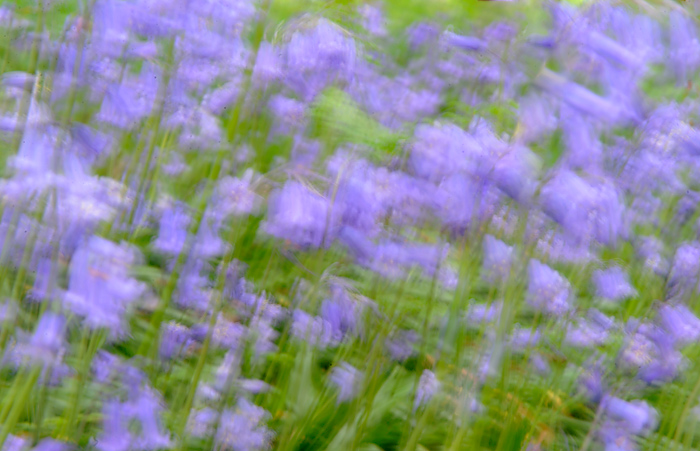
Arty Bluebells

I live within an urban environment in Staffordshire,where from a small child I was able to find these, little ‘Green Lungs’ within that world,in which unknowing to myself at the time, were helping me,my contact with nature building a love,a empathy towards the natural world,and in turn the world I lived in.There is a place known locally as ‘Bluebell Wood’ where I have visited as a youngster,playing tree houses,soldiers,hide and seek etc, right through to the present day as an adult.Its an old coppice of woodland,made up of  hazel, magnificent beech, elegant silver birch and ancient oak forming the backbone to this wood.
Beneath their foliage they shelter a vast carpet of native bluebells which have taken several centuries to reach perfection. The intense azure haze and glorious heady scent from these beautiful, elegant flowers is one of the chief delights of the English countryside and a truly unforgettable sight.Its a place I go too,often finding myself just sitting,laying down and listening to nature,the corus of birds signing their hearts out,the distance noise of urban life occasionally piercing the silence of this magical place.

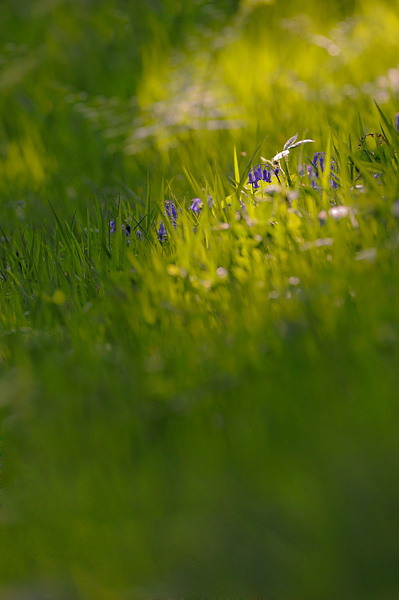
Bluebells In Sunlight

Over the last year I have been trying to capture a family of Foxes that I caught abrief glimpse of last year while visiting this place.Giving me the slip everytime I tracked them down, through foot prints,tracks,smells etc.As quick as I’d find their den,they’d move to another. I’ve had this relationship with this family of Foxes now for over a year,and to this day it bring a big smile to my face, as trying to capture a wild Red Fox away from rubbish bins,street corners is very hard I have found.I have used my many,many trips to this place to build a picture of their lives and behaviour’s and just as I getting somewhere the famous dog walk comes around the corner and breaks that silence and trust I have built up,in turn making the Fox really sensitive to disturbance.

The den is under a thick,dense tree line,making for poor light,but I have been able to find a way in, almost disappearing within the stinging nettles,and thorny vegetation this Fox family have chosen to live in,affording them a private world only available at ground level.Over the last week I have observed their cubs coming out and playing,most of the time to dense for a photograph.With several holes into the den its been a trail and error exercise for me to place my hide where I think they will appear while moving at a snails pace,most of the time though they outwitt me!!.This week I have been lucky as the cubs are getting more bolder and don’t see my hide which I have left there now for weeks,each time I return to the hide, the adult foxes have covered it in their distinctive ‘Smell’ which after several hours makes your noise and eyes run its so strong,nice to know they’ve ‘accepted’ my hide though. The male Red Fox can been send above with the beautiful Bluebells as the backdrop.

Fox Cub

Fox Cub

Often as a Wildlife photographer you wait on the off chance for a wild animal to linger in front of your lens longer enough to be able to get a decent picture of that special moment,placing a ‘Frame’ around what you have seen,showing this to others so in turn the picture of Wildlife around us becomes clear to them.This is the essence for me what Wildlife Photography means.Where my unique philosophy when it comes to Wildlife Photography that was derived from those early encounters with nature,where being at ‘One’ with nature to get the best from your subject is key, also helping your well-being in terms of this encounter with the natural world.

In my conclusion on the topics I have mentioned in this post,and as our understanding of the natural environment has developed, and the massive destruction human activities can have on natural systems has been observed, a more clearer view has emerged. This view recognizes that plants and animals,including humans do not exist as independently as was once thought, but instead are part of complex and interconnected ecosystems on which they are entirely dependent.The ‘ecosystem’ is the fundamental point on which all life is dependent.It is clear that nature and the natural environments relate to human health and well-being.Where that’ Contact With Nature’ is key to un-locking the door to human well-being and happiness, where my advice would just be simple,seek out these ‘Green Lungs’ within your place of work or where you live,learn and watch nature,through the changing seasons as they come and go,look out for whats happening around you,the noises,the smells etc and in turn it will enrich your life more than you can imagine.

CJWP


Read full post