Entries in the ‘Places Of Interest’

Nature Always Surprises

Filed in Places Of Interest, Wildlife, Workshops on Jun.12, 2011

Nature is a wonderful thing, her beauty, the innocence of the subject, and once you are among her you just don’t know what you’ll see or what will turn up as you walk the countryside.  Over the last several weeks I have been visiting some of my popular sites within the Peak District, at the same time running my successful Spectacular Skomer one day workshops, where I show the beauty of nature whilst at the same time learning clients many things they take home with them to improve their own work and seeing the beautiful Puffin up close.

With British Summer time now well and truly here, those early starts for that dream light that all wildlife photographers wish for, start really early and sometimes when working late the night before it has paid to just sleep for a few hours as the new dawn is never far away. I normal meet the client(s) before dark and then we head out on the chosen day they have picked.  In this case it was the amazing and beautiful landscape of the Peak District.  A place I have visited for many years, building up a unique knowledge of the wildlife here but each visit I still get surprised at witnessing something new, such is nature, you just never know what will happen and you have to be among her beauty to get those amazing encounters.

Here the sun broke the horizon as we walked onto the moorland, nothing prepares you for that moment, the light, the freshness of the morning air and the orchestral of birdsong is magical, just pure heaven.  We headed up as the sun was breaking through the clouds, fighting for a clear path in which to warm the moors below. We both set up and captured a few images of the Curlew, a large bird so at home on these landscapes, such is their wonderful camouflage.  Your only real indicator they are around is their piercing loud, a single note call, which cuts through the morning air.  Here he was flying past in the morning light, I managed a nice image of this wonderful bird as he was calling.

After that first few moments of beautiful light the clouds started to consume the beautiful light we had seen rise that morning, the temperature also drops a touch at that time of morning.  The landscape of the Peak District is full of different and very diverse wildlife, from beetles to birds, it really has something for everyone. Our aim was to see the moorland birds- Curlews, Golden Plovers, Dunlins, Red Grouse and fingers crossed the Short eared Owls that nest on these moors.

We were greeted by a pair of Golden Plovers, a typical moorland bird, nesting among the thickets and heather of this habitat.  They had young nearby so we just sat at a distance and watched ,staying low presenting them with little or no disturbance by our presence, they were calling each other as the female was in one part and the male in another part. Their call really stands out and it was an amazing moment as my client, Ian, on a one to one wanted to see this iconic moorland bird and here we were among them.

When the male Golden Plover had finally broken cover to gain a high vantage point to survey his territory the cloud had filled the sky and hid that beautiful sunlight as seen with the first image.  The background is one of the high peaks covered in mist and low lying cloud. We had some wonderful encounters with this pair of charismatic birds as we blending into their habitat and using fieldcraft as the key element.  The highlight of the day was an amazing 45 mintues with a pair Mountain Hare in their summer coats, going about their lives and feeding among the fresh shoots of vegetation.

Outside of Scotland, the Peak District is the only place to have a good population of these beautiful mammals, normally seen in their pure white coats.  Seeing them in their fluffy Summer coats was a real bonus as they fed on the fresh young shoots after some of this area had been carefully burnt.

Very shy and elusive the Mountain Hare blends so well into their habitat, the prevailing wind was our best friend here as it was blowing our scent away allowing us to both slowly and carefully advance to where this pair where feeding.  Even with the strong wind they where very alert, with this image above I tried to captured just how hard it was to see them at the same time capture a little of their character.  They settled a little and carried on feeding and moving among the burnt heather treating us both with a window into their lives as we hugged the ground for what little cover we could use to hide behind and use to blend in as we watched this amazing mammal.

The background added a real different element to our images, very different to snow or heather as the different colours contrasting with the stark blacks of the burnt heather.

Heather is kept young and vigorous by controlled burning, if left unburned it eventually grows long and reduces in its nutritional value. During this process of burning the heather roots are left undamaged and the whole process ‘shocks’ the heather seed lying in the ground into germinating quickly. The burning cycle creates a pattern of different aged heather, the oldest provides cover for the Grouse and other birds, and the new shoots provide succulent food for birds, mammals and sheep. A skillfully burnt moor will have a mosaic of heather and other moorland plants of differing ages offering a rich variety of wildlife to this special habitat.

We were treated to one of those beautiful moments, spending this long with such a shy animal.   I have seen and photographed them in Winter, when I run one to ones here in the same location, but it was a real bonus to see them in their wonderful Summer coats. We had a great day so thanks to my client, Ian, who was amazed also at what the whole day delivered for him and I wish you well.

The next day it was onward to Skomer where I was meeting other clients for my Spectacular Skomer one day workshops, on this amazing island off the beautiful Welsh coast, a stunning part of the UK.  The weather can change without warning off this coastline, I have been caught on Skomer as the heavens opened and the cloud base dropped, it can be very testing.  Thankfully for my clients it was sunny and very warm as we met early and waited for the first crossing to the island on that sunny morning.

We were the first boat onto the island, the BBC Springwatch team were there all week broadcasting live each evening from the island, so there seemed alot more people around. After the briefing you get from staff on the island, going through information to help your short stay on the island, we then headed to a favourite spot for Puffins.  Before the main crowds come you can have a good hour or so here among these “clowns of the sea” as I have always called them, a name that’s becoming quite popular now.

It was a real warm day with bright sunshine making the job of exposing for the Puffins plumage a little difficult. I always try to show and tell people to work with what ever light you have or haven’t got and use it to your own advantage.  We arrived at one of the most popular spots for the Puffins and settled down to watch at first, looking for flight patterns, their different ways in which they land and quickly dive down their burrows before the ever present danger of the Gulls who mob them of their catch, as the image below clearly shows.  This gives you a good idea of the general movements in a given area and helps with your photography.

In this area there is a large cliff with many different birds nesting on its ledges and I was watching a pair of Fulmars, one bird kept flying off and around in circles, soaring on the air thermals, coming out from the darken area of the cliffs and flying into the direct sunlight, right over my head and then diving down towards the sea then back up onto the nest, amazing behaviour to watch and capture.

Effortless flying at its very best with these beautiful birds that are part of the same family as Albatross, Shearwaters and Petrels. These birds nest and breed in colonies on ledges and steep coastal cliffs, sometimes in burrows on inaccessible slopes.  They are masters at exploiting the air currents to travel miles on and hunt all the time conserving their own fuel reserves.  Sharing the same cliff ledges are Guillemots, Gulls and the most handsome member for me of the Crow family: the Chough, jet black with bright red beak and legs, its a strking looking bird that gave us a little fly past just enough for us to see this handsome bird at close quarters.

There is so much wildlife on this small island of Skomer, in each direction you look you’ll see something different, from Puffins,Gulls, to Rabbits.  The different Gulls, all ranging from the small Herring Gull to the governor of them all, the large Black backed Gull all nesting in the own places, higher up on the island and away from the coast cliffs.

In the centre of the island their is a good population of Short eared Owls but during our visit we didn’t see them, but this little chap turned up and became quite a star during the week, posing really well as people walked past this section of rock this Little Owl had made home. So enduring to see and watch a lovely looking Owl, with real character for its size.

The island, the sea around it all teaming with wildlife giving this island its special status as a crucial island for breeding birds within the UK. The sea is rich with life and having dived this area myself before I know of the riches under its surface. This image I took shows the frailness of the whole area as Skomer and the surrounding islands are on one of the major shipping lanes around our coastline, carrying vital oil/fuel to the nearby refineries up and down this stunningly beautiful coastline. 

Thank you to all my clients who have attended my Spectacular Skomer trips, I look forward to meeting those that have booked for the trips in the next month.


Read full post

Tigers of India

Filed in Places Of Interest, Wildlife, Workshops on May.26, 2011

It only seems like five minutes since I was in the Tiger reserve of Ranthambhore in India and twelve months have passed since those beautiful encounters with the Royal Bengal Tiger last April in the year of the Tiger.  I have just returned from 8 days there with clients on my Tigers Of India photo tour, where we spent some amazing moments with these beautiful creatures.  Everyone’s wish was to see these animals at the same time and maybe capture them on camera and that’s exactly what they all did during our time in the magical country of India, a firm “Welcome Back  greeted us all.

After the early evening flight on Saturday from Heathrow, Terminal 5, British Airways, we arrived in the early hours of Sunday morning where our air conditioned transport was waiting to drive us the 370km drive to Ranthambhore and our accommodation on the outskirts of the National Park.  We drove through many cities and small towns that were a cauldron of beeping horns, mopeds, cows and children and tuk-tuks, real India all around us.  We stopped off to fresh up, a cup of hot, sweet chai and a bite to eat, before setting off on our path to Rajasthan, the vast state of kings that shares a border with Pakistan.  The colours of the buildings are brilliant, bright colours that come zinging out of the deserts, simple clay houses all painted iridescent pink, domed temples are blue and people clad in colourful clothing right the way through to the village elders its an amazing drive and one where you see the real India.

The Ranthambhore Tiger Reserve is the single largest expanse of Dry-Deciduous Forest left intact in India, such forests were found all along the North and Central Aravalis but in the last few decades they have been badly degraded and right now this Tiger Reserve is their last strong hold.

Its one of the best place’s in India to see the mighty Bengal Tiger, one of the most stunning, handsome and awe-inspiring creatures on earth. The Ranthambhore National Park, which is a part of the much larger Ranthambhore Tiger Reserve, is a Project Tiger reserve; it lies in the Sawai Madhopur district of eastern Rajasthan. It is right now the only forest reserve in Rajasthan state and in the entire Aravali hill ranges where tigers exist. There are seven ‘old’ gates within the national park and twice a day we’d pass through the main gate, our way to one of the 5 zones you are allocated before each trip,with each zone being around 25 km plus in size, where your jeep has to stay on a small path which takes you around the chosen zone,with a very strict code of conduct on board eg.no shouting/loud noise, you cannot get out of the jeep, its all controlled really well with the Tigers welfare being paramount. 

On Our first full day of safaris both jeeps had some amazing views resulting in great close ups of the Bengal Tiger. On this trip I have two small jeeps that can sit 6 people plus driver and guide, however, I only put two people in each enabling better movement and space for the clients photography as I have first hand experience that this is the very best way to photograph Tigers from the constraints of a small jeep where timing is everything.  We had two safaris per day, one in the morning and one in the late afternoon taking us into the late evening light.

I rotated myself during the day between each jeep, so each group received my help with the correct apertures and camera settings for the Tigers, also working alongside the expert knowledge of two of the best guides in India who I worked with last year; Salim Ali- star of the BBC programme Broken Tail seen below in the trailor working with Colin in Ranthambhore for over 400 days tracking this Tiger.  Ragh heading up my second jeep, the best local guides giving my clients the best chance to see these amazing animals perfect recipe for success.

On that first day everyone saw and photographed Tigers and for me it was the perfect welcome back to this amazing place in India.  I could see the look of surprise and shock a little to what each group had witnessed that day, remembering my first encounter, so I knew that look on the clients faces.  Below is an image taken on the first day as we watched this female Tigress stalking Samba Deer, crouching low just like a domestic cat on the lawn at home the only difference being this cat weighed almost a quarter of a ton.

Words just cannot do justice to one of the most beautiful animals on the planet going about its life around you, heading towards you as you slowly feel your heart beat increase, its such a special moment that was mirrored by all the group.  There are less then 3000 Tigers left in India and here on day one we were having encounters that you just would not believe.

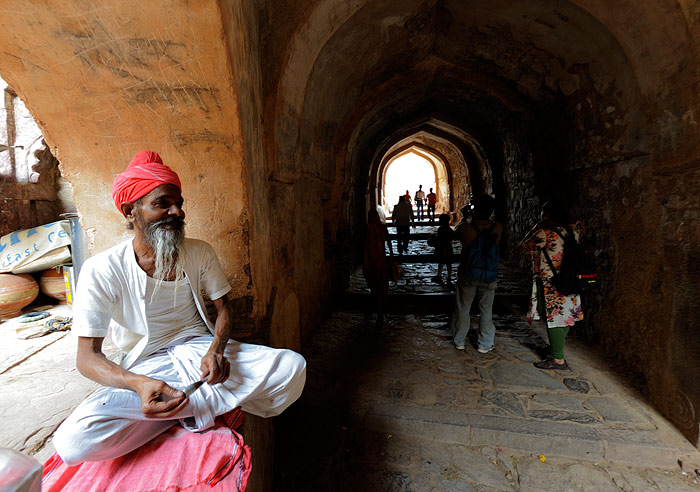
On the second day there was a census to count the Tiger numbers so as a group we visited and photographed the fort at Ranthambhore along with all the coloursand people that visit this place to pray and pay respect to their gods, the women bringing their children as the men walk behind,passing through the many gates and dark corridors on the way to the temples to pray. The fort can be seen in the image below on top of the large rocks, being looked over by a female Black Faced Langur Monkey with young.

The Ranthambhore fort is believed to have been built in 944 A.D. by a Chauhan ruler. It is strategically located on the border of Rajasthan and the surrounding forests were used as an outer defence to the advantage of the fort, making it one of the strongest forts of Northern India. The fort had many buildings inside of which only a few have survived the ravages of wars and time. Among the remaining ruins, the two pavilions, Badal Mahal and Hammirs court and parts of the royal palace gave an idea of the old grandeur.

Once you reach the top the view of the Tiger reserve is breath taking with views stretching for miles.  I photographed through one of the many fort holes here showing the park in the distance, giving you a sense of scale of the place.  Its a wonderful place and I can highly recommend a visit here if you are ever visiting Ranthambhore.

It was great to see some of the guards which I had made friends with the year before.  They do an amazing job with limited resources keeping just over 30 Tigers safe from the ever presence of poaching.  They showed me around and were very kind and helpful to my group by letting us pass through the main gate and onto our zone for that day with minimal fuss. I only wished the many politicians and people involved with Tiger conservation  around the world could see the frontline in the battle against poachers and give them more equipment and resources, because on the ground we are asking these fellows to risk their lives against a well organised band of poachers.  Once these Tigers have gone the whole area falls and the Tiger will not return, very sad but money has to be channeled into helping the guards around India in keeping the Tigers alive. I was shocked and saddened by how these guys stop poachers with their limited resources.


After the census had finished we settled into our daily routine with an early rise at 5am, coffee from the staff before the two jeeps came to pick up the different groups, then setting of in search of the Tiger. It is guaranteed to send adrenalin coursing through the veins, whilst every movement in the undergrowth raises the expectation of a sudden appearance of this animal, striped body, footprints in the dust or the warning cries of deer all serving only to heighten the almost unbearable sense of excitement as you watch and listen for the first clue that a Tiger is around you. The photo below shows one of the seven gates we pass through  during our safaris.

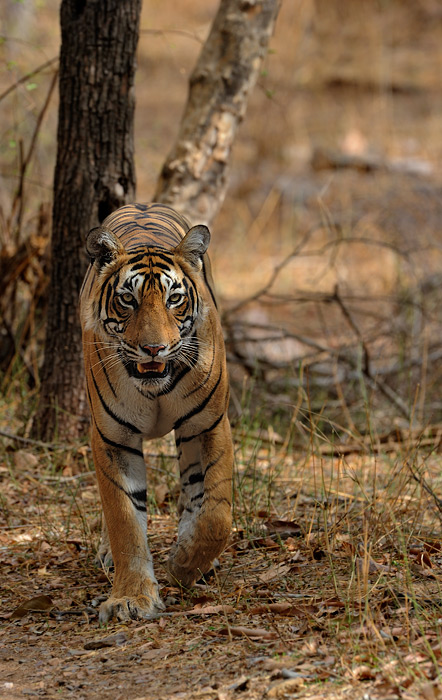
The mornings for me are the best, the sights and sounds of the Jungle are amazing,so very different to back home.  Every call you tune into and having to stay on small tracks as you try to see what is happening far ahead by listening and watching for tell tale clues that the ghost of the forest is about.  Warning cries from other animals like Deer and Monkeys are the first indicator somethings not right, then in a flash a Tiger appears as above.  This female was hunting and I captured her walking through a shaft of light.

I always say on my blog the different wonderful and beautiful moments I witness in nature but for me seeing and watching this animal in the wild is one of those moments I truly love and ranks as some of the best times I have spent watching wildlife.  We followed this female as she was actively hunting prey through the forests, sometimes appearing to vanish without trace only to reappear on the tracks that the jeeps use, then standing so still you struggled to see her if you lost eye contact.

The size and build of these animals is amazing, and to see them so close is something I cannot put into words. After the morning safari we’d have breakfast at around 10am then rest until our afternoon safari from 3pm until around 6.30-7pm.  This was our routine for the rest of the week and as with everything you love, it goes to quick.  Sitting with clients in both of the jeeps I always discussed which were the best settings, giving my advice in these testing conditions, where a Tiger can just appear from knowhere then vanish before you ever got your camera ready. I demostanded the best ways that I have found to capture those moments, working with different focal lengths and lens, all the time trying to capture what you see.

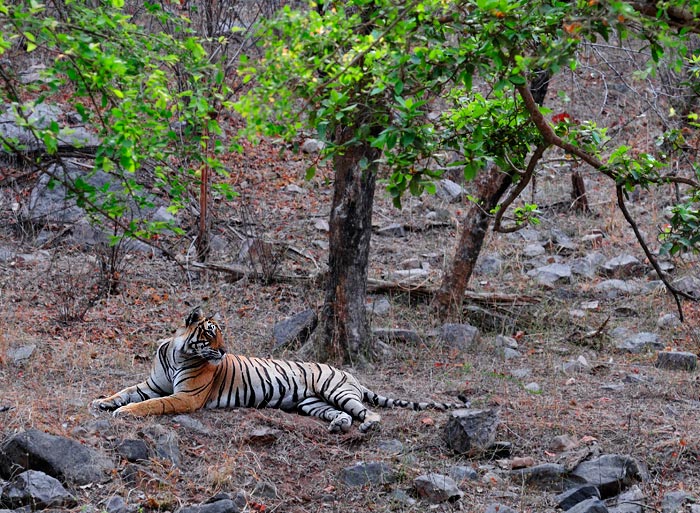
As the week went on some of the sightings were at a distance, we did come across a female Tigress protecting a kill among a dry riverbed where she was well hidden from view.  She had killed a Samba Deer some days earlier and was feeding, then leaving it, all the time going back. She had cubs in the area, well hidden from view and she would vanish then reappear again often going to feed and tend to her young.

This photo captured that first moment we made contact with her as she hid the kill really well and had cubs nearby, it was a dry riverbed with overhead cover from the forest trees.  She took nearly two days to finish the kill off and we just watched from a distance before she headed off and walked past our jeep and headed out of site towards where she may have had her cubs safety hidden.  It was clear from her nipples she was feeding cubs and I was praying they might show but I was told by Salim that it was to early and in another 4-5 weeks they will be around and feeding.  I’ll have to wait until next year when there may be a good chance of seeing them at nearly a year old fingers crossed.  A number of other females are pregnant also so there’s lots of new life on the horizon, which will be great for their numbers.

Over time as we watched this female Tigress a crocodile seemed to be heading towards the kill but in the end he chose another path from that one where the Tiger was.

The whole group captured some amazing images of the Tigers and this female was the most popular, where over a period of a couple of days we had a great insight to her behaviour which was fascinating to witness.

The week there pasted far to quick and before we knew it the time had come to leave Ranthambhore and head off home.  I wished I could have stayed as I really love this place and its Tigers, it has a magical feel to it, an old fort taken over by nature.  We headed for the airport the same way we came, packed lunches in hand as we started the journey home, thank you to my clients for your company, big thank you to Ragh and Salim for your help and expert tracking and guidance with the Tigers. 

Many thanks to the staff at the Ranthambhore Bagh where we stay, great food, warm welcome and a great base for this trip.  Next years details and dates on on my website here, I only take 4 people maxim, 2 person per jeep, this is the best for photographing the Tigers I have found over my time there, as space in the jeeps is crucial to capturing that shot you sometimes only have seconds to take before they have vanished into the forests.

I will be releasing a few more limited edition prints very soon to go along with the 3 others I currently have, where 50% of the profits go to a charity I work with to help rise money for Tigers around the world; 21 Century Tiger.  Where they spend 100% of your money in helping Tigers around the world, these animals are in real danger of extinction and need as much help as possible so that future children get the chance to see this amazing animal in the wild. 


Read full post

A Taste of Texel

Filed in Places Of Interest, Wildlife, Workshops on May.05, 2011

The bird paradise of Texel in Holland became our home over the last four days during our annual yearly photo trip there.  This picturesque island on the north tip of the Dutch mainland is a heaven for wildlife, at around 25 miles long and seven miles wide the island is the largest of the Wadden Islands.

It’s a haven and paradise for thousands of waders and waterfowl during the spring/summer months where they choose this picturesque island to play out their courtship routines and breed, feed their young all quiet close to you, presenting some of this best chances to photograph Avocets, Spoonbills, Caspian and Black Terns, Oystercatchers, Kentish Plovers, and many more waders.

When we arrived after the over night ferry relaxed and far less stressed than if you travel by plane, we headed to a site on the mainland first where a family of Foxes are living wild among a woodland environment, twinned with paths and humans walking around.  Even through the foxes were wild it was plain to see they had become use to human actively, and after my own ongoing Fox project at home which has become so testing at times, it was refreshing to see these wonderful animals up so close, going about their lives around us, very endearing moment for me and the group.

We all shared some lovely moments before heading to Texel and settling into our lovely hotel accommodation on the island, where all your meals are of the highest standard, comfortable place in which to use as our base during our time on Texel.  In the morning we all heading out at around 05.30am for the morning light and to visit the places where the Avocets feed and other waders. The weather during the whole trip was warm, sunny but windy, this hampered a few of the birds we all had on our wish lists, but all in all many wonderful moments were all captured by the group during their time on Texel and the mainland.

Amazing light on offer each morning but that wind just made the going a little tough for the wildlife, right place right time is one of those key elements in wildlife photography and again we all managed to be there while witnessing a very beautiful piece of behaviour from a pair of Oystercatchers in the morning light. These birds by their very nature are very loud, their call travelling for miles, a single, high pitched note this can be your first indication that these birds are around.

We watched having been drawn to a certain pair due to the vocal calls, they were following each other in straight lines, mimicking each others movement then setting off again traveling behind each other always calling, how wonderful nature is.

Then in a flash the male would jump up onto of the female, calling constantly, steadying himself by flapping his wings really fast to keep himself up right, wonderful to see this action that really only lasted seconds before the male jumped off and started cleaning himself up.

We spent quite a lot of time photographing the Common, Arctic, Little, Sandwich Tern colonies that Texel supports in good numbers, most if not all are inland, dotted around this small islands pools, with the ever present noise and smell’s these busy little communities give off.  For me the Tern family is a beautiful bird, on one hand really hardy, tough, on the other so gentle and elegant with such a graceful appearance.  I watched as one parent sat on the nest as the other flew in and passed over the sandeels they had just caught, all while hovering for a split second, so beautiful to watch, I was able to capture the sequence with the image below.

The birds are so fast and fly in, you only have a few seconds and trust me there were hundreds of  attempts that ended in nothing but blurred images, but you only need one image to convey the moment. Great displays of affection between the birds were witnessed showing real care for each other which was very nice to see.

Among the vast colonies of Terns there were good numbers of a bird often over looked in the presence of other birds, the Black headed Gull, strikingly beautiful in their summer plumage.  They are a common colonial breeder, nesting among reedbeds and marshland, their dark brown hood often mistaken for black is stunning in the light and with matching leg and beak colour they are a match for most colourful birds.  The noise from these birds though can be earsplitting a real loud call they use to communicate with each often.

I captured them building their nest, the male would fly in and drop off the twigs to the female who chose to start their home on a grassy embankment covered in small colourful flowers. Great fun to watch and again above their noise really comical to watch.

The routine most days was the same an early start to see the island awaken,capture those beautiful encounters with our cameras, then head back for our wonderful self service hot and cold breakfast, then head back out for the whole day. Driving to the different sites and always on the look out for a shot, in this case it was the handsome Spoonbill. A large bird with wonderful markings on their bills and plumage, we managed to capture this guy feeding and having a good clean up, disembarking the vehicle slowly and moving very quietly and slowly to get a close up of this wonderful looking bird that’s very rare in the UK.

Here I captured him having a good old stretch or was he exercising in the morning who knows but a funny image where I was laughing as I took it as nature does afford you so much fun at times.  After three amazing days on the island of Texel we caught the early morning ferry on the Monday and like last years trip we headed to the mainland to photograph the stunning and beautiful Black Necked Grebe. On the way stopping off at another Grebe site, this time the Great Crested Grebe a site Jeroen knew really well.

Another stunning bird from the same family, here she had chicks with her perched on her back. Mum would swim around while dad would fish to feed them. Then unannounced the male would turn up with a fish in his beak and offer this up to the young chicks on mum’s back.  I watched as the young chick would reach round to take the fish, sometimes falling into the water, in the end though the parents where amazingly attentive to their offspring.

And here I under exposed a lot to get this effect, where the Grebe had swam into a darker area with the light still shining on her, making for a lovely image and a style I really look to produce in my work.

We travelled for about two hours until we reached the area in which the Black Necked grebes nest, where you can get some beautiful close up’s of this striking bird. We found a small spot,where we lay down and watched the Grebes feed at some distance away,over time they came closer into land, all the time feeding and on some occasions displaying to each other.

And the light was really changeable, so here I tired a hi key image over exposing to gain this effect in camera, adding a different feel to the image.

The group had some lovely encounters with these amazing birds before moving onto another site then heading to the port for our over night ferry crossing to Harwich. It was a really good trip, lovely clients all of which were great company so thank you all. I hope you got alot from the trip and I hope to have helped you in some regard with wildlife photography, how you can capture a subject within its environment, fieldcraft etc.  Thanks to Jeroen Stel for your time and effort in this amazing photo trip. Next years trip dates are up and for those that wanted to book this year but could’nt join us because we were full I’ll send you the dates on my monthly newsletter. For more info click here .


Read full post

Falkland Islands Photo Tour

Filed in Places Of Interest, Workshops on Mar.17, 2011

The Falkland Islands have a raw, unspoilt quality that provide one of the most unusual and spectacular wildlife destinations in the world, lying some 450 kilometres from the coast of South America  amid the rich fishing grounds of the South Atlantic.

Explore the wildlife-rich beaches of Sea Lion Island, discover Pebble Island and marvel at the King penguins and Elephant seal colonies at Volunteer Point alongside a huge choice of other amazing and unique wildlife the Falklands has.

The islands are inhabited by huge numbers of seabirds during the breeding season which extends from October to March, the spectacle of these great assemblies of penguins, albatrosses, cormorants and terns is reason enough to visit the Falkland’s but the islands are so much more than just a haven for seabirds.

The scenery is often reminiscent of the Scottish islands and there are many unique aspects to life in the Falklands, visitors are constantly charmed by this blend of familiar and unfamiliar and in many ways the islands are essentially British in character but a flavour of the South Atlantic exerts its own influence onto the islands. The site of huge Elephant Seals hauled out on the sandy beaches, or the giant Albatrosses gliding effortlessly over the sea, this place is pure magic in terms of its wildlife.

Sea Lion Island, Carcass Island, West Point and Saunders Island constitute the main centres for this photo tour each of which offers something different, we will be spending several days at each location to get the very best light conditions and best photographic opportunities for those amazing images. Once on the islands we will travel between them by a 9-seater ‘Islander’ aircraft which give superb views of the scenery.

January and February are the best months for wildlife watching, as the extended daylight hours provide up to 18 hours a day to photograph and capture the wonderful wildlife.  You will benefit from expert photographic and fieldcraft advice explained and demonstrated by me and tuition on photography skills and techniques, use of lighting and composition, slow shutter speeds, impending movement shots and much more.

A well planned full day’s excursion trip from Stanley to Volunteer Point is sure to rank among the tour highlights as we visit the Falkland’s colony of over 1000 breeding pairs of King Penguin, along with Gentoo and Magellanic.  This is a very remote spot and provides one of the best places to see all these species of penguin.

Seeing these beautiful birds with be amazing and the timing of this photo tour has been chosen to coincide with the birth of their chicks which will be very appealing, parading in front of you wearing their comical ‘fur’ coats of thick down.  A memory to take home with you from these extraordinary South Atlantic islands.

We travel to the islands with the RAF out of Brize Norton in Oxfordshire, stopping on Ascension Island to refuel. The flight time is 8 hours for each leg, with 1 ½ hours on the ground on Ascension to enjoy the warm tropical fresh air before continuing the journey to the Falklands. Our itinerary takes in all the main visitor sites, we’ll see many different aspects of island life as well as enjoying the birds, wildlife and flowers of this unique archipelago which, in spite of having become more popular and sophisticated over the years, has not lost that magic which visitors find so enchanting.

Come and join me on this amazing 14 day photo tour to this island, working with the best people making for a magical trip you’ll never forget. For more information or to book please visit my Falkland Islands page on my Photo Tours & Workshops page or send me an email here, many thanks.


Read full post

Norfolk in Monochrome

Filed in Photography Tips, Places Of Interest, Workshops on Feb.22, 2011

I have spent the weekend in the sleepy, tucked away county of Norfolk, one of my favourite places within the UK.  A bounty of diverse birds and wildlife which enrich this area throughout the year, making this a mecca for wildlife loving people.  I had clients with me during these two days on One To Ones covering the Spring Tides, Barn Owls and the many other species of wildlife that live along the North Norfolk coast, dominated by the Wash a large area of salt marsh which has one of the greatest concentrations of bird life within the UK, internationally important for many breeding birds and over-wintering wildfowl.

During the two days the weather became testing at times where the the sun stayed hidden behind a wall of cloud for the best part of the two days, just giving us enough light to capture some of the wildlife through photography.  With an almost colourless appearance to most of the images from both days I have chosen to present them in a black and white manner or Monochrome as the term is better known, where you have to look further and deeper into an image to see what is captured within its frame.

Devoid of colour the human eye is forced to look right into the image, spending more time in the absence of colour which can often let you know which species is displayed.  I have always loved black and white images, glimpses of a bygone era where you wonder in the absence of today’s technology how on earth they managed to capture such wonderful images.

Photography is the art of taking or making photographs, it is the creation of images by exposing film or a computer chip to light inside a camera.  The word photography comes from Greek words meaning to write or draw with light.  So by presenting these images in a black and white format from a well visited place I visit, it gives a different account of the images I capture during my many visits there during the year.  Simple composition and strong elements are key to all photography, more so with black and white, where some images you take and review on the back of the camera will lend themselves very well to this monochrome format.

Black and White Photographs are among one of my favourite styles, both to look at and to create.  Shooting for black & white is challenging, you immediately eliminate one of your building blocks of design;  Colour.  That’s one less tool that you have to compose with.  Personally I am drawn to the beauty that is created by black and white and always have been.  It makes the viewer focus on the strong compositions, textures and shapes as opposed to symbols, colours.  Contrast in photographic composition is an effective means of directing the viewer’s attention to the centre of the interest.  The positioning of the subjects elements to create contrast gives them added emphasis and directs the viewer’s attention all brought about in the absence of colour.

A photograph of wildlife on an overcast day can result in a dull photograph, but taking that same scene in black and white will help the viewer to see the contrasts and graphics of that image. Focusing on the emotions of the subject.

I have always said that there is always an image to be had from the moment I picked up a camera , if the main subject does not turn up then never put the camera down.  This is the advice I always give to clients.  Adopting this attitude and ‘can do’ approach will broaden your own ideas along with your creative style resulting in many interesting and different images from your encounters with nature, while at the same time learning new and exciting techniques within your  own photography, which can cross over into many different formats of this discipline.

Animal behaviour is something I love to capture within my work.  However simple you can learn so much from wildlife in general and more so the subject you are photographing.  This is another ‘learn’ I like to show all my clients and it can make the difference to your photographs on a massive scale.  During one of the days at Norfolk we were at one of the sites I know, where the incoming tides flood the gullies and inlets which provide great feeding for many different birds.  The Turnstones were busy turning stones, foraging for food, doing all the leg work for often little reward in terms of food.

Black-headed Gulls watched them, perfectly still, not really attracting any attention, then in the next breath bully their way in after the Turnstones had found a food item.  These couple of images show one Gull alone, watching a Turnstone feed, break open the mussel shell, for him to come in and steal the prize.  I chose to focus on the Gull with the second image clearly showing him watching this poor Turnstone work on this food source he’d found, clearly showing the Gulls intentions.

How wonderful nature is in every form and these simple behaviours are right under our noses alot of the time.  Always stay tuned in to where ever you are and never put the camera down.  This is the very best advice I can give.  My clients over the weekend hopefully went away with this and much more from the One To Ones– Spring Tides, Waders, Barn Owls days I run almost three times a month now throughout the year.

I show clients keys sights, go through their cameras and settings, I also cover fieldcraft, wind direction and the use of natural light, enabling all clients to go home with more tools in their ‘own box’, in turn helping to improve in all aspects of wildlife photography, at the same time showing behaviours in wildlife and the subject  in question, looking for impending action and movement, using whats around you to hide and conceal your presence and much more during these action packed days.

If there is anything I have touched on here that interests you or you want any further information on workshops etc then please send me an email here .  Thank you to Karl and Ingrid on Saturday and Jonathan on the Sunday for your company and I wish you all well in your photography.


Read full post

Spring Tides at Norfolk

Filed in Articles, Places Of Interest, Workshops on Jan.24, 2011

The first Spring Tides of 2011 graced the Norfolk coastline this weekend with its customary mix of dramatic weather conditions and amazing ariel displays as thousands of waders, mainly Knot twisting and turning as the incoming sea covers the land forcing them into the air. The effect this gives is amazing, one minute its a wall of dark and then the next a wall of white, twisting, turning like a massive fish out of the water. The Spring Tides only really happen around  3-4 times a month and in some months, like December, there weren’t any at all. When the sea comes in and covers the whole area forcing the birds closer to shore, they gather together for protection and by doing so form stunning shapes and patterns.

I was in Norfolk for the Spring Tides over two days, running One To Ones.  On the first day, Friday, the light in the morning was amazing, beautiful colours with small clouds giving the place that summers morning feel.  As the light came up thousands of birds were flying around, forming vast flocks, twisting and turning, all in perfect harmony with each other, creating a smooth fluid movement, which is breathtaking to watch.  Anyone who witnesses this does so in sheer amazement that something so beautiful happens on our own shorelines during the year. 

Once the sea has consumed all the land the birds fly around in an almost panic state before settling into the pools or pits as they are better known in front of the hides there. These offer them a safe place to roost in, rest and relax until the spring tide starts to retreat, exposing the vast areas of mudflats, where the sea has replenished the whole area with food brought in by the incoming tides.  Its then you get to see their numbers and sheer power, feeling the force as they take off from these pools, the noise is amazing and the sheer power of one of natures most amazing spectacles has to be seen to believed.

The light had faded a little, with the sun coming out one mintue then returning behind the clouds the next.  As we watched with great anticipation as the Knot slept, heads tucked into their wings, sleeping, waiting for the signal to return back to the vast mudflats where they can roost far out to sea. The photograph above shows this behaviour as thousands of Knot all sleep, huddled together forming these vast groups, occasionally the air was filled with them all calling, chattering to each other, moving, others flying in, swelling their numbers. Sometimes the wait is long then next it is short, but when it happens its amazing.  I had a sequence of one to ones with a few people during these days in Norfolk and the second group had never seen this event, which made it even more enjoyable.  So as we all waited, apertures ready, enough shutter speed to freeze this moment, fine tuning everything for that moment they take off, something I have witnessed many times over the years, where each time you see something different, then with no warning, no introduction, they go.

Birds start to take off as the others wait on the ground for their turn to join their group and return to the sea. Peeling off , perfectly timed formations take to the air back to where they belong, the power and force can be felt as you sit in the hides.  With the photograph above I wanted to convey this moment, how some birds wait for their turn while others have already taken off, following each other back to the safely of the sea, a truly amazing site within our wonderful wildlife in this country.

Then with only the last few birds to leave the land, the sky is full, thousands, upon thousands of birds take off, a shiver always goes down my spine upon seeing this, such is the power and beauty of this event.  After which a hot coffee is a must to warm you and reflect on what we  just saw. I then head around the coastline showing the clients the various places I visit, capturing images, going through techniques and helping everyone take better images, where at the same time seeing and learning what amazing wildlife we have around us and how they live their lives.

I also have a few Barn Owl sites I visit and work on.  During the day I show clients this area hoping that they turn up, as many people have never seen one of these amazing birds which are one of my favourite species. Then right on time, they arrive from know where, hunting the ground, they then disappear in a flash giving you a brief insight into how they hunt and go about their lives.

I have been running these great days now for sometime, where each month there are a few dates that this amazing event happens so if you wish to make an enquirey or book, then send me an email here and I will get back to you with dates,spaces etc.  These One To Ones can be run on an individual basis or as a group.  Big thank you to all the nice people I met this weekend, Roise, Martin, Stuart, Marjan.


Read full post

Mull-One Man And His Camera

Filed in Places Of Interest, Workshops on Jan.16, 2011

I have just returned from a wonderful week on the beautiful island of Mull in Scotland.  The island lies on the west coast of Scotland and it has a breathtaking coastline of 300 miles.  The climate is a mixture of rain and sunshine, and from the moment you step onto this beautiful island the wildlife is everywhere, and the scenery is stunning.  The island is a wonderful place to see Golden Eagles, White-tailed Eagles, Otters, porpoises and a whole host of Hebridean Wildlife.  My main aim was to capture through photographs the UK’s only species of Otter; the European Otter-Lutra lutra that live on this island.

Firstly, I spent two days at Caerlaverock Wetland Centre, a spectacular 1,400 acre wild reserve situated on the north Solway coast of Scotland with clients on one to one’s.  During our winter months this area becomes home to the whole Svalbard breeding population of Barnacle Geese, where some of the best views of this great wildlife spectacle can be seen from the hides within this beautiful place on the north west coast of the UK. 

The weather was a mixture of cloudy and sunny weather where both days the temperature struggled to pass freezing point, the pools that the birds use to drink from were frozen and many of the Geese were using neighbouring fields to feed from, the centre has two daily feeds.  They feed the Whooper Swans and the many other species of birds with a supplement feed consisting of grain, seeds and potatoes. The Whoopers also spend their winters with us before heading back to their breeding grounds in eastern and western Iceland. Whooper Swans are highly vocal, with sonorous bugling calls, used during aggressive encounters, with softer “contact” noises used as communication between paired birds and families.

It was a great two days with lots of good sightings of Barnacle Geese, which were on our most wanted list to see.  We had to travel a little away from the centre to catch up with them but were rewarded with a few shots of them feeding in the nearby fields before heading off to their over night roost sites on the Solway.  After the two days I then headed north, tackling the 326 miles drive to the port of Oban ready for my morning crossing to the island of Mull.

As I set off for Oban the weather looked fine and I was looking forward my morning ferry to Mull. An hour from Oban and I drove into what was little snow at first, but as the miles counted down on my sat nav the snow became thicker and covered the road in front of me.  However, I was so determined to reach my destination. It turned into a blizzard with inches of snow on the roads making driving harder, the ascent into Oban was hard with abandoned vehicles everywhere, motorists were stranded on all the main roads in and out of Oban. 

The police were out helping to dig cars out and in general doing a great job in the absence of any gritters.  I wanted to help the many people just walking around and stuck in their cars but the police just wanted the traffic to keep moving.  In 2 hours, 7 inches of snow fell wreaking havoc and shutting all roads into Oban, I had just managed to get through and finally got to my hotel at around 10pm, a journey that was to take 3 hours and 10 minutes on my sat nav turned out to be over 5 hours.  The cup of tea and free biscuits in my hotel room that night never tasted so good.

From the moment you leave the ferry at Craignure the vast space and amazing landscape of Mull is evident straight away.  Vast, snowy peaks litter the sky line dwarfing the landscape below, a place I truly love.

The main subject I aimed to work on in the days ahead, was the European Otter, whos population in Britain suffered a significant decline from the late 1950s to the end of the 1970s. By then the Otter was absent throughout England, rare in Wales and was only found in numbers in the north and west of Scotland.  The probable cause of this crash in numbers was because of the use of toxic agricultural chemicals which are now banned, this drained into rivers and accumulated in the bodies of the animals through their prey of fish.

In response to its fast decline the Otter was given full protection under UK law in 1978, recent studies have shown a significant recovery in numbers, where both government and voluntary organizations are involved with the protection of this species, which has now become a symbol of the great efforts from many conservation movements in saving this beautiful animal.  I wanted to spend as much time as I could watching this animal and hopefully document their behaviours during my short trip to this magical island.

Because of the vast size of Mull and the lochs, sometimes the best option for seeing these very elusive animals is to drive around on the off chance you may see a silhouette of an Otter feeding or moving on the rocks.  I have done this in the past but on this trip I wanted to find a place they where using and wait, using all my fieldcraft skills to become part of their landscape where their sense of smell and hearing is amazing. On my first day there I vistied two lochs that I know of, where I have previously witnessed Otters and cubs.  I chose one of the sites and went back for the rest of the first day. 

Whenever I visit a  new or old place within nature I always just sit and watch, look for signs, droppings, ensuring that I’m out of site with no camera, no pressure, staying low, placing every foot print carefully so not to make a sound, testing the wind direction, breaking up my appearance with camouflaged clothing and with no white skin exposed, as this reflects light and gives you away, but for me the moment you break an animals horizon its game over, whatever you are wearing, so the need to stay low and present no silhouette is very important and key to my fieldcraft, without using a hide or car in the hope of trying to get a feel of a place. 

I settled into a little inlet, where at high tide the sea came in really close and at low tide expose the lovely colourful seaweed covering the jet black rocks forming the coastline.  I had seen signs of Otters, broken mussel shells with a single puncture hole and the meat taken cleanly out with great ease leaving the in tact shells littering a high vantage point.  I know the Otters can hunt great distances but saw many black droppings and fish bones on this place telling me that I needed to stay here. So I did, getting myself into place before dawn each day, laying on the very slippery rocks for 7 hours a day without moving, my back was protected and covered by a line of rocks behind me, I had a great  vantage point out onto the loch with the high tide water just touching my boots. 

Tucked into the rocks, presenting the smallest target you could imagine, I waited, bending my frame to fill the steps and contours of the rocks, two days passed after which time you become so tuned into a place every plop, every noise, every dive from a bird you hear you immediately look with great excitement, this for me is one of the best things about wildlife photography, the peacefulness of waiting, the minutes turning into hours, all the time waiting for just that one moment in which you get a view into a wild animals world where the camera enables me to capture what I see, capturing the beauty of the subject, perserving the moment forever.

With every passing hour, sat motionless, you see so many other species of wildlife and over time you become accustomed to their presence and own individual behaviours, they become your friends, keeping you company, ready for the main event should they turn up.  With Mull’s famous own micro-climate the weather changes from clear skies to angry skies in a moment, pouring rain gives in to calm, windless conditions, light you dream of as a photographer is replaced with almost zero visibility.  I use a layers system when staying put in one place for some time, breathable under garments, covered with warm natural fibres finished of with rustle-free, waterproof clothing, this lets me take anything mother nature throws at me at the same time my camera and lens has two covers.

The first two days were long, traveling the 40 minutes from my accommodation to the loch on snow covered tracks.  Great care was needed.  Seeing this landscape awaken is so special with each day you witness these dawns really does make you feel alive.  I got into place each morning as the new dawn was breaking.  In the distance the massive peaks of the mountains looked down on me, the beautiful light choosing when and where it showed up that given day.

Two and a half days had passed when my luck changed, two Otters to my right breaking cover and feeding on something they had caught, slowly I moved my camera, a drill I had gone through many times before practising the turning arch of the tripod, assessing the ground to my front and what I could cover with the least movement as possible. The Otters could not smell me as there was no wind or ripples on the water.  As they fed I waited, they dropped down behind a large rock they had come out on.  I choose to stay put as chasing wildlife is never an option for me.

Then in a flash she was there, I let off two shots very slowly as not wanting to cause her any disturbance, she seemed to stand her ground for a moment, unable to make out what was making this slight noise made by my shutter.  Then she got into the water and began swimming towards me, I could not believe what I was witnessing, two extremes, days with nothing then in a flash a wild European Otter coming towards me.

Never in my wildest dreams did I ever envision a wild Otter swimming towards me so boldly, checking out what I was, nestled into the rocks.  She became almost too close too focus on with my long lens, right on the threshold of the minimal focusing distance.  I turned to portrait when she popped up from a deep dive,  coming up and standing in a real proud stance for a few seconds, smelling the air desperately trying to make out what was making this noise.  When things happen this quick you react on pure instinct so my thoughts at the time was that I just wanted to capture something of this magical experience.

Seconds later she went back into the water and started to swim to my left, I followed the trail of bubbles as she dived deep, surfacing only for air. Seconds later she popped up, hanging onto rocks, forcing her body out of the water in a strong vertical line, again to see what I was, just amazing and again acting on pure adrenaline I slowly let off a few shots wanting to capture this moment but at the same time reading her behaviour and not wanting to spook her.  This beautiful, sleek, silent hunter, moving with ease and grace through the water was suddenley out and crawling forward towards me on the rocks, just amazing.

My heart beat was bursting, I could feel the beats in my neck as she slowly moved up the rocks where I was able to compose her so that all images are full frame, she was that close.  What seemed like minutes was in fact seconds and she ventured no further and went back into the water, heading off to fish, her distance trail of air bubbles leading my eyes off into the distance.  I waited until almost darkness but I never saw her again that day.  I returned the following day and again no sightings. I still could not believe what I had seen that day, this shy, mainly solitary animal coming this close to me.

Otters are mainly nocturnal and hunt in open, marshy places, rivers, lakes, seashores and estuaries. They will often travel a long way overland, from one river system to another, in search of food. They are strong, agile swimmers and catch fish by chasing them underwater, the European Otters that choose to live in and around our coastline are slightly bigger than their river dwelling ones and have adapted very well to this testing environment appearing bigger when you first see them but they are the same species. For the slightly smaller version that live in our rivers, streams they are mainly active at night which makes sightings of them harder, fishing in and around fish farms, campsites etc, clear evidence can be seen when you walk around and look at the water inlet areas where they regularly patrol their territory, marking it here and there with droppings called ‘spraints’.  These have a scent which tells other Otters that the territory is already occupied.

As the days passed, looking and waiting to see Otters, I decided to change tack and the following day I went walking.  I wanted to try and capture wild Red Deer as they are very hard to get near to outside of their park habitat where you can witness and see them during the year.  The morning mist was heavy as I set off walking towards a few of the peaks that dominate this islands skyline.  As I ascended further up the mist seem to become even more thicker I did however see a lone Red Deer Stag but he vanished as quick as he appeared.

I went into nearby woods hoping the mist would clear alittle and photographed the different sizes and shapes of the large majestic conifer trees, using a slow shutter speed capturing the different colours and patterns of the straight lines of countless trees all in rows.

Giving a very arty effect from a simply technique.  The mist was clearing a little, so out came my OS map, and I carried on walking up on the path, now able to make it out again. With the thawing of the snow and the temperatures rising above freezing, there was a lot of water heading down bank causing waterfalls.  I’d often come across many waterfalls bursting with rain water, their power and size truly inspiring within this landscape.

I could see a natural clearing in front of me, the light was really poor, so I decided to get my flask out and have a cup of tea, upon taking my bag off I heard a noise, so I got my camera out and just stopped and listened, tuned into the habitat, listening to any alarm calls from wildlife to tip me off to what was about.  In the next breath this young male Red Deer appeared from the mist, standing there for a few seconds, making powerful eye contact with me, a couple of images and he was gone quicker than I could blink.  I cannot see or make out where he had gone so carried on making the all important, morale boosting hot, sweet cup of tea and a kit-kat my treat for the walk.

Another beautiful encounter I had been privileged to see and come across.  As the mist was clearing I carried on but found no more wildlife until I was descending, again coming a cross a lone Red Deer stag just below me, again a few shots in the poor light and this big fellow went and disappeared.

The week was almost over, time does fly and I would be sad to leave Mull so on the last day I spent 7 hours at the Otter site again.  The trip was well worth all the effort for that one magical encounter I had.  A special and magical moment I will never forget.  I have many encounters with wildlife using my fieldcraft etc but this one will never be forgotten as my time on the island was coming to an end.

I will be returning to the island again before my Magic Of Mull photo tour in June with a second trip added in October for the autumnal colours and the Red Deer rut. Many thanks to the lovely people I met during my stay there and a big hello to you all.


Read full post

Happy New Year

Filed in Places Of Interest, Workshops on Jan.04, 2011

As 2010 leaves us and a new year begins I would like to take this opportunity to wish you all a very happy and prosperous new year and all the best in the four coming year.  Now that the holiday period is over and the snow has melted in most areas it was nice to get out with the camera to blow the cob webs of Christmas off at the same time break in my new walking boots I had received as a present.  A walk around the Peak District in better conditions than before Christmas was the perfect taster for the trips and workshops coming up.

I love the vast open moorland and the views on a clear winters day are just stunning, and as ever the Red Grouse where out in numbers calling, patrolling their territories in the morning light, always on the look out for a female. Beautiful birds I love spending time with watching and listening to their calls.

I am heading to Scotland soon, to photograph some of the animals that live in and around this area over several days working the land, watching, listening, looking for clues using my skills and fieldcraft to capture wildlife in this amazing part of the UK.  If and when I can I will update my blog before heading home.

I have had some great interest in the Sumatran Orangutans trip in September so thank you to all those interested in this very different trip which is more remote and totally different then its neighbour Borneo.  Also my trip to Greenland- Arctic Adventure 2012 is almost ready where I have chartered a whole ex-racing yacht to head up to Greenland and Turner Island to see and photograph Polar bears, Whales and so much more living and operating from this ex-round the world racing yacht during our 14 day trip.  It will be an amazing adventure and something very different where the wildlife will not hear our approach, add to this a lower point of view almost level with the sea making for a perfect platform for wildlife photography.

I have one place left on my Tigers trip in May- Tigers Of India, witness this amazing animal in the wild, and just a quick reminder that I have 3 limited edition Tigers prints where 50% of the profit goes directly to helping Tigers around the world through the charity 21 Century Tiger who spend every penny raised on helping this amazing animal survive around the globe.

There are a few places left on my Masia Mara Migration trip also so if these or any of my other trips, one day workshops interest you then just contact me here for more details.  Big thanks to all those who have booked and I look forward to meeting you all in the coming weeks and months and helping you improve your wildlife photography at the same time learning you more about the wildlife around you and how to capture the things you see,  so all the best and many thanks


Read full post