Entries in the ‘Wildlife’

Tigers of India

Filed in Places Of Interest, Wildlife, Workshops on May.26, 2011

It only seems like five minutes since I was in the Tiger reserve of Ranthambhore in India and twelve months have passed since those beautiful encounters with the Royal Bengal Tiger last April in the year of the Tiger.  I have just returned from 8 days there with clients on my Tigers Of India photo tour, where we spent some amazing moments with these beautiful creatures.  Everyone’s wish was to see these animals at the same time and maybe capture them on camera and that’s exactly what they all did during our time in the magical country of India, a firm “Welcome Back  greeted us all.

After the early evening flight on Saturday from Heathrow, Terminal 5, British Airways, we arrived in the early hours of Sunday morning where our air conditioned transport was waiting to drive us the 370km drive to Ranthambhore and our accommodation on the outskirts of the National Park.  We drove through many cities and small towns that were a cauldron of beeping horns, mopeds, cows and children and tuk-tuks, real India all around us.  We stopped off to fresh up, a cup of hot, sweet chai and a bite to eat, before setting off on our path to Rajasthan, the vast state of kings that shares a border with Pakistan.  The colours of the buildings are brilliant, bright colours that come zinging out of the deserts, simple clay houses all painted iridescent pink, domed temples are blue and people clad in colourful clothing right the way through to the village elders its an amazing drive and one where you see the real India.

The Ranthambhore Tiger Reserve is the single largest expanse of Dry-Deciduous Forest left intact in India, such forests were found all along the North and Central Aravalis but in the last few decades they have been badly degraded and right now this Tiger Reserve is their last strong hold.

Its one of the best place’s in India to see the mighty Bengal Tiger, one of the most stunning, handsome and awe-inspiring creatures on earth. The Ranthambhore National Park, which is a part of the much larger Ranthambhore Tiger Reserve, is a Project Tiger reserve; it lies in the Sawai Madhopur district of eastern Rajasthan. It is right now the only forest reserve in Rajasthan state and in the entire Aravali hill ranges where tigers exist. There are seven ‘old’ gates within the national park and twice a day we’d pass through the main gate, our way to one of the 5 zones you are allocated before each trip,with each zone being around 25 km plus in size, where your jeep has to stay on a small path which takes you around the chosen zone,with a very strict code of conduct on board eg.no shouting/loud noise, you cannot get out of the jeep, its all controlled really well with the Tigers welfare being paramount. 

On Our first full day of safaris both jeeps had some amazing views resulting in great close ups of the Bengal Tiger. On this trip I have two small jeeps that can sit 6 people plus driver and guide, however, I only put two people in each enabling better movement and space for the clients photography as I have first hand experience that this is the very best way to photograph Tigers from the constraints of a small jeep where timing is everything.  We had two safaris per day, one in the morning and one in the late afternoon taking us into the late evening light.

I rotated myself during the day between each jeep, so each group received my help with the correct apertures and camera settings for the Tigers, also working alongside the expert knowledge of two of the best guides in India who I worked with last year; Salim Ali- star of the BBC programme Broken Tail seen below in the trailor working with Colin in Ranthambhore for over 400 days tracking this Tiger.  Ragh heading up my second jeep, the best local guides giving my clients the best chance to see these amazing animals perfect recipe for success.

On that first day everyone saw and photographed Tigers and for me it was the perfect welcome back to this amazing place in India.  I could see the look of surprise and shock a little to what each group had witnessed that day, remembering my first encounter, so I knew that look on the clients faces.  Below is an image taken on the first day as we watched this female Tigress stalking Samba Deer, crouching low just like a domestic cat on the lawn at home the only difference being this cat weighed almost a quarter of a ton.

Words just cannot do justice to one of the most beautiful animals on the planet going about its life around you, heading towards you as you slowly feel your heart beat increase, its such a special moment that was mirrored by all the group.  There are less then 3000 Tigers left in India and here on day one we were having encounters that you just would not believe.

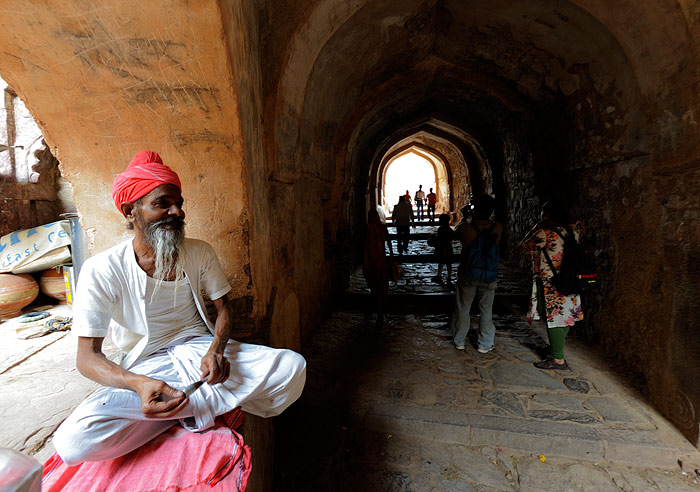
On the second day there was a census to count the Tiger numbers so as a group we visited and photographed the fort at Ranthambhore along with all the coloursand people that visit this place to pray and pay respect to their gods, the women bringing their children as the men walk behind,passing through the many gates and dark corridors on the way to the temples to pray. The fort can be seen in the image below on top of the large rocks, being looked over by a female Black Faced Langur Monkey with young.

The Ranthambhore fort is believed to have been built in 944 A.D. by a Chauhan ruler. It is strategically located on the border of Rajasthan and the surrounding forests were used as an outer defence to the advantage of the fort, making it one of the strongest forts of Northern India. The fort had many buildings inside of which only a few have survived the ravages of wars and time. Among the remaining ruins, the two pavilions, Badal Mahal and Hammirs court and parts of the royal palace gave an idea of the old grandeur.

Once you reach the top the view of the Tiger reserve is breath taking with views stretching for miles.  I photographed through one of the many fort holes here showing the park in the distance, giving you a sense of scale of the place.  Its a wonderful place and I can highly recommend a visit here if you are ever visiting Ranthambhore.

It was great to see some of the guards which I had made friends with the year before.  They do an amazing job with limited resources keeping just over 30 Tigers safe from the ever presence of poaching.  They showed me around and were very kind and helpful to my group by letting us pass through the main gate and onto our zone for that day with minimal fuss. I only wished the many politicians and people involved with Tiger conservation  around the world could see the frontline in the battle against poachers and give them more equipment and resources, because on the ground we are asking these fellows to risk their lives against a well organised band of poachers.  Once these Tigers have gone the whole area falls and the Tiger will not return, very sad but money has to be channeled into helping the guards around India in keeping the Tigers alive. I was shocked and saddened by how these guys stop poachers with their limited resources.


After the census had finished we settled into our daily routine with an early rise at 5am, coffee from the staff before the two jeeps came to pick up the different groups, then setting of in search of the Tiger. It is guaranteed to send adrenalin coursing through the veins, whilst every movement in the undergrowth raises the expectation of a sudden appearance of this animal, striped body, footprints in the dust or the warning cries of deer all serving only to heighten the almost unbearable sense of excitement as you watch and listen for the first clue that a Tiger is around you. The photo below shows one of the seven gates we pass through  during our safaris.

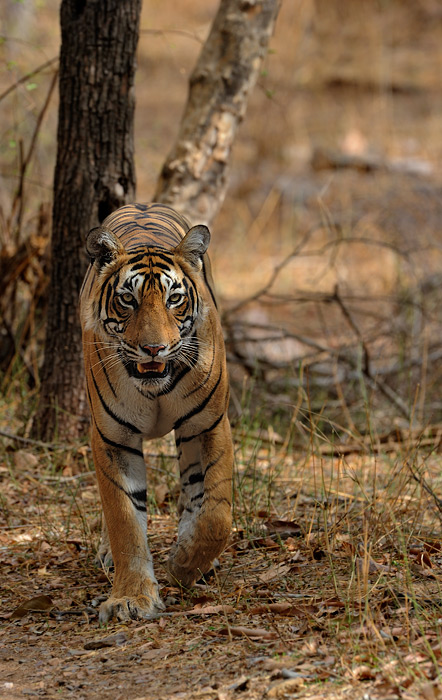
The mornings for me are the best, the sights and sounds of the Jungle are amazing,so very different to back home.  Every call you tune into and having to stay on small tracks as you try to see what is happening far ahead by listening and watching for tell tale clues that the ghost of the forest is about.  Warning cries from other animals like Deer and Monkeys are the first indicator somethings not right, then in a flash a Tiger appears as above.  This female was hunting and I captured her walking through a shaft of light.

I always say on my blog the different wonderful and beautiful moments I witness in nature but for me seeing and watching this animal in the wild is one of those moments I truly love and ranks as some of the best times I have spent watching wildlife.  We followed this female as she was actively hunting prey through the forests, sometimes appearing to vanish without trace only to reappear on the tracks that the jeeps use, then standing so still you struggled to see her if you lost eye contact.

The size and build of these animals is amazing, and to see them so close is something I cannot put into words. After the morning safari we’d have breakfast at around 10am then rest until our afternoon safari from 3pm until around 6.30-7pm.  This was our routine for the rest of the week and as with everything you love, it goes to quick.  Sitting with clients in both of the jeeps I always discussed which were the best settings, giving my advice in these testing conditions, where a Tiger can just appear from knowhere then vanish before you ever got your camera ready. I demostanded the best ways that I have found to capture those moments, working with different focal lengths and lens, all the time trying to capture what you see.

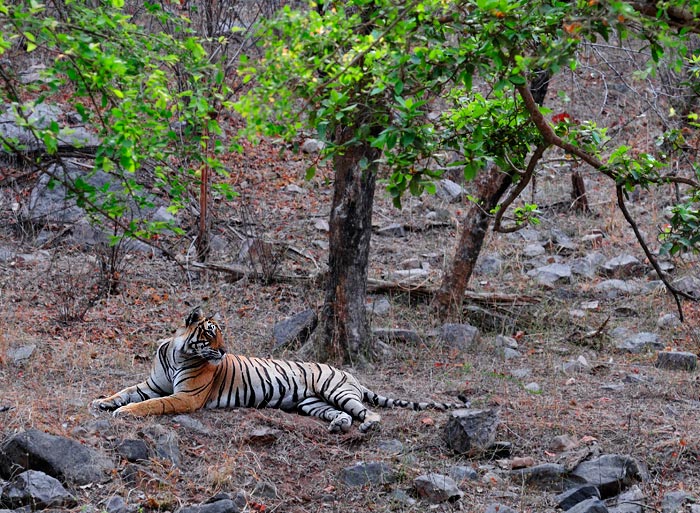
As the week went on some of the sightings were at a distance, we did come across a female Tigress protecting a kill among a dry riverbed where she was well hidden from view.  She had killed a Samba Deer some days earlier and was feeding, then leaving it, all the time going back. She had cubs in the area, well hidden from view and she would vanish then reappear again often going to feed and tend to her young.

This photo captured that first moment we made contact with her as she hid the kill really well and had cubs nearby, it was a dry riverbed with overhead cover from the forest trees.  She took nearly two days to finish the kill off and we just watched from a distance before she headed off and walked past our jeep and headed out of site towards where she may have had her cubs safety hidden.  It was clear from her nipples she was feeding cubs and I was praying they might show but I was told by Salim that it was to early and in another 4-5 weeks they will be around and feeding.  I’ll have to wait until next year when there may be a good chance of seeing them at nearly a year old fingers crossed.  A number of other females are pregnant also so there’s lots of new life on the horizon, which will be great for their numbers.

Over time as we watched this female Tigress a crocodile seemed to be heading towards the kill but in the end he chose another path from that one where the Tiger was.

The whole group captured some amazing images of the Tigers and this female was the most popular, where over a period of a couple of days we had a great insight to her behaviour which was fascinating to witness.

The week there pasted far to quick and before we knew it the time had come to leave Ranthambhore and head off home.  I wished I could have stayed as I really love this place and its Tigers, it has a magical feel to it, an old fort taken over by nature.  We headed for the airport the same way we came, packed lunches in hand as we started the journey home, thank you to my clients for your company, big thank you to Ragh and Salim for your help and expert tracking and guidance with the Tigers. 

Many thanks to the staff at the Ranthambhore Bagh where we stay, great food, warm welcome and a great base for this trip.  Next years details and dates on on my website here, I only take 4 people maxim, 2 person per jeep, this is the best for photographing the Tigers I have found over my time there, as space in the jeeps is crucial to capturing that shot you sometimes only have seconds to take before they have vanished into the forests.
I will be releasing a few more limited edition prints very soon to go along with the 3 others I currently have, where 50% of the profits go to a charity I work with to help rise money for Tigers around the world; 21 Century Tiger.  Where they spend 100% of your money in helping Tigers around the world, these animals are in real danger of extinction and need as much help as possible so that future children get the chance to see this amazing animal in the wild. 

Read full post

A Taste of Texel

Filed in Places Of Interest, Wildlife, Workshops on May.05, 2011

The bird paradise of Texel in Holland became our home over the last four days during our annual yearly photo trip there.  This picturesque island on the north tip of the Dutch mainland is a heaven for wildlife, at around 25 miles long and seven miles wide the island is the largest of the Wadden Islands.

It’s a haven and paradise for thousands of waders and waterfowl during the spring/summer months where they choose this picturesque island to play out their courtship routines and breed, feed their young all quiet close to you, presenting some of this best chances to photograph Avocets, Spoonbills, Caspian and Black Terns, Oystercatchers, Kentish Plovers, and many more waders.

When we arrived after the over night ferry relaxed and far less stressed than if you travel by plane, we headed to a site on the mainland first where a family of Foxes are living wild among a woodland environment, twinned with paths and humans walking around.  Even through the foxes were wild it was plain to see they had become use to human actively, and after my own ongoing Fox project at home which has become so testing at times, it was refreshing to see these wonderful animals up so close, going about their lives around us, very endearing moment for me and the group.

We all shared some lovely moments before heading to Texel and settling into our lovely hotel accommodation on the island, where all your meals are of the highest standard, comfortable place in which to use as our base during our time on Texel.  In the morning we all heading out at around 05.30am for the morning light and to visit the places where the Avocets feed and other waders. The weather during the whole trip was warm, sunny but windy, this hampered a few of the birds we all had on our wish lists, but all in all many wonderful moments were all captured by the group during their time on Texel and the mainland.

Amazing light on offer each morning but that wind just made the going a little tough for the wildlife, right place right time is one of those key elements in wildlife photography and again we all managed to be there while witnessing a very beautiful piece of behaviour from a pair of Oystercatchers in the morning light. These birds by their very nature are very loud, their call travelling for miles, a single, high pitched note this can be your first indication that these birds are around.

We watched having been drawn to a certain pair due to the vocal calls, they were following each other in straight lines, mimicking each others movement then setting off again traveling behind each other always calling, how wonderful nature is.

Then in a flash the male would jump up onto of the female, calling constantly, steadying himself by flapping his wings really fast to keep himself up right, wonderful to see this action that really only lasted seconds before the male jumped off and started cleaning himself up.

We spent quite a lot of time photographing the Common, Arctic, Little, Sandwich Tern colonies that Texel supports in good numbers, most if not all are inland, dotted around this small islands pools, with the ever present noise and smell’s these busy little communities give off.  For me the Tern family is a beautiful bird, on one hand really hardy, tough, on the other so gentle and elegant with such a graceful appearance.  I watched as one parent sat on the nest as the other flew in and passed over the sandeels they had just caught, all while hovering for a split second, so beautiful to watch, I was able to capture the sequence with the image below.

The birds are so fast and fly in, you only have a few seconds and trust me there were hundreds of  attempts that ended in nothing but blurred images, but you only need one image to convey the moment. Great displays of affection between the birds were witnessed showing real care for each other which was very nice to see.

Among the vast colonies of Terns there were good numbers of a bird often over looked in the presence of other birds, the Black headed Gull, strikingly beautiful in their summer plumage.  They are a common colonial breeder, nesting among reedbeds and marshland, their dark brown hood often mistaken for black is stunning in the light and with matching leg and beak colour they are a match for most colourful birds.  The noise from these birds though can be earsplitting a real loud call they use to communicate with each often.

I captured them building their nest, the male would fly in and drop off the twigs to the female who chose to start their home on a grassy embankment covered in small colourful flowers. Great fun to watch and again above their noise really comical to watch.

The routine most days was the same an early start to see the island awaken,capture those beautiful encounters with our cameras, then head back for our wonderful self service hot and cold breakfast, then head back out for the whole day. Driving to the different sites and always on the look out for a shot, in this case it was the handsome Spoonbill. A large bird with wonderful markings on their bills and plumage, we managed to capture this guy feeding and having a good clean up, disembarking the vehicle slowly and moving very quietly and slowly to get a close up of this wonderful looking bird that’s very rare in the UK.

Here I captured him having a good old stretch or was he exercising in the morning who knows but a funny image where I was laughing as I took it as nature does afford you so much fun at times.  After three amazing days on the island of Texel we caught the early morning ferry on the Monday and like last years trip we headed to the mainland to photograph the stunning and beautiful Black Necked Grebe. On the way stopping off at another Grebe site, this time the Great Crested Grebe a site Jeroen knew really well.

Another stunning bird from the same family, here she had chicks with her perched on her back. Mum would swim around while dad would fish to feed them. Then unannounced the male would turn up with a fish in his beak and offer this up to the young chicks on mum’s back.  I watched as the young chick would reach round to take the fish, sometimes falling into the water, in the end though the parents where amazingly attentive to their offspring.

And here I under exposed a lot to get this effect, where the Grebe had swam into a darker area with the light still shining on her, making for a lovely image and a style I really look to produce in my work.

We travelled for about two hours until we reached the area in which the Black Necked grebes nest, where you can get some beautiful close up’s of this striking bird. We found a small spot,where we lay down and watched the Grebes feed at some distance away,over time they came closer into land, all the time feeding and on some occasions displaying to each other.

And the light was really changeable, so here I tired a hi key image over exposing to gain this effect in camera, adding a different feel to the image.

The group had some lovely encounters with these amazing birds before moving onto another site then heading to the port for our over night ferry crossing to Harwich. It was a really good trip, lovely clients all of which were great company so thank you all. I hope you got alot from the trip and I hope to have helped you in some regard with wildlife photography, how you can capture a subject within its environment, fieldcraft etc.  Thanks to Jeroen Stel for your time and effort in this amazing photo trip. Next years trip dates are up and for those that wanted to book this year but could’nt join us because we were full I’ll send you the dates on my monthly newsletter. For more info click here .


Read full post

Sumatran Orangutan Expedition

Filed in Charities, In the Press, Wildlife on Apr.27, 2011

In the May issue of the Outdoor Photography magazine there is a full page advert for a wonderful trip I am leading to the amazing jungles of Sumatra. The aim of this trip is to highlight the cause of maybe the first great ape to become extinct should current trends continue. At the same time raise money for the charity SOS- Sumatran Orangutan Society.

This charity is dedicated to the conservation of Sumatran Orangutans and their forest home, where each person on this photo-tour will directly be helping the Orangutan and their habitat, with money from each person booked onto this trip going to the Sumatran Orangutan Society, whose work is to help protect and conserve this area for the future of our closest relative. The principal focus of this photo tour will be the Orangutan, capturing them within their natural habitat, looking for behaviours to capture and so on, as we visit some of the most magnificent forests on Earth, which are also the domain of many other beautiful and stunning animals and birds, where some only live in this part of the world and nowhere else on the planet.

Sadly the ‘Old Man of the forest’ has been subjected to relentless pressures which has reduced the world’s population by as much as 50% during the last 10 years. Hunting for meat and the demands of the pet trade have been contributory factors but the more significant issue has been the large-scale clearance of rain forest throughout this region leaving very few habitats left for these apes.

There are surely few more enduring creatures in the world than the gentle giant of the rainforests, the Orangutan. With around 97% of an Orangutans genetic makeup being the same as a human and where such a close affinity to Homo sapiens is obvious upon gazing into their beautiful faces and watching their behaviour and how they conduct their lives. The evolutionary links with mankind are plain to see after such encounters with this amazing ape that now only live wild in two places in the world, Borneo and Northern Sumatra.

The charity also works in restoring degraded areas inside the border of the Gunung Leuser National Park, working with local government and local communities to restore vital Orangutan habitat that has been damaged by illegal oil palm plantations established within the protected area. So much brilliant work is going on out there to save these animals.  This trip as you can see by the Itinerary will be truly amazing, covering different areas, sleeping in the jungle with its amazing noises and uniqueness all of its own.

There is an amazing film called “Green” the film is an emotional journey following Greens’ final days, a powerful film that has won many awards. The sounds of the jungle are amazing, this trailer transports you there with those amazing jungle noises you will here every morning on this trip.  There are thousands of Orangutans in need of real help in this part of the world, another animal on the very brink of disappearing from our plant.

http://www.youtube.com/watch?v=sQn9-GPHZIY

Helen the UK Director of SOS has done an amazing job and she has had amazing support for this trip from many people, Paramo, the clothing company are offering 10% discount on their range for people going onto this trip. Greys Of Westminster, Practical Photography/Photo Answers, Outdoor photographyAction for Apes and many more have got behind SOS in turn helping this great ape.

So on behalf of the Sumatran Orangutan I’d like to thank all those involved and who have helped.  There are places still available on this trip, so for more details please contact Helen at SOS, or contact Different Travel directly. I look forward to meeting you all in September, many thanks.


Read full post

Love Is In The Air

Filed in Wildlife, Workshops on Mar.27, 2011

With the start of British Summer time upon us, there is a feeling of love in the countryside, animals displaying and showing off and saying ‘look at me’.  This behaviour is mirrored in the human world also, in the hope to attract a female so their genes can continue upon breeding.  With the clock going forward, the light will come up earlier in the morning and set later in the evening making those beautiful summer days last ages.  Long gone now are those late starts as you wait for the sun to rise. I really look forward to the warmer months, the new life, animal behaviour and the many different and wonderful things you can witness within nature during our longest days of the year.

Here I took a wide angle of a lone male Marsh Harrier that was circling over our heads for some time, calling to the female who was hidden in the reeds. I wanted to convey the true beauty of that morning, with the low lying mist and Norfolk reed in the background. We then headed for cover where I show and teach clients how best to use what’s around you in order to disappear from view. The same male Marsh Harrier then dropped into the reeds in front of us all, where a mixture of watching the subject and following in camera resulted in us all capturing lovely images from that morning.

Camping out in the field, a small fire, favourite foods all packed away to maximise the space along with the many other items you carry as a wildlife photographer living in the field. I like to camp and be closer to the subject I am hoping to photograph, getting up for the light, spending those amazing first few hours of light engrossed in my work. After a long day I then like to head back to where I have made camp and start a small fire, get the little camping stove on, hot water,a strong sweet cup of tea, as I review the days events in camera. With so many things and subjects I am working on along with my one to ones and photo trips there is just not enough time in the day to get round to everything I wish to photograph, even with the extra light.

This week I have had a wonderful time with a lovely couple who travel the globe photographing wildlife. Sue & Rob from the UK. They booked me for two days to show them the beauty of Norfolk and all the places I know and have found during the many visits to this amazing county over many years. You always wish for the best weather for your clients in order for them to get the very best from the day(s) and the conditions during the two days, they could not have wished for better. A slight frost adding that little crunch under foot welcomed us on both days but the light and clear skies were what as a wildlife photographer you dream of.  Many thanks to you both and I hope to see you on my Greenland or Tigers Trip next year.

Along with my Fox work, Brown Hares, Barn Owls and Dippers, I am also working on Great Crested Grebes, a bird I have loved for ages, their elegant pose, their beautiful marking and stunning plumage makes them one of the most handsome water dwelling birds in the UK in my eyes. They are the largest of the European Grebes and during the spring and summer they are such a striking bird, with their spectacular head, ruff and spiky head tuffs when they greet each other or display during courtship. Last year I photographed these birds at the same site but was unable to go back at the start of the breeding season due to commitments, so this year I’d hoped to capture them as they build their bond between each other and go through their amazing courtship dance where they dive for weed, surfacing with this in their bills and offer it to one another while sharply turning their heads back and forth.

Having spent some time there now, the lives of these amazing birds are played out before me, where they show real love and care for each other, when one goes out of sight the other calls in an attempt to locate its mate, such a strong bond which was so lovely to witness. I am using a hide on the shore to photograph this pair of Grebes; just on the water’s edge and not in the water as this disturbs the birds and other species of animals around too much. Getting there before the sun comes up, with the dawn chorus as my companion, each bird jockeying for their own patch, staking their clam to that bit of land. It’s such an amazing time of day and one you greatly benefit from for being among its beauty and peace.

The morning starts cold and sometimes there’s that morning mist lying low on the water adding an air of mystery to the place as you wonder what will come, always praying your chosen subject may just make a short and brief appearance for your morning efforts in getting into place.

Then a bird appears an unmistakable appearance, their head plumes held or raised aloft as they swim proudly on their way. The same head plumes compressed when the bird is alarmed or alerted to something, making their whole face area very streamline. Hours can pass with nothing, each bird fishing far and wide from each other, with the odd highly vocal call echoing around the lake. It’s a strong, rolling like call ‘crrra-ahrr’ repeated often and appearing very nasal in sound as the beak doesn’t really open during calling.

To witness their courtship weed dance was amazing and from know where the two birds would come together, something unseen triggering the need to display with each other in a moments flash. Swimming towards each other with great intent, and then rising up inches apart sharply turning their heads from side to side, climaxing in their penguin dance in which both birds raise their whole bodies upright from the water, breast to breast, just amazing to see.

The weed dance only happens a few times during the day and is so beautiful to see, poetry in motion as you witness each bird working to please the other in a real act of affection and love which for me was very touching to witness this very private and powerful moment.

This display is over as quickly as he begins in most cases, this pair are in the early days of courtship and building their nest, gathering twigs, and small branches and bringing them back to increase the size and shape of their nest.  Occasionally they mate, only briefly at the moment but this will increase once the nest is finished. The male climbs onto the female, she flattens herself and a small call by the male advertises their brief period of mating before climbing off her.

In the coming weeks I do hope to capture those beautiful images you see with the Grebes chicks on the adults back, thumbing a lift around the lake while tucked under their wings.  On some days I have stayed there until dusk some 16 hours almost in the hide, but with love in the air the place is alive with action and calls from other birds and surrounding wildlife so there’s really never a dull moment during the relentless waiting for the Grebes.

Whatever you choose to do good luck and remember the wildlife should always come before any photograph, with careful and respectful fieldcraft, the key with wildlife photography your efforts will be rewarded with those priceless and private moments you get into a wild animals life, capturing them with the camera just lets you record those times, all the best


Read full post

Dartford Warbler-Natures Beauty

Filed in Wildlife on Mar.19, 2011

The highly secretive and stunningly beautiful  Dartford Warbler  photographed here among its health land habitat further North from its more Southernmost stronghold in the UK.  A tiny, secretive bird, often only ever glimpsed darting between bushes on lowland heaths.  They emit a harsh rattling call before vanishing into cover, only to reappear somewhere else having worked their way through the thick cover they love to live in.  I have been really lucky to have seen this bird so close after travelling to many wonderful places in the UK on the lookout for this attractive bird with a hope of seeing and photographing its beauty.  The Dartford Warbler is rare in the UK and lives almost exclusively in the South.  It was first found in England in 1787.

To watch him was amazing, his lively and very nimble movements, hoping from one perch to another, twitching his wings and tail every so often. He spent long periods concealed in the vegetation offering only the briefest of glimpses, his bright red, angry looking eye peering at me from the thick, thorny thickets.  Every so often he’d appear and gain the highest vantage point in which to sing from, his song was very distinctive and harsh and high in pitch once heard you never forget this call and then he’d vanish for a while.  The first indicator he was around was his call, as it stood out among the other bird calls on the moors.

The challenge was to second guess where he’d appear allowing me a clean, full length photograph of him, using fieldcraft and blending in, as I was not using a hide making it hard to pin down a certain place he’d appear and come out from cover using the many natural perches open to him.  The colour of these birds set them apart from many UK birds for me, a dark grey head and back with a dark wine-red chest and underside with white fine spots on and the most beautiful eyes you’ve seen in a bird, bright red, almost angry looking in appearance, just a stunning bird standing as proud as punch singing away among the heathlands, an amazing time with this amazing bird.

What truely amazed me was how well the different colours of this bird blended into his environment, where the colours of mother nature worked together so well in letting this shy bird completely blend in and become totally unseen. The rich colours of the heathland lending their colours almost identically to those of the Dartford Warbler , a clear view to just how wonderful nature his.

In the past the bird has been vulnerable to changes in climate and two harsh winters left just 11 pairs of the bird in 1963, but Britain’s most colourful warbler is spreading its territorial wings having returned to Wales, the Midlands and East Anglia, there are now more than 3,000 pairs – the highest tally for more than 40 years. The Royal Society for the Protection of Birds says the recent rise in numbers – to an estimated 3,208 pairs from 1,890 in 1994 – is due both to milder winters and improvements in the conservation of heathland habitats.

But the latest reports indicate after the two harsh winters the birds numbers may have dropped significantly, Cold weather in 2009, 2010 caused a 90% reduction in warbler numbers across the South of the UK . However, freezing weather and snow in the early parts of 2009 and 2010 and earlier this year have caused great concern that these small birds could die out, with a crash in numbers in their southern stronghold of the UK.

A truely stunning bird with a call you’ll never forget once you hear it, just amazing to see these birds within their natural habitat and I will be going back soon where hopefully he will have stayed and may have a mate around as during all the time there I never saw a female and his behaviour would indicate with his ever present singing he was looking for the female, marking his patch, defending his territory from other birds, more so Stonechats that share the same habitat.  I hope to photograph this amazing bird again during the year.


Read full post

Barn Owls

Filed in Wildlife, Workshops on Mar.12, 2011

When the sun shines everything around awakens and comes to life, warming the slight chilled March air, you can hear the countryside come to life.  Over the many years I have visited Norfolk whether it be alone or with clients on one to ones or workshops, the wildlife never disappoints.  It’s a place I feel at home in, a place that never truly gives up its secrets straight away, almost teasing you with the ever present sightings of different birds gracing this amazing place with their presence throughout the year.

Each month I meet clients on one to ones/workshops, during the Spring Tide days, helping them with their photography, giving real and helpful advice and at the same time showing how to approach and use what you have around you in order to get close to and photograph wild animals in their environment, at the same time watching for any behaviour you may be lucky enough to witness. In between these visits I work on my own projects, mainly focusing on the bird that got my love and interest going as a child with the YOC- Young Ornithologists’ Club, the Barn Owl or ‘Ghost’ as I call this amazing bird.

This nickname relates to when I wait and watch for these Owls to show up.  You wait and wait for a passing glimpse and a view into this bird’s life entrenched with mystery, then from no where and without warning the Barn Owls turns up in perfect silence, gliding, riding the winds currents, traveling effortlessly. Eyes glued to the ground beneath, on the lookout for small rodents that they feed on. They divide the field or area and hunt or quarter which refers to this practice these owls do so well on the lookout for movement, in turn prey.

They are amazing birds and one of my favourite British birds, watching them fly and hunt for a few minutes and then to make eye contact with you is a priceless moment to treasure.  When you see them in the wild you  witness their very distinctive appearance with a white heart-shaped face with no ear tufts and sharp black eyes all contributing to its striking appearance. Those large black eyes only let the Barn Owl look forward in a fixed position and cannot move to the side, so consequently the Barn Owl has to turn its head to see to the side or back. Their hearing is amazing and the ability to locate prey by sound alone is one of the best in the animal kingdom.

Barn Owl’s feathers make them perfectly adapted for silent flight, but this makes them prone to water logging so they are not well suited to hunting in wet weather. The key to an owl’s silent flight is in its feathers, the next time you find an owl feather, turn it on its side and look at the edge — the line of fibers is scalloped, like a stretched seam. The slight alteration in shape allows the feather to cut the air without making sound, making them perfectly aerodynamic.

I’ve been hoping that the ones I watch and photograph in Norfolk survived the recent two very harsh cold snaps we’ve had, which has really impacted hard on the numbers of these birds around the UK, where Norfolk has always been a stronghold for these birds.  The pair that hunt over farmland and marshland have done well so far and are looking their best with the breeding season just around the corner but I have been lucky enough to find another couple of places that have Barn Owls.

So this year I am hoping to document the different birds that live in different environments capturing my trademark images showing them within their natural habitat of rough grazing, marshland and Norfolk reeds.  With the onset of summer around the corner and longer days, the prospect of working with Barn Owls fills me with such joy.

Within my work, habitat, small in the frame and behaviour, form my foundation where I only photograph wild animals, letting people see how and where a certain subject lives and how it conducts its life, so with these images I wanted to show where they live in Norfolk. One site I have known of for many years has a mixture of rough grazing and reeds with small streams and dikes splitting the place into many little areas, perfect for small rodents and perfect for Barn Owls.  I photographed using high iso’s to give me enough speed to freeze the bird in flight, at the same time balancing that with the poor light.  I love small in the frame images, where there is a real innocence about the image, adding a sense of truth to the image and in turn learning people more about the subject.

My work on Barn Owls will last forever, capturing images for as long as I live.  They have such beauty and grace in my eyes, a bird that takes me right back and brings a massive smile across my face, visualizing the great joy that these birds have brought to my life over 3 decades. I hope to bring you more images of this iconic bird over the coming months and even years to come.

My Springtide & Waders Workshops are fully booked until July onwards.  My Barn Owl/Raptors One to Ones days can be booked at a time at your convenience now with the weather getting better and the longer days, these days last from dawn until dusk and include a homemade packed lunch made by my wife.  I will show you several different sites, go through key fieldcraft skills on how to approach and photograph these birds without disturbing them, as they are protected by law, so great care must always be given to these birds.

I give camera advice, settings, composition and exposing advice for these birds, show you the best flight settings, basically, everything I use myself.  Thanks to Nigel for traveling up from Ashford in Kent to Norfolk for a One to One yesterday for Barn Owls.  I look forward to seeing your images.

If you would like any advice on anything I have mentioned or touched on here in this blog post then please drop me a line here, alternatively please go to my One To One page.  For more than one person there is a discounted rate and I often get couples and friends all attending together.  To enquire about free dates please email me, many thanks.


Read full post

Springs Around The Corner

Filed in Wildlife on Mar.03, 2011

Over the last couple of weeks I have noticed a slight change in the weather, with brighter mornings and lighter evenings.  It would seem spring is on its way and maybe upon us very soon. After a long period of poor weather, resulting in low light, it will be most welcomed, with my recent trips to Norfolk and my wildlife workshops at the beautiful Trentham Estate and working on the several projects I am doing in my own time the working conditions have been testing to say the least, but ingrained in me along with a deep love for wildlife is that motto of mine ‘that there is always an image to be had’, however big or small.

However good or bad weather, working with this mindset always rewards you, bringing out your flare and passion in changing conditions at the same time learning you more about how you view an image, pushing your own creative images and boundaries. I have been lucky on a few occasions though where I have been working on several different subjects, when the clouds broke and the area was bathed in warm sunshine.  Warmth lifts the spirits and brings places to life and I really think spring now is almost upon us and its the best time of year for me, full of life, action and behaviour.  A complete paradise to be among its beauty at this special time of year, witnessing the countryside awaken from its dormant winter state.

The mornings are a wash with bird song at the moment, all competing to be the most musical, filling the air as each bird stakes their claim on a certain patch of ground, among the beautiful songs at dawn one song in particualr symbolizes the British countryside and springtime more than any other call and that belongs to the beautiful male Blackbird. The call travels far, cutting through all other bird songs and is a mixture of different notes and pitches that once you hear its distinctive sound you will never forget the sound.

Spring is one of the four seasons, the period between winter and summer, and for me the words Spring and Springtime bring thoughts of life, birth and regrowth to our countryside.  A special time for wildlife, where all species are looking their best, in tip top form hoping to attract the ladies and breed with.  Behaviour within the animal world starts in spring, handsome males showing off, displaying to each other in an act of supremacy over the other, using what ever they can to win over the attentions of the females securing a mate for that year.  With the lighter mornings and evenings wildlife becomes busy, more active giving greater opportunities to capture its beauty during springtime.

As our Winter visitors leave to go back home to breed the influx of our summer visitors start to slowly arrive to our shores making spring one of the best times in the calendar of nature.  I maybe a little early still but from the work I’ve been doing over the last two weeks a change is in the air, alas the odd frostly night and cold morning thrown in to confuse and disorient the wildlife is always on the cards but on the whole winter is behind us all I feel.

The countryside becomes a wash with colours and new growth, a mesmerizing number of birds fill the lands.  Flowers start to bloom, eventually carpeting the woodlands in a blue carpet of bluebells, one of the great sites of Britain.  Many other flowers suddenly start to appear, muti-coloured and hugely varied in form and shape.  A beautiful time of the year where that extra hour of light at either ends of dawn and dusk is very welcome and needed, making the days longer and warming the place for longer.  It really is my favourite time of the year.

I have been working on many different subjects, building trust and patience with each species involving many hours waiting.  I have two new Dipper sites and my workshops are as popular as ever, the Skomer workshops I do are being booked with the arrival of the “clowns of the sea” as I call them.  Any day now the Puffins will arrive now spending 8 months of the year at sea and only 4 months on land, an amazing feat.  I have always loved small in the frame images, showing the subjects habitat letting people see where the animal lives and how it conducts its life.  The following two image are a male Wren and a male Dipper on the same stretch of river looking in top condition.

While photographing the Dippers at this new site I spent some time watching this male, who had found these logs all gathered together at the side of the river and used them to defend his territory from and sing.  I saw him dive into the water and feed and he seemed to be acting differently so I turned on the video on my camera and began filming.  About thirty seconds into the film he turned around and in a flash regurgitating a pellet.  The contents of a bird’s pellet depend on its diet, but can include the exoskeletons of insects, indigestible plant matter, bones, fur etc, many birds do this to remove such pellets, I have rarely seen this though in Dippers and I was really lucky to have captured it with this short film.

Below I managed to photograph a male Kestrel hunting over marshland over the last few days which is among a large industrial estate, where I think they have started to make a nest, here I used the cover of the reeds to break my shape up at the same time hide my approach clearly showing the estate in the back ground. Something I plan on working on should these birds stay.

There is just so much going on now within the countryside so enjoy this magical time of year where for me there is just not enough time in the day to capture everything I plan working on, I am hoping to capture images from my time spent on the various different species over this beautiful time of year that spring is. This is not always possible though so for me just being there is enough, where I witness a window into a wild animals world.

For details on my workshops, one to ones and the photo trips I run  then please contact me here or alternatively view the workshops page for full listings. The Sumatran Orangutans trips itinerary can now be viewed and booked here

All of my photo trips from one to ones right up to the bigger trips are designed and lead from the front by myself, where each trip is designed  for wildlife photographers where I pride myself on working with the very best people on the ground and in the field giving that personal and private touch offering all clients the best service possible with smaller group sizes in most cases ensuring all my clients get my full expertise and guidance, learning more about the wildlife and the environment in which they live.  Many thanks and good luck with the weather.

And before I go on page 90 of the March issues of the BBC Wildlife magazine you’ll see an advert for a range of clothing called 511 Tactical series, they want me to trail some of their clothing and equipment while on my travels here and abroad. Ray Mears himself an ex-soldier has been using this brilliant clothing for years.

The name “511” represents a gruelling climbing grade as listed in the Yosemite Decimal Grading System, and as a skilled climber myself I’m looking forward to using this clothing and equipment.  I’ve spoken with their top UK guy and they are branching out from their American homeland and going for the ‘softer’ approach away from the guns and the body armour etc. They are looking to the outdoor market, walking, camping, survival market and climbing for which it was originally designed for and gets its name from.

I will be using their tactical pants –cotton, tactile Pro pants, tactical Pro long + short sleeved shirts all in green and browns,sand colours, their Rush 72 back pack complete with hydration pack idea for long walks with heavy kit which is the way I work while in the field.  A place where you have to rely on your kit to make it just that bit more comfortable, I will update my blog and do a full field test and review when I’ve received the items of clothing and equipment. Their website can be viewed here.


Read full post

Amazing Autumn

Filed in Events, Wildlife on Nov.02, 2010

The season of Autumn provides us with some of the most beautiful and intense colours within nature. Woodlands all over the UK are revealing their amazing colours of red, orange, yellow and gold.  This happens when the trees start to withdraw their chlorophyll from their leaves revealing these vibrant pigments in the leaves giving this amazing and distinctive appearance during the season of Autumn.

Autumn is a great time to get out with your camera as the ground is laden with fruits and nuts forming a carpet of food.  A very rich bounty in which all animal’s take advantage of this extra food source before the onset of Winter.  Capturing behaviour in some animals during Autumn makes for some beautiful encounters with wildlife. The most commonly known one is the Deer Rut , which was very late this year, I have been to several places around the UK over the last month and seen some brilliant behaviour and great moments.

This time of year is also one of the best times to see and witness one of the most secret and shy birds within the bird world, the Jay, part of the Crow family.  You only normally hear these birds in the tops of trees, but during the plentiful bounty on offer during Autumn you’ll see them on the ground feeding on the acorns and other nuts and fruits the trees shed at this time of year.

The changing seasons and the yearly life cycle of animals, plants and trees will enable you to photograph many different images throughout the year, which will tell the story of the changing weather and colours of the different habitats in which the wildlife live in.  The season of Autumn for me is arguably one of the finest times of year to enjoy and view wildlife with a backdrop of amazing colours, while most summer birds have now gone. Vast numbers of new arrivals make up for their departure, with the likes of Fieldfares, Redwings, and various Geese and Ducks that spend the winter months with us.

One of my favorite winter visitor’s is the beautiful Whooper Swan that have started to arrive from Iceland along with the slightly smaller but equally beautiful Bewick Swan.  When they have all arrived numbers can surpass more than 1,000 Whoopers in and around the various places I visit, one of the best is on the North West coast of the UK.  So graceful and elegant for a large bird they truly are beautiful and amazing to watch in flight.

I have also been photographing a real comical and funny bird, always on the move and constantly calling  as they climb and pose up and down trees with great finesse and ease, the Nuthatch.  I wanted to try and capture a few different view points of these charismatic, iconic woodland birds with their bold mannerism’s.  I waited out of site to where they were landing, hoping to capture their cheeky side within an image.  The following two photos I feel demonstrate this, with the amazing colours of the autumnal woodland as the back drop.  Very funny birds and just one of the many wonderful animals you can photograph now as they feed on this rich source of food nature provides them with during Autumn.

Autumn marks the transition from Summer into Winter and is a short season compared to the other three so make the most of it with the colourful foliage on offer, adding great impact to any photographs you take. With the cooler temperature’s you maybe lucky enough for some amazing sunsets as I was with this lone Kestrel hunting in the very last rays of light over marshland.

With so much happening now my best advice would be to just go out into nature and capture this amazing and visually beautiful time of year, your reward will be views of animals you may not be able to see during the other seasons of the year, at the same time witness these stunning colours. 

The migrants that these shores attract along with the special winter wildlife we have, finally show up in good numbers from now onwards giving you a unique insight into their lives, some of the best for me are Short-eared Owls that come down from the mountains to feed at sea level during our winter months, Mountain Hares that change colour to pure white to avoid predators and blend in with their snow capped landscapes along with Ptarmigan and many more species of wildlife where the only downside is that it becomes colder but you get to put more layers on!!.  Whatever you do you will not be disappointed with the beauty of mother nature.


Read full post