Entries in the ‘Workshops’

Always Inspired

Filed in Places Of Interest, Workshops on Oct.28, 2011

Inspiration can come in many forms and from many different avenues I believe, personally I get inspired by many different things, most of which are visual, where words dont need to be spoken, let the image speak for you and inspire those to see the wonderful world of wildlife and the subjects it supports. Over the last two weeks I have been working on my own projects at the same time working with clients in improving their own photography while seeing and witnessing that inspiration, which for me is nature.  Watching nature and capturing her beauty is a wonderful thing where I am at total peace,surrounded by her beauty.

Over the weekend I visited London for the annual WildPhotos 2011, a selection of the best photographers go through their work, how they work and tips etc which I find very inspiring and during the 3 years I have visited this event it never fails to ignite yet more passion in me. This year I had a nice surprise as the editor of the BBC Wildlife magazine, Sophie Stafford used one of my images, kissing Puffins so show the audience what the magazine look for when it comes to images submitted and different looks etc.

The image captures two Puffins kissing each other and going through their bonding process with the onset of the breeding season ahead of them. Nice moment as I sat there and looked up at this Puffin image, remembering the moment I captured them like it was yesterday. BBC wildlife magazine chose my image “Kissing Puffin’s for a full page spread in their June issue.

Last week I visited several different areas around the UK to photograph the annual deer rut, this year with the added warm temperatures and the warmest October since records begin it seems to have never really reached its peak, instead just slowly building with action and deer still calling and claiming their females as I write this.

I witnessed fighting, gentle young Fallow Deer learning their skills from their mums within the different habitats I visited from open grasslands to dense woodland that offered the deer a safe place to hide, making the process of finding them just that bit harder.

I witnessed some beautiful moments along with the males fighting for control over their females. I’d got into place just before dawn at all the places I visited, some I got really lucky at others the deer failed to show. One morning I was feet away from two fallow Deer’s stags fighting, t he noise of that smashing in to each other could be heard from far and wide such was the brute force. Then on the other hand I saw a young Fallow Deer following her mum through the thick cover only to become separated and disoriented.

The image below captures that special moment , soon after she caught up with her mum and everything was fine again.

Nature is wonderful to be around and spend time alongside where I am always inspired everytime. The places I go and also run my trips and workshops too always come up with something different and I am constantly learning more and more about the subjects or the environments and animal behaviours.

After my trip to London on Saturday just gone I had almost back to back one to ones in the Peak District, on my Mountain Hares workshop and then mostly in Norfolk for Barn Owls and two Spring tide days with the predicted high tides. Living out of my bag and just having time to charge my cameras batteries along with my own has been the routine but I love every minute. Helping clients take better photographs and learning more about their own equipment is something I pride myself on during the time spent with clients.

Over the three days we had a mixture of weather, sunshine, rain but on the hold the weather was kind to all my clients which is something I always wish for. As the dawn broke each morning the thousands of geese would travel in from their overnight coastal roost site and head inland to feed during the day light hours, before heading back out just before dusk.  The skies where full of calls,shapes,formations over our heads and it was amazing to witness. The dawn light was just amazing, with the cloud formations creating a very beautiful feel to those mornings with their shapes and colours.

The light was just stunning as the sky filled with geese and also waders during these spring tide days. Norfolk is famous for its winter flocks of geese, wildfowl and waders who begin to gather here to make their home during our winter months, amazing spring tides with thousands of Waders being pushed up the beach as the tide works its way in covering the mud and sand flats, submerging the whole estuary.

Once the majority of these areas have been consumed by the sea the birds are forced into the ‘Pits’ which are behind the beach where the RSPB have built a number of hides from which you can watch this amazing spectacle. Where large flocks of Knot, Dunlin, and Oystercatchers come into roost escaping the tide, forming great masses of birds as they all move and sleep in a synchronized manner.

The birds almost fly as one, one minute dark the next flashing silvery-white as they all turn one way their dark backs are facing you, then their pale undersides, in a show of coordination that is second to none, all without a signal or mishap. I have never seen any two birds ever make contact in all the years I’ve witnessed this beautiful site.

The only time you see them make any form of contact is on the ground when they hustle together shoulder to shoulder. The return to the mudflats once the tide starts to retreat is a less coordinated affair, but the smaller flocks still reward you with some fine performances. It can be a really quiet place most of the time, with the Waders feeding on the mudflats some distance away on the estuary, but on these high tides the place is awoken with a bang, bursting to life, and for me the place never disappoints, with so much going on it truly is one of nature’s wonders.

Once the sea starts to retreat it exposes the vast mudflats and this is when all the waders return back to feed on the rich food sources of the mudflats that make up this area of Norfolk.

On the last morning though the weather wasn’t the best,with overcast conditions, I took a few hi-key images that morning, capturing a different feel within the images. I covered this technique on my blog under photography tips sometime ago now, click here to read it.

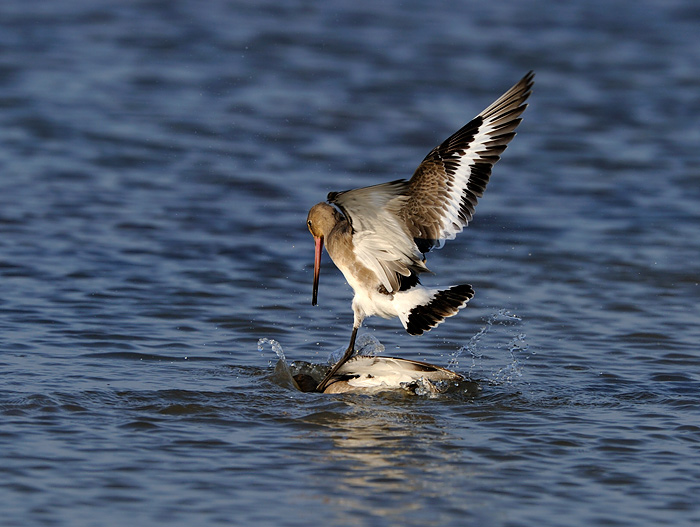
After our time on the beach we leave and head around the many places I know around this stretch of North Norfolk’s coastline.  From my first visit on the Sunday I had witnessed some amazing behaviour while watching some Black Tailed Godwits. From a hide we watched as different adults would be feeding one minute then the next warn each other off, or away from the food source they were feeding on. Most went their own ways and there was peace, but a few times that peace was shattered with some of the most violent behaviour I have seen in birds.

Each bird would try to drown the other, forcing their heads under the water, the bird that submitted would then escape as quickly as possible. It was difficult to witness as we all watched on the three days we were there, with each client being amazed at this action at the same time a little taken aback such was the level of aggression.

The following series of images will hopefully show you what happened during these hard to watch moments. Nature is so beautiful, but at times so cruel too, where only the strong survive, this was a perfect example.
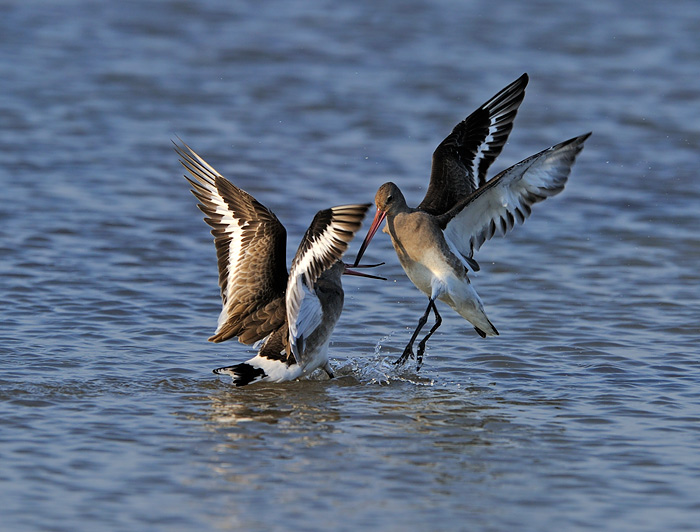
Truly breathtaking behaviour to see and capture this was, the bird seen being moved off was unhurt be the ordeal of being drown so everything was ok in the end. On these spring tide or Norfolk days I run we always finish the days at one of the Barn owls sites I know there hoping to capture this most beautiful on birds at work, hunting.  The owls showed up for all my clients which was nice as the sun set and once in the morning light,showing just what a master they are at hunting and flying silently.

Know matter how many times I visit an area I never fail to be inspired but something I witness, there’s always a different take on what I may have already witness. Many different images to be taken because you just do not know whats around the corner when you photography wild animals, this has been and always will be my greatest enjoyment while observing nature.

A big thanks you to all my clients over the last week, thank you for your company and I wish you all the best within your own wildlife photography.


Read full post

The Beauty Of Wildlife-Calumet Manchester

Filed in Wildlife, Workshops on Oct.17, 2011

Where did the time go I asked myself as yesterday came to an end?  Two wonderful days showing eight clients ‘The Beauty of Wildlife’, firstly at Calumet Manchester in their brilliant studio/classroom and the second day out on the moors of the Peak District, Derbyshire, on my wildlife workshop in conjunction with Calumet. The aim of this workshop is to demonstrate the simple techniques that I apply to my own photography and to then share these with the group.

I demonstrated to the group how to approach their subject using fieldcraft skills without causing any distress to the animal, this in turn lets them relax, which will present you with the best opportunities to photograph their beauty, expressions and behaviour.

The first day was a mixture of talks, slideshow presentations and photographic tips and advice, followed by a cup of tea and biscuits.  After which I went through each clients camera showing how to get the best from each make and model in readiness for the second day out on the moors, where those tips could make all the difference to a well composed image while at the same time learning more from the wildlife that live in this part of the world. All the information and advice we discussed was contained in a handout I’d prepared for each client as seen above, this would help once the group had gone home to use as a reference guide.

Photographing wildlife in ‘the wild’ is the only real and true way of learning about behaviour and fieldcraft, so it was very important for me to show the group on the second day how I work and go about getting the images that I achieve, while working with subjects that are free to come and go as they please and have fear for humans, where you have to work the land and the environment to try and obtain an image, straight from the wild so to speak. The group was a great mix of people, from all over the UK at varying levels of competencies and were really good company.

We had some amazing light on the second morning of the workshop.  We met at 5am in the pitch black of the morning and there was a low lying mist, but above I could see the world’s atlas as I call it, the stars, so I knew this would clear as we made our accent. I had gone through some key elements to wildlife photography the previous day in my presentation to the group. One of those elements was ‘light’. Find it, work with, and create your image alongside what light you have.  So after a 40 minute accent in total darkness, guided by our small tourches we reached the area in which the grouse, hare and other wildlife of the Peak District make their home in.

Straight away over to the east the sun was just beginning to force its way up, burning off that surrounding mist and exposing a warm, wonderful glow to the area. I quickly saw a silhouette of a Red Grouse, let the whole group know and watched as they all used fieldcraft, slow movements and got themselves into place, went through the settings, checking shutter speed and so forth, using the key skills and elements I’d touched on the previous day.

The images above show that wonderful moment and all of the group had at least one image, capturing several elements that came together during the few minutes this grouse allowed us into his life. Light, colour, silhouette, composition and exposures all working together to produce a lovely and different image, what a great start to the day.  I couldn’t have asked for more for the clients. I wanted to try and capture some of the colours and shapes of the clouds during this amazing moment so I used a wide angle to try and focus on the bird while showing the colours.  He took off not long after and you can just make him out over to the left, very small in the frame with blurred wings. It gives you an idea though of the wonderful site the group had that morning.

During the morning we were all treated to many different encounters as the heathland and moors came to life. Grouse flying, landing, settling down on rocks to call and state their claim to a given area, wondering who these shadowy figures were at that time of the morning, moving around this beautiful and unique environment. Rain and mist came in afterwards, so we all took shelter and waited for the visibility to improve and for the mist to go away, which it did sometime later and the sun shined all day there afterwards.

The group followed the advice I’d given the day before on another real key element within wildlife photography, fieldcraft!  Approach with care, stay low, and see and read the signs on the ground in front of you, look for light and above all respect the subject more than any photograph. All the group were brilliant and got some amazing encounters and images through their hard work , ‘you only get out what you put in’.  This is the key.

After lunch the group were free to explore for themselves, put into practice skills and tips I embedded throughout those two days and it was really good to see them all going about their own work and capturing some lovely images with strong composition, good use of natural light and above all listening and watching wildlife to build a picture of whats happening around you.

Being in the wild really showed the guys how to capture images using fieldcraft and watching and listening to wild animals in their own environments.  This is the only true and real way people will learn this key skill I believe. When I met up with the bosses at  Calumet Photographic I stressed that I would only like to work among nature, showing people key elements you must learn and use to be able to photograph wildlife. After the two days I think the whole group enjoyed those two days, learning and benefiting so much this way, which is my main aim when delivering this beauty of wildlife workshop to the public.

A big thank you to all the clients for your time and efforts during the two days.  I really hope you got a lot from the days and learned something new. You were all great on the second day and looking back now you can see through the images you captured why the early start was so important to capturing lovely images of wildlife.

I have another two wildlife workshops planned in conjunction with Calumet Photographic, Saturday 21st & Sunday 22nd January and Saturday 10th & Sunday 11th March, with other ideas for the spring including a 2 day workshop in the beautiful county of Norfolk, photographing the spring coming alive with wildlife. More details will be posted on Calumets events site very soon and I will update my blog when they are finalized.

Also many of the workshop participants hired camera equipment on the day from Calumet which worked really well for the clients, so if you’d like to attend and hire your equipment then just speak to Calumet, Manchester and it can all be arranged for you when you turn up as their service is excellent. The same goes with the many wonderful workshops I run here in the UK and abroad where you can hire from your nearest Calumet dealer before you come on any of my workshops should you wish to hire. For details of prices and rates contact your nearest branch on the link here.

Calumet,  Manchester have a Autumn open day on the 9th November where I will be in attendance to help or answer any queries or questions about wildlife photography, they have lots of other things going on that day including a free camera sensor clean, special offers along with some brilliant companies offering advice and help. So if you are in the area pop in to say hello.

These workshops have been included in this months BBC Wildlife magazine as part of their photographic tours/trips, again for the second year running along with one of my favourite images of a Barn Owl hoovering and hunting as their main image, covering two pages 112-113 of the October issue, it looks amazing, or you can view online here and last years, where have the last 12 months gone.  Many thanks again to all the clients who booked, it was nice to meet you all and thanks for a great two days.


Read full post

Changing Times

Filed in Places Of Interest, Workshops on Oct.06, 2011

With temperatures touching nearly 30c over the last 7 days little more proof is needed of the fact our weather is/has changed over the last two decades. And over the last two years I have noticed a warm April and May then the so called summer months of June, July and August seem never to reach their target with regards to temperatures and sunshine. During the summer months when I was in Mull the locals told me of a real wet May, washing away a lot of the birds’ nests, both ground nesting and higher nesting birds having water logged nests.  Fast forward, the warmest September for many years, with the start of October being brought in with sun worshipers wearing swimwear around our coasts.

Many experts have their own ideas to what is causing this but there can be no more firmer proof than in the Polar Regions. Climate change is having a greater and faster impact on the Arctic than previously thought, air temperatures in the region have on average increased by about 5c over the last 100 years.  Change to the way humans live their lives is needed, with population growth worldwide exceeding beyond space.

During the last 7 -10 days the number of items of clothing you apply when working outdoors in the cold at this time of year has slightly been put on hold, instead the summer order as I call it has remained way pass its purposed shelf life within the natural seasonal calendar.  Visits to Norfolk were bathed in sunshine and felt more like a Spanish holiday resort.

Closer to home in the glorious sunshine I have been working on a few subjects, the Short Eared Owls have arrived, coming down from altitude to feed during the winter months around low lying moorland and marshland. I have been lucky enough to have some good sighting over the last couple of weeks of this beautiful owl within the habitat.

With the harvest now having been collected and gathered in by the farmers its left the fields slightly exposed, which helps when trying to find Brown Hares, as the low height affords these mammals no or little cover once they leave the safety of the hedgerows and small pockets of woodland they use as cover. I spent a couple of mornings, dressed head to toe in camo gear stalking, covered in sweat once the sun had risen due to the temperatures. A couple of lovely encounters here from the different days.

The deer rut is an event really just starting now around the country with Autumn upon us.  I have already been out a couple of times, once with a client on a one to one and the other on my own, and its still not really started in great earnest, almost like the calm before the storm.  This year I will, like last year visit the different places around the country, finishing in Scotland hoping to capture different images and angles to this wonderful event in the natural world.  I am also hoping to do a short film for Phototraining4U covering my day from dawn till dusk on this event, so lots going on.

Hopefully over the next several weeks I am able to capture a few images of this event and post them at a later date. I am looking forward to meeting the folks who have booked onto my Beauty of Wildlife two day workshop in conjunction with Calumet Photographic. I will be presenting a few slide shows, talking about some key elements to wildlife photography, then going through peoples cameras and settings in readiness for day two out on the moors of the Peak District.

The second day we will be capturing the wildlife that live in this area, at the same time helping each person to improve their own wildlife photography. Learning fieldcraft in a wild environment, which is the only way people can truly see what skills are needed to approach an animal that’s not use to humans.  I will update my blog after this event which I am really looking forward to.

I am just testing out some new and amazing slideshow software I have for talks and presentations and thought I’d share this first example with you.  I’m still working on different things but it gives you a flavour of what I plan on doing, hope you enjoy this short film.


Read full post

Wildlife Photography-Helping Others

Filed in Advice On Wildlife, Photography Tips, Workshops on Sep.30, 2011

I have just returned from the Welsh capital, Cardiff after two wonderful days filming for the online training company PhotoTraining4U. The site offers quality training for all photographers at an affordable price. The site is based on streaming video that capture photographers at work. PhotoTraining4U is aimed at both professional and amateur photographers alike and is structured into bite size learning films, over 800 at present, each around 20 minutes.

On the first day we went through where and how my love of wildlife, nature and photography began, forming the great passion I have for the natural world today which is the foundation to my work and images. The second day I was out among nature, my office as I call it, watching and looking at the beauty of nature all around. The beauty of photographing wildlife is that it is always changing and evolving, encountering the unexpected and in this environment the photographer must learn to work with these changing environmental conditions and behaviours.  The result cannot always be predicted, which makes fieldcraft one of the most important skills you have to learn to be fully connected to wildlife.

I always try where possible to work the land as I put it, and stay away from staged or set up shots where bait is placed out while you wait, preferring the more natural image, as seen or shot when I encountered the subject, not changing an animal’s behaviour to obtain an image. You just never know what will turn up working in this manner, so being ready to capture what you see is key through composition, fieldcraft and the correct camera settings.

I have always loved helping people and when I first started in wildlife photography this carried through. I know how hard it is to get help or advice when you are first beginning to take photos of wildlife, what works?  What bag to buy?  Is this lens any good? What camera settings? the list goes on.  Emailing professional wildlife photographers asking for help or advice most of which never return your email,  so because of this I like to show others the techniques I have taught myself, what works and what doesn’t while on the ground, in the theatre of wildlife.

During the first day Mark Cleghorn, Director and founder of PhotoTraining4U went through several interviews with me on film, going back to the beginning, where it all started which was fun.  As I was talking I was reliving some of the funny moments I could recall, the tiny things that made all the difference, which all set me onto the path today.  We went through some of my images where I explained the motivation behind each shot, how and why I captured the images on show while being filmed, which was very new to me as I am normally behind the camera a lot of the time, when not working with clients on various workshops and trips.

That evening we went to a local marshland area not far from Cardiff town centre, this for me was perfect to go through some basics within wildlife photography.  I had not visited this area before and upon arriving to a new site I wanted to demonstrate that you can always witness something within wildlife.  A saying I have said from the beginning of my own work is that there is always an image to be taken no matter where you are.

When I arrive somewhere new I always look for the light and get a feel of the place, where the wildlife is or may turn up, direction of light, possible different images and so on, I find my brain is almost scanning around and presenting me with choices in an almost automatic way, if that makes sense?  While the photography was going on, Jay the cameramen was filming and I was explaining what I was doing and looking for, giving useful tips and advice. Both Mark and Jay where brilliant in helping me to relax in front of camera and I think my sheer passion and true love of wildlife carried me through.

That evening we all went for a lovely meal and I got to see the passion and resolve behind the company and I was very impressed with all of the team and their future plans. Then it was back to my hotel in readiness for the early start and the amazing light I was hoping for.  Mark had found a place not to far again from the town centre which was surrounding by housing, a little oasis within the urban environment which supports many different species of wildlife.

We wanted to show and demonstrate that when you are just starting out or have started out that wildlife is everywhere, lakes and marshland/grasslands are everywhere around the UK, ‘green lungs’ as I have called them in an early blog posted a while back now. These areas have often been left to their own devices, brimming with wildlife which makes a great addition to the urban habitat surrounding them, which can be photographed in close proximity to where you live, capturing those moments with your camera.

Both Mark and Jay came with me on that early morning start, after the first days interviews I had told mark of my affection with cold toast,so it was a nice surprise to see two slices prepared and wrapped up in foil as I was picked up, which was really funny and made me laugh in the darkness of that morning. When I arrive in a new place that I have no knowledge of, I always find myself looking around, smelling the air and really trying to build a picture in my own head of what’s going on around me and tell tale signs or clues to what wildlife may or may not be around.

I always find east with my compass, knowing where the light will come from will really help in capturing images in the morning light. I had a look around the lake, worked out where I’d like to settle and got myself into place and all set up for the rising sun, which had slowly started to creep up before me. Jay and Mark set up their cameras and again just left me to it and started to film and photograph me while at work, as I explained all the time what I was doing, looking for ,camera settings and so on.  The light was amazing, calm water with no ripples giving you that affect that the birds, in this case Mute Swans were floating in space.

Swans are big and powerful birds that are really beautiful when you take a closer look. They have a calmness about them if left alone which shows off their great elegance and beauty.  I wanted to capture that beauty within these images as they calmly drifted effortlessly around where I witnessed at times them closing their eyes and sleeping. Such gentleness and calmness I saw and that I hope I have captured with these images.

These Swans kept me company throughout that morning coming in close to see if they would be fed, then retiring to a safe distance should I present some bread or other food for them. I didn’t use any food as I just wanted the birds to come and go as they wished, even though they had a slight tolerance to humans they were still wild animals and free to come and go. As it happened I captured some wonderful moments using my trusted long lens and much loved wide angled lens which is perfect for wildlife and getting those wider shots I love seeing and photographing.

I spent a good several hours around the lake and surrounding area that morning and had some wonderful moments, making several short films, all explaining my craft for PhotoTraining4U. I will be going live on the site in January 2012 when I will officially join the site as one of their masters, covering my passion of wildlife photography for them.  The films I’ll be shooting with the team will follow me as I work the land, from dawn to dusk.  I will showing members how I work, photographing wild animals within their habitat, showing their different behaviours and characters within photography.

I had a really good time, big thanks to Mark, Jay and the rest of the team.  Thank you all for your hospitality and warm welcome, and I look forward to working with you guys. As I mentioned I will be going live on the site in January 2012, becoming their master on wildlife photography. Where all the films I will be making can be seen on there website, so if you’d like to know more information then visit PhotoTraining4U’s website or email me direct here.

And just before I go I heard back from the British Wildlife Photographic Awards – BWPA last week and my short-listed Red Grouse image in the Habitat category was beaten by a Red Grouse wide angled shot, almost the same as mine, without the light, so I was a little gutted there, the winning image there was amazing. I entered some amazing images captured in the wild but they didn’t get anywhere, with alot of images doing well from set up sights which aren’t the same as finding the image through your own hard work in my eyes.

It really puzzles me to what judges are looking for within a wildlife photograph for a competition, where it comes down in the end to the photographers integrity to disclose the facts of the shots, that can be judged alongside the image. Good luck to all those who won or where commended. Here is the image, 15 minutes crawling forward to capture this male Red Grouse calling down the valley which was covered in morning mist, shot with a 24-70mm wide angled lens

And one of my favorite images entered into the same competition, two Great Crested Grebes going about their courtship, captured here swimming alongside each other in a show of affection towards each other.


Read full post

In The Coming Months

Filed in Events, Exhibitions, Workshops on Sep.16, 2011

The onset of autumn is just around the corner now, as the trees and plants lose their prominent green colour and replace it with those wonderful yellow and red colours. Symbolizing the changing seasons, as we leave the summer and enter into the lovely season of autumn, trees are left exposed to the elements, giving that minimalistic feel in its place. Woodland and parkland echo to the noise of Red and Fallow deer roaring and grunting during the annual ritual of the rut. All is quiet until the silence is broken with the dawn roars during this period of frenetic activity.

I have been really busy with one to ones and my own work over the last couple of weeks as I’ve noticed a slight nip in temperatures and the evenings are beginning to draw in.  I have found a few new sites that look really promising, more news in the future fingers crossed, and while spending quite a bit of time at one I managed to capture this male Stonechat in the setting sun, with the slight autumn colours forming the background.

I’ve also been revisiting my Watervole site, watching where this fellow feeds and comes ashore, I was able to photograph him on the riverbank here, just sniffing the air in the image below,  such wonderful creatures to watch.

Birds are on the move everywhere now and autumn is a great time of activity as young birds seek their own territories as migrants birds undertake their extraordinary journeys around the world.  All around our coast you’ll see alot of action too, with Seals, wintering flocks of birds, vast influxes of Pink foot, Brent Geese.

I really look forward to welcoming our winter visitors that spend their time on our shores during this time, returning in early spring to the breeding grounds back home. The bounty of food that litters the land during the autumn months brings many species out as they gorge on natures offering before the cold of winter sets in. You also get lovely light with the shorter days and colder temperatures all adding so much to any image.

Whooper Swans are one of my favourite as they travel south from their arctic breeding grounds to spend their winters in the UK, a beautiful and elegant bird.  Another great event in natures calendar shortly is the deer rut, an event that reaches its peak in mid October.  This year as well as visiting the sites within the UK I will be making my way north to Scotland hoping to capture this amazing event within the dramatic surroundings this part of the UK offers, along with some lovely autumn light fingers crossed.

The Red deer stag is Britains largest land mammal, during the rut they advertise their presence, power and control over a harem of females with dawn roars which echo for miles.  When rivals cannot be separted on their roars alone things turn physical then as the stags with antlers locked push each other, trying to force the other to the ground.  The risks are high though with massive, sharp antlers which can inflict seroius, even mortal wounds.  The rewards though are great, as the dominant male wins the chance to father all of the next years offspring from the harem.

Lots of wonderful events within natures calendar coming up over the next few months which I am hoping to capture with my camera.  Wildlife changing with the seasons, one such animal I have spent a lot of my time on during the summer months is the Mountain Hare which turns white with the onset of autumn/winter.  The Peak District is a great place for this mammal and outside of Scotland is the only other place they live in the wild after being introduced some years ago now.

Towards the end of September I will be at the Outdoor Trade show at Stoneleigh Park, Warwickshire with 511 Tactical UK clothing stand.  I have been testing some items kindly sent to me from 511 over the last six months in different climates, I have found them to be really comfortable and very hard wearing in the field, a full review will be posted soon on my blog.  Ray Mears, TV presenter who also uses this brand of clothing will also be there on the Monday so if you are in the area drop in, or alternatively see their website here for full product range.

PhotoTraining4U is aimed at both professional and amateur photographers alike and is structured into bite size learning films, over 800 at present, each around 20 minutes. It’s online quality training for photographers for an affordable price.  This type of training enables photographers of all levels to learn new techniques on every subject.

After a recent meeting I am pleased to say I have been asked to do some filming with the team, covering how I work in the field, giving helpful tips and advice in order that people can capture those amazing moments in nature that they see.  At the same time learning more about key elements when working with wild animals, that in turn will help you read what’s happening around you, giving better results with your own wildlife photography.  I will update my blog once the filming is complete which is due to start in the last week of September.

All the new dates for my workshops and photo tours are now up for next year, please click here to see them.  Thanks you to those who have booked onto the Beauty of Wildlife 2 day wildlife workshop I am doing in conjunction with Calumet Photographic, Manchester. I look forward to meeting you all and helping you capture and see the beauty of wildlife.

I have a few places left for my Winter Waders, Norfolk 3 day photo tour in December.  The Wash is England’s largest tidal estuary and one of the country’s most important winter feeding areas for waders and wildfowl and you’ll be spellbound as you watch tens of thousands of pink-footed geese from Iceland leave their night time roost site and head inland to feed. Norfolk in the winter offers so much in the way of wildlife and my aim on this 3 day workshop is to get you some of the best images of the winter wildlife Norfolk has to offer.

And lastly, I have an exhibition called “The Beauty of Wildlife” for one week from Sunday 27th November until Sunday 4th December 2011 at the amazing Winter Gardens in Sheffield. Officially opened by Queen Elizabeth 2nd, on 22nd, May 2003, this is one of the largest temperate glasshouses to be built in the UK and a beautiful place in which to display my work, with trees, plants and other fauna around creating a peaceful and tranquil environment.

I will be in attendance throughout the week.  There is also coffee and light refreshments available within the site. So if you are in the area then please pop in to say hi and have a look at the exhibition. And if you have any questions or require any help or advice on the equipment you are using then I will do my best to help. Look forward to seeing you there.


Read full post

Grizzly Bears In Alaska Photo Tour

Filed in Places Of Interest, Workshops on Sep.12, 2011

Katmai National Park is undoubtedly one of the best locations in Alaska for Grizzly Bear viewing. This is the home to the renowned Kodiak bear or Kodiak Grizzlies, some of the largest bears in existence having been known to be 10ft in height when standing.In summer North America’s largest land predators gather along streams to feast on salmon runs, building weight from this wealth of protein and fat, preparing for the long winter ahead. The Grizzlies of Alaska are the principal reasons for visiting this corner of the world, with a population of approximately 32 – 43,000, Grizzly Bears are found in most corners of Alaska.

Come and join me on this amazing adventure to the stunning wildness of Alaska and witness this amazing animal in this stunningl habitat. We will be working with the best guys on the ground in Alaska ensuring we get to the best locations safely, giving us as a group the best opportunities to photograph this amazing bear and surrounding wildlife. Unlike bear viewing at other spots in Alaska, on this trip we watch grizzlies from our small boat and from the ground. Of course grizzlies are unpredictable and can never be guaranteed, but the ship operator has been running scientists and a select few photographers to this region for over 10 years and has never missed seeing them.

This fantastic boat, simple in design will provide the ideal accommodation from where to explore the wilderness of Katmai National Park and the awesome Kodiak Grizzlies. A fantastic converted tug boat simple in design but providing the ideal accommodation from where to explore this amazing wilderness.The Grizzly Cruiser is only for small groups and is ideal for photographers looking for an intimate wildlife experience where they can get those up close and personal shots of the huge Kodiak Grizzly Bears, following the bears from bay to bay.

As well as travelling the shores watching for bears, we also track them on foot here. Not from viewing platforms, or from vehicles, but on their territory with the protection of your skilled and knowledge guides on the ground. This is a truly wild encounter and access to the land is via a skiff (fat bottomed boat). These are wild animals and we can never fully understand their behaviours and motivations, its an amzing trip with stunning images at every turn.

This 7 day photo trip will be backed by ABTOT/ATOL bonded tour operator World Bear safaris, giving you complete piece of mind. For bookings and further information, please click on this link


Read full post

Calumet-The Beauty of Wildlife Workshop

Filed in Events, Workshops on Aug.12, 2011

In October I will be running a two day “Beauty of Wildlife” workshop in conjunction with Calumet Photographic, one of the leading photographic suppliers in the UK. It will be the first workshop of many planned with this leading camera supplier company.  The first day will be based at their Manchester branch, where we I will go through camera settings, compositions, setting up of each person’s camera and sharing/passing on my knowledge in order to improve individuals photography.

I will also show you some slideshows, touching on the various different skills needed for wildlife photography, use of light, what to look out for, fieldcraft and lots more. Tea and Coffee will be provided during the day and I’ll answer any questions in regard to wildlife photography that you may have in order to improve or move along your own existing skill level. I demonstrate to everyone that attends my one to ones and workshops what works and cut through all the ‘minefield’ of what’s best and what should I use, which mode etc that can drag people down.

I will replace all of that with a usable workflow that works on the ground, the same as I use, with no secrets, no hidden settings. Once clients have seen this I feel it gives them a more relaxed approach to their own work, knowing full well they weren’t really doing a lot wrong in the first place. I am self taught with over 30 years of knowledge of wildlife, which is the real key to wildlife photography.

The second day, unlike the first which will be classroom based will be in the beautiful Peak District. As a wildlife photographer the great outdoors is my office, a place in which I capture the beautiful images I am blessed in seeing. The beauty of photographing wildlife is that it is always changing and evolving, encountering the unexpected. In this environment the photographer must learn to work with these changing environmental conditions and behaviours, and the result cannot always be predicted.

My images represent an event that occurred in the wild, something that I witnessed and recorded with my camera. Learning to get close to wildlife without disturbing the life of the animal is the key to my work and this approach enables me to get close enough to capture the animal’s beauty and behaviour which both feature strongly in my style of photography, showing a wild animal within their natural habitat being the foundation to my work today.

Fieldcraft is the most important tool in a wildlife photographer’s box I believe, because if the animal is not use to human contact, isn’t tame or use to you putting food out, then they will be very difficult to get close to in the absence of hides.

Learning fieldcraft skills will improve your photography, as a subject going about its life, free from human contact always makes for the best photographs. I feel you cannot learn real and true fieldcraft from anything other than a wild animal, in the wild. I have never worked with captive or tame animals as their behaviour is too contrived for me and is as a result of contact with man.  I will show you simple and key elements to fieldcraft on the second day where you’ll greatly benefit from the wonderful wildness that is the moors of the Peak District and its wildlife.

Many clients who attend my workshops all go away with a better understanding of photographing wildlife, where it’s not about what you have but how to best use your equipment to obtain those lovely images you see with your eyes. Things change very quickly in the wild and I will give you ideas and a workflow that empowers you to capture and improve your own work. Seeing an image takes time, this skill can be learned by watching your subject and understanding its behaviour.

The Red Grouse by nature is a very elusive bird, always hiding away and making best use of the habitat in which to disappear, as shown in this wide angled image of a Red Grouse hiding, blending in very well.  They will see you long before you see them.

We will start early to capture the beautiful wildlife as the sun rises against the backdrop of the Peak District which will make for some amazing images. During our day in the Peak District we will be concentrating our efforts on Red Grouse among the autumn/winter landscapes and Mountain Hares, the only place outside of Scotland where there is a healthy population of these mammals.

We will also have the opportunity to see Short Eared Owls and many other birds which stay in this area all year, and don’t migrant like alot of other birds.  You will need to provide your own photographic equipment or alternatively you can hire equipment from Calumet Photographic, Manchester and we will meet in Buxton train station car park.  It will be a great day, where you will learn alot more about the ‘wild’ in wildlife photography, capturing images that will be around you, gaining subject awareness which again is key to capturing a wild animal’s character and behaviour.

So if you would like to book onto this wildlife workshop then please click on this link, which will take you to Calumets website. If you would like to hire any camera equipment for the day of which I will help and go through with you on the first day then again just ask at your time of booking. I look forward to seeing you in October and should you have any questions or queries don’t hesitate to contact myself or Calumet Photographic Manchester.

Over the last seven days I have had four one to ones. Two in Norfolk photographing Barn Owls and Waders -thank you Ian and Daniel.  Then travelling onto the Peak District for two days of one to ones photographing Red Grouse, Dippers and Watervoles with repeat customer Andrew, many thanks for your company gents. The weather was testing at times but I hope you all got everything and more from your one to one days with myself and look forward to seeing you all in the future. Many thanks.


Read full post

A Nice Surprise-BBC Discover Wildlife

Filed in Places Of Interest, Wildlife, Workshops on Aug.04, 2011

A selection of my photographs have been chosen to form part of the online gallery of the highly prestigious and respected BBC Wildlife magazine; Discover Wildlife.  Showing a few of my favourite images taken in the wild, capturing private and personal moments with my camera.  I contacted the editor many months ago and was informed that there was a long waiting list and thought know more of it after submitting my images. Then a welcome email this week confirming that they are up was a lovely surprise.  So a big thank you to Sophie, the editor and her team who were very helpful.

During the last few days alongside my own work, I visited the county of Norfolk for the predicted spring tide, with an early drive to meet clients at 4am. We then head out onto the beach in readiness for this amazing event.

There was good activity earlier on out on the mudflats, with good numbers of Dunlin and Knot all congregating together.  Still having the remains of their summer plumage visible which gave a splash of colour within this mudflat environment.  Alongside these waders were the Oystercatchers, whose number grow as the weeks pass.  The weather was kind in parts but the lack of light at times quashed our shutter speeds during the morning.  The weather picked up during the rest of the day in Norfolk.

Once the sea has consumed the land the birds fly around in an almost panic state before settling into the pools or pits as they are better known, in front of the hides located there, which are provided by the RSPB. Upon settling down and looking out of our chosen hide we were greeted by hundreds of Waders, Dunlin and Knot all gathered on shingle banks, moving one way then the next, with more birds coming in all the time from the mudflats.

These offer them a safe place to roost in, rest and relax until the spring tide starts to retreat, exposing the vast areas of mudflats, where the sea has replenished the whole area with food brought in by the incoming tides. I wanted to try and convey all the movement, shapes and sights of these waders, so I focused right into the heart of the action using a tele-convertor along with my long lens.

Its then you get to see their numbers and sheer power, feeling the force as they take off from these pools.  The noise is amazing and the sheer power of one of natures most amazing spectacles has to be seen to be believed. It’s always great to witness when clients haven’t seen this amazing spectacle, people are amazed as they witness this event in nature and all the drama it brings to these Norfolk shores a couple of times a month.

We all had a great day and the weather was really kind which is something I always wish for clients to have on their day. I have been running these great days now for sometime, where each month there are a few dates when this amazing event happens, so if you wish to make an enquiry or book, then send me an email here and I will get back to you with dates, spaces etc.

These One To Ones can be run on an individual basis or as a two to one as in Ian and Marie-Laure’s case.  Big thank you to you both and I hope you enjoyed your day with me having learned more about wildlife photography.


Read full post