Entries Tagged ‘Craig Jones Wildlife Photography’:

Bright Eyes

Filed in Projects, Wildlife on Dec.11, 2011

Winter announced its arrival recently bringing to an end one of the warmest autumns since records began with gales, icy winds and snow in parts of the UK. While the seasons change from autumn into winter there seems to have been an invasion of Short-eared Owls to various areas around the UK. These birds come down from the moorland and higher ground during our winter months to spend their time at sea level before departing back to the higher breeding grounds come February and March. The numbers of this most striking of owls has been up on last years and at this rate looks set to match the brilliant numbers of 2009.

Many of these birds are being seen across the whole country at present indicating a fantastic year for their main food source of voles and small rodents. One of the many things that is good about these beautiful birds is that they hunt in mainly daylight, particularly from mid-afternoon onwards and they can stay in an area through the winter months providing the voles and other small rodents in which they feed mainly on remain at a good level.

This year has been a bumper year for voles with the warming temperatures making it ideal conditions for these small mammals to breed. Birds are coming from the continent also to take advantage of the plentiful food source experts have recorded. Over the last couple of weeks I have visited several places of which I have photographed these owls in the past and as mentioned 2009 for me was one of the best years, but this year may just beat that as numbers and sightings continue to rise each week.

Bright yellow eyes that look at first glance as though they are frowning if they look at your directly.  With their pale faces acting to enhance their most striking of features, those bright eyes. Hidden away I watch and scan the marshland and rough grazing grounds that these owls love to feed and live on and being a ground dwelling bird they blend in so well with their plumage colours.

Their feathers a mixture of bold bands and rings forming a wonderful pattern that renders them invisible once they are on the ground. Sometimes you hear them before you see them, a loud short “bark” like call echoes across the area. They are normally late risers, starting to hunt from lunchtime onwards but I have noticed after a period of wet weather they can come out from first light, as they need to feed and recover lost time and build up those supplies of food that will see them through the cold weather.

Once in the air you witness their broad, stiff wings flap with great purpose almost in a slow motion fashion, covering the ground well with each rise and fall of their wing beats. Once they leave the sky and come down low you almost lose them among the vegetation colours, until you see their white under wings as they pass by. The distinctive black bands and bold barred tail standing proudly as they glide in between their wing beats.

I have had mixed fortune with the weather so far, after one of the mildest autumns since records begin the weather has changed getting colder with windy and wet weather a lot of time, with the odd break in the cloud sometimes, warming the areas in which these owls are at present. In weather that all owls dislike and choose not to hunt in, survival is by feeding on their larder of food which they stock pile when the goings good and keeps they going until hopefully the weather breaks. If the weather doesn’t change I have known Short-eared Owls to leave an area, vanish to warmer climets way before the late February get away, back to their breeding grounds.

Their bright yellow eyes are surrounded by smudged black makeup, set in a large round, disc like shaped face which is stunning to the eye as they glare at you before flying past. They always seem so startled by the world around them as I watch them hunt or perhaps that’s defiance, but they are full of character and self belief and watching them hunting and comb an area for prey is a magical experience to witness.

They fly warily around each other, closing and drifting apart, rising and falling, slowly spiraling in wide circles, as they drift across the marshland. Notoriously during the breeding seasons they are very territorial and fiercely defensive of their area. But during the winter months as they glide around our countryside almost in a nomadic manner are very tolerant of each other.

I am hoping the cold weather of the last two winters doesn’t happen this year as along with the Barn Owl many Short eared Owls died due to being unable to feed and break through the frozen ground that at times was covered in snow for days even weeks at a time making the whole process of finding food a real contest of pure survival.

I will be concentrating my efforts in the sites I have known for many years over the next several months and I hope to capture a few more images and spend some time filming and watching these beautiful owls. I will update my blog on how I get on during that time and fingers crossed the weather doesn’t betray them, forcing them to move on to other areas.

WWT Photography Competition 2011-2012

I am delighted to have been asked for a second year to become one of the regional judges in this brilliant photography competition. Over the last week I have judged two categories which I was assigned from the Martin Mere wetland centre. Choosing my selection from the autumn heat which then goes onto the final. When the competition closes on 31 August 2012 all regional heat winners will go through to the grand national final to be held in autumn 2012. Then the Portfolio Photographer will be chosen and awarded the grand prize of a trip to Antarctica.

The winter heat is now open until the 29th February 2012 so click on the following link for more information and details of how to enter this brilliant competition. I visit Martin Mere quite a lot, and during the winter months they have the beautiful Whooper and Bewick Swans as visitors, as they spend their winter months with us before heading back north to their summer breeding grounds. The image above was taken at Martin Mere showing three Whooper Swans flying in against the cold winter sky on a frosty day.The very best of  luck to everyone that enters.


Read full post

Calumet Beauty of Wildlife Workshops 2012

Filed in Articles, Workshops on Nov.21, 2011

In October I ran my “Beauty of Wildlife” workshop in conjunction with Calumet Photographic, one of the leading photographic suppliers in the UK. It was a great success with a full contingent of clients who really enjoyed the two days. Two more of these workshops are now available one in late January 2012 and one in March 2012 with more workshops planned  with this leading camera supplier company throughout the year and at diffent places around the UK.

The Autumn issue of Calumet Photographic magazine arrived today and there’s a nice little piece in their about my workshop, info and dates etc, thank you to the guys that attended and I hope you are all using what I showed you still

The first day will be based at their Manchester branch, where we I will go through camera settings, compositions, setting up of each person’s camera and sharing/passing on my knowledge in order to improve individuals photography. I will also show you some slideshows, touching on the various different skills needed for wildlife photography, use of light, what to look out for, fieldcraft and lots more.

Tea and Coffee will be provided during the day and I’ll answer any questions in regard to wildlife photography that you may have in order to improve or move along your own existing skill level. I demonstrate to everyone that attends my one to ones and workshops what works and cut through all the ‘minefield’ of what’s best and what should I use, which mode etc that can drag people down.

I will replace all of that with a usable workflow that works on the ground, the same as I use, with no secrets, no hidden settings. Once clients have seen this I feel it gives them a more relaxed approach to their own work, knowing full well they weren’t really doing a lot wrong in the first place. I am self taught with over 30 years of knowledge of wildlife, which is the real key to wildlife photography.

The second day, unlike the first which will be classroom based will be in the beautiful Peak District, as a wildlife photographer the great outdoors is my office, a place in which I capture the beautiful images I am blessed in seeing. The beauty of photographing wildlife is that it is always changing and evolving, encountering the unexpected. In this environment the photographer must learn to work with these changing environmental conditions and behaviours, and the result cannot always be predicted.

My images represent an event that occurred in the wild,something that I witnessed and recorded with my camera. Learning to get close to wildlife without disturbing the life of the animal is the key to my work and this approach enables me to get close enough to capture the animal’s beauty and behaviour which both feature strongly in my style of photography, showing a wild animal within their natural habitat being the foundation to my work today.

Fieldcraft is the most important tool in a wildlife photographer’s box I believe, because if the animal is not use to human contact, isn’t tame or use to you putting food out, then they will be very difficult to get close to in the absence of hides. Learning fieldcraft skills will improve your photography, as a subject going about its life, free from human contact always makes for the best photographs.

I feel you cannot learn real and true fieldcraft from anything other than a wild animal, in the wild. I have never worked with captive or tame animals as their behaviour is too contrived for me and is as a result of contact with man. I will show you simple and key elements to fieldcraft on the second day where you’ll greatly benefit from the wonderful wildness that is the moors of the Peak District and its wildlife.

Many clients who attend my workshops all go away with a better understanding of photographing wildlife, where it’s not about what you have but how to best use your equipment to obtain those lovely images you see with your eyes. Things change very quickly in the wild and I will give you ideas and a workflow that empowers you to capture and improve your own work. Seeing an image takes time, this skill can be learned by watching your subject and understanding its behaviour.

We will start early to capture the beautiful wildlife as the sun rises against the backdrop of the Peak District which will make for some amazing images. During our day in the Peak District we will be concentrating our efforts on Red Grouse among the autumn/winter landscapes and Mountain Hares, the only place outside of Scotland where there is a healthy population of these mammals.

We will also have the opportunity to see Short Eared Owls and many other birds which stay in this area all year, and don’t migrant like alot of other birds. You will need to provide your own photographic equipment
or alternatively you can hire equipment from Calumet Photographic, Manchester and we will meet in Buxton train station car park. It will be a great day, where you will learn alot more about the ‘wild’ in wildlife photography, capturing images that will be around you, gaining subject awareness which again is key to capturing a wild animal’s character and behaviour.

So if you would like to book onto this wildlife workshop then please click on this link, which will take you to Calumets website. If you would like to hire any camera equipment for the day of which I will help and go through with you on the first day then again just ask at your time of booking. I look forward to seeing you in 2012 and should you have any questions or queries don’t hesitate to contact myself or Calumet Photographic Manchester.


Read full post

A Helping Hand

Filed in In the Press, Places Of Interest on Nov.18, 2011

Wildlife around the globe is in trouble, some species are on the brink of extinction and many others are threatened daily with habitat destruction and loss. The most endangered ones would have been long gone had it not been for a helping hand by humans.  Consigned to the history books with a stuffed version in museums to show us and remind us of what we lost. Without the hard work by the many wonderful people involved in helping to keep so many different species alive today, the worlds wildlife would be in an even worse mess than it is now.

Red Squirrels could be extinct in Britain within 20 years according to a recent review of some of the UK’s mammals,Scotish wildcats, hedgehogs and mountain hares are also at risk the report suggests. That report by Oxford University’s wildlife conservation research unit warns that mammals are being hard hit by intensification of farming along with other human activity. Damage and the loss of habitat is affecting not just the wildlife but also the rural economy because it creates a countryside devoid of wildlife, discouraging walkers, birdwatchers and many others whose money should be going into this economy. One of the biggest examples of this is that of the Red Squirrel, which was widespread throughout the UK until the introduction of the Grey Squirrel from America in the 1850’s.

This visitor to our shores is not only a more effective forger of food than the red but it brings with it the lethal disease called squirrel pox virus. The greys have colonised most of the UK now with the reds only really hanging on in Scotland but even there the virus-infected greys are moving into those areas. There are a few places south of the border of Scotland where you may see these adorable mammals, where red squirrel colonies are doing better thanks to a helping hand from wildlife trusts, volunteers and others concerned with the species not completely dying out from our shores as predicted by this report in around 20 years time which makes for shocking reading.

One place in England where numbers seem to be on the up is Formby, managed by the National Trust. Formby is well known as a special place to see red squirrels and numbers have recovered well following the deadly outbreak of squirrel pox virus in 2008. My last visit to this place was on the 18th December 2008, I remember it well as I had just taken delivery of my prime lens after using the older version of the Sigma 50-500mm lens. I wanted to put the lens through its places and chose Formby.

I decided to visit Formby hoping to see and photograph these cute and adorable mammals. What I didn’t know was that Formby had just recorded their worst year, with almost 80% of the reds having caught this dreaded pox and dying. When I got there I walked around the woodland walks most of the day and never saw one squirrel all day which was really odd as the place had been recommend to me and all of the research I’d done online suggested the place was full of red squirrels. Later that day I saw a warden and he explained to me the pox disease had almost wiped out the whole red squirrel population there and you would be very lucky to see one today which was really bad to hear.

I’d not been back since that day in 2008, until this week after researching some facts and figures and it seems that things are improving through the hard work and helping hand from the wildlife trust, and many other staff involved in the research and help to save these reds. The signs are that 2011 has been a good breeding year and Formby anticipate the results of the autumn monitoring will show that red squirrel population has recovered to over 60% of the pre squirrel pox level which is amazing and a great success story.

A few squirrel feeders were introduced in one particular place within Formby to give visitors a better chance of getting close views of red squirrels. They have been reintroducing in a controlled way so that the staff there can monitor the situation and avoid the reds becoming too dependent on supplementary food, maintaining their wild ways and feeding patterns. Many of the smaller woodland birds there also benefit from the feeders with the onset of the colder weather while larger birds like pigeons and crows are excluded by the design of the feeders.

During my time there this week I found the squirrels to be extremely shy, they would come down from the tops of the trees, their crawls scratching on the bark letting you know they were on the move. They’d come to the feeders and they’d grab something, run down the tree trunk and off to find a quiet place in which to bury their bounty for another day. Once the food had been consumed in the few feeders they’d concentrate their efforts on picking up the left over’s which had fallen from those feeders and littered the forest floor.

In a flash one or more would come, in a ‘grab and go’ style and vanish off into the distance to again bury their catch and return. Often they would chase each other around making for a really comical spectacle, once that stopped they’d get on with the stashing of food.

I used the natural light that was piecing through the tree canopy and often the squirrels would appear out of the dark areas and then disappear back into the shadows the next, it created a lovely effect though where I tried using the natural trees and branches they were using to compose my images on and around. Most of the time though the squirrels were on the forest floor making for that very intermit view point where you are level with the subjects eyes. I had a wonderful time and it was great to see these fellows doing so well with all the work and care in looking after their welfare by the trust.

If you’re planning a visit to Formby you have a much better chance of seeing a red squirrels on the woodland trails that form part of this area. The trust asks people to stay on these paths, don’t via off them or climb over the fences and don’t bring you own food as the wardens put a little bit of food out for them to go along with their natural diet. The reds spend much time feeding on natural foods like pine cones which are much better for them, and please respect these animals by not placing them under any stress in order for you to get an image, sit, wait and watch and you’ll get to see their patterns and bombing raids as I call them, ‘grab and go’ moves to feed then disappear back into the pine woodlands.

The threat of further squirrel pox outbreaks remains and squirrel workers are actively involved with residents in the local area in an attempt to contain outbreaks of the disease should it reoccur. Anyone seeing a grey squirrel or a sick red squirrel in the Formby area should report it to the National Trust rangers there. This guidance is laid down but the wildlife trust to protect these at risk animals. I will be going back to carry on capturing these adorable mammals and will update my blog to how they are doing in the future.

Several of my wader images from the amazing springtides in Norfolk made the papers this week, showing the beauty of this event. Click here to see The Mail online and here for the Daily Telegraph image of the day. And I had the image below printed in Wednesdays paper where it covered two pages and looked stunning with the details and colours of thousands of waders taking off.

I have put together some images that show the true beauty of this amazing event that happens in Norfolk throughout the year in this slideshow below.


Read full post

Mull-The Briefest Of Encounters

Filed in Places Of Interest, Workshops on Nov.05, 2011

Nature offers you in most cases just the briefest of encounters in which to witness a moment you see with your eyes and if you are lucky enough with your camera, so that you can show others that special encounter you shared with nature. Nowhere is this more apparent than the beautiful island of Mull. The island lies on the west coast of Scotland and has a breathtaking coastline of 300 miles. The climate is a mixture of snow, rain and sunshine, and from the moment you step onto this beautiful island the wildlife is everywhere, and the scenery is stunning. With Mull’s famous own micro-climate the weather changes from clear skies to angry skies in a moment, pouring rain gives into calm, windless conditions, light you dream of as a photographer is replaced with almost zero visibility.

Having just returned from 4 days there,  I again feel blessed with some of the close encounters I witnessed.  A lot of the time the clouds afforded me no or little light, then in an instant rays of sunlight would pierce through momentarily lighting up this amazing landscape, giving the land beneath the clouds life.

The rain at times was heavy giving you poor visibility, so we just impravised and used our vehicle as a hide in order to still capture the wildlife that was around.  Because of the vast size of Mull and the lochs, sometimes the best option for seeing the wildlife here is to drive around on the off chance you may see a silhouette of an Otter feeding or a certain bird feeding and so fourth.

I do love to work and stay in the same area.  Sitting in a place that you become so tuned into, where every plop, every noise, every dive from a bird you hear, you immediately look with great excitement to see what made that noise.  This for me is one of the best things about wildlife photography, the peacefulness of waiting, the minutes turning into hours, all the time waiting for just that briefest of encounters in which you get a view into a wild animals world, where the camera enables you to capture what you saw, capturing the beauty of the subject, preserving that moment forever.

During those 4 days the weather did break occasionally, affording me a little more light which in turn gave me more shutter speed should the wildlife show, and in a lot of cases the wildlife showed up during those briefest of spells to feed and clean, and in some cases have a nosy at me clicking away from the mobile hide in which the vehicle had turned into.

The camera settings and key drills I go through during those quiet times really pay off when nature spontaneously turns up, with an almost automatic routine of checking the shutter speed, iso levels and moving the focus spot etc.  The hard part is to then second guess where your subject will go, as they will have an acute fear of man, giving you only seconds to take the shot.

There were some great encounters on the island, some close, others at a distance, but never the less still wonderful to witness. During my stay it was a case of juggling your time along with the weather. Once the cloud had broken and warmed the landscape the island was awash with colours and its beauty came alive making it a pure joy just watching for Otters, Eagles and the many other species of wildlife that live on Mull. One evening a female Hen Harrier chose to brave the weather and started hunting over the marshland only to disappear as quickly as she’d showed up.

My knowledge of Mull is something I rely on most of the time, the places I’ve found or discovered over many hours and days during my 2-3 trips to Mull each year.But often or not wildlife can pop up at anytime and those places I’ve worked at before were a little tougher in the weather during my time there.  While waiting for your chosen subject or wildlife to show there is always a shot to be taken as I say. This arty,slow shutter speed image focusing at the heart of a pine forest, where the autumn leaves just offer a splash of colour to the image.

During high tides and when they start to retreat is a good time to watch for Otters, where in most cases unlike their counterparts they live in the UK’s rivers, these European Otters can been seen during day light hours, hunting, sleeping and generally lazing around. As with all wildlife though, great care must always be exercised when approaching wildlife in order to capture that briefest of encounter.  I prefer to get into place under the cover of darkness and wait, on the off chance that my fieldcraft skills and knowledge of a certain areas pay off and the subject may just give me that brief glimpse into their life.

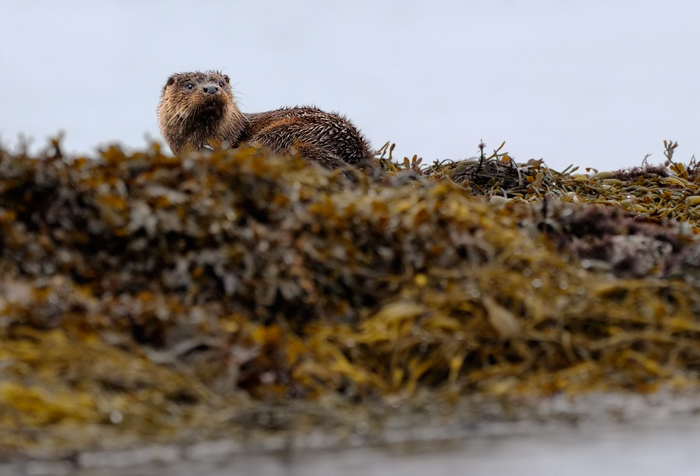
I’d had a fleeting encounter of a female Otter entering the water not far from her holt and as the clouds broke I chose to spend sometime there hoping she’d come back, but she didn’t.  The tide times on Mull were early in the morning, so on the next day, after that brief encounter captured above, I returned to the same place where I’ve had some good luck during my past visits. Although nothing is ever guaranteed with wildlife, and she nor her young showed the following day, and with the weather changing from overcast to rainfall I was confined to the vehicle for the rest of that day, searching in vain for Otters and other wildlife.

And it always seems customary for me while waiting for a subject to turn up,  a Stonechat always turns up in a lot of cases, gaining confidence and coming closer, in an almost curious manner to see what I am, which always makes me laugh.  They are a stunning looking bird and very inquisitive in nature, with care and respect, and no fast movements from you, they’ll come quite close to you, sussing you out, whether you are friendly or not, or maybe this is just how I perceive this during the long hours of waiting, who knows.

I was hoping to see some if not all of the deer rut on Mull, but I feel I was just a little late this year. I never witnessed any stags at all, which would suggest that they were all off feeding and building up fat reserves in order to survive the impending cold weather, as during the rut stags dont feed, instead they protect their ladies and territory from would be opportunists. After the physicality of the rut they go off to feed, and as there was no sign of any majestic stags roaming around, I was just to late.

I did have some nice encounters with female Red Deers though and the shot of the trip were these four females all looking at me.  I’ve called the image “game over” as literally it was game over as they’d spotted me and then moved but not before I got a couple of shots.  the shot below being the better of those, capturing that moment and briefest of encounters when they saw me, heard me and knew I was there, nice try.

Amazing to see them in this beautiful sighting of Mull, so close and in stunning condition.  I managed a few other sightings most of which were taken in dense woodlands where they love to hide, making it a harder prospect to photograph. This image below was taken in the early morning, showing such habitat.  Soon after she disappeared, as though she was never there.

On the last day I had one last steady drive around the island.  And among the choppy waters on that mornings hide tide was a dog Otter feeding and working the shore.  I left the vehicle and tried to position myself where I thought the Otter would come past. I managed to capture just one image from the most briefest of encounters on that wet and faithful morning.  The Otter was working the coastline looking for crabs and other food items.

Here he took a short cut over the coastal rocks instead of swimming around.  I just got him with this image, a blink of the eye and he was gone. Some encounters though are too special and live on in your heart and this was one, but lucky for me I had just one image to remind me of the closest encounter with a wild Otter that I have ever had in my life, amazing.

I stayed, hoping he’d reappear but again it wasn’t meant to be so I moved on to another Otter spot on the island. Whenever home time is looming or your packing up I find the subjects appear from nowhere and in an act of almost defiance they teese you knowing your time is almost up. After a short drive south, there was another dog Otter, and he was cleaning and grooming himself. Again only the briefest of encounters that I captured, but another wonderful moment in the life of a wild Otter.

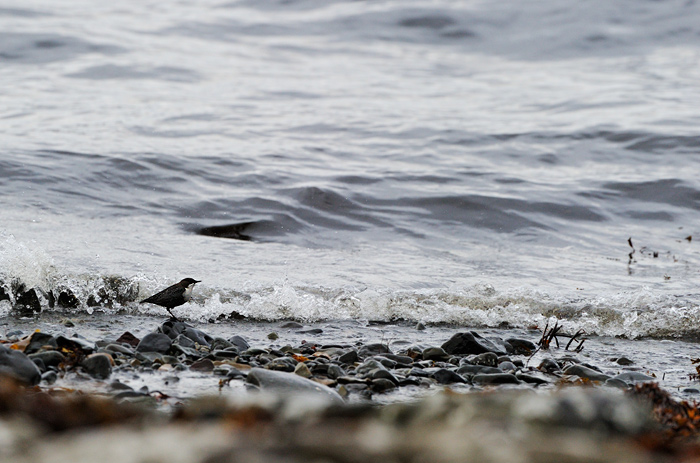
After lunch on the last day I saw a small bird feeding among the freshwater streams entering the loch, it was one of my favourite birds, the Dipper. It felt good to see them here and very different among the coastal waters of Mull.  The light had gone at the time but you can just see the little fellow below on the sea edge.

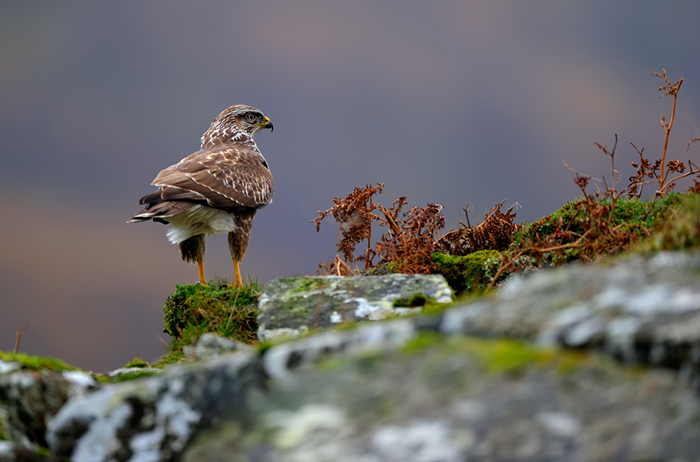
During my time on Mull the weather was testing at times, but it also offered a great deal in terms of atmosphere, with the sun constantly battling to break through the dense clouds to warm the land with its rays. In the distance a large bird was sitting on some rocks, appearing to be looking for prey, the wind was strong so the bird seemed happy just to try and sit out the windy weather that would zap his energy should he take flight, it was a beautiful adult Buzzard in amazing conditon.

Slow movements in getting my lens up and out of the window, placing the beanbag down so slowly you didn’t want to look up just in case the bird had flown, in this case he hadn’t.  One shot, two shots, relax and watch, I was saying to myself in my head, as Buzzards are very very shy in nature and one move to many and you’ll never see them again.

He took off, turned around and faced the wind, while jostling the strong winds, all the time looking below himself for food. The engine had been turned off at the first instance, the vehicle was on a slight bank which allowed the handbrake to be taken off and roll forward hoping to keep up with the Buzzard as he went from post to post looking for food.

He heard my camera, as captured above.  It killed me to stop but I did for a few seconds hoping he’d settle and not be disturbed by my presence that was my vehicle with me shooting from the window.  He carried on looking as the vehicle slowly rolled forward, enough to capture him full frame in all his glory with the image below. I couldn’t believe that I was capturing such a jumpy bird, with a clear background, fence line post and looking out to sea. He stayed for a minute or so before flying off, carried along on the wind and out of sight.

Soon after it was time for home and the long drive south once on the mainland. I am always amazed at the wildlife on Mull, the peace, the tranquilness of this place, where just sitting and watching wildlife live their lives around you is truly a wonderful thing to witness and be part of while on this island. Whether it rains or is baked in sunshine the wildlife always gives you the briefest of encounters into their lives, and if you capture them with your camera then thats great, if not they’ll always be in your heart and mind I say.

I run two trips to Mull each year, one in June and the other in October, our base will be the picturesque village of Tobermory, with its brightly painted buildings, overlooking the harbour of Tobermory and facing out to Calve Island and the sound of Mull. We stay in a great hotel overlooking the bay and I have 2 places left on each trip for next year so if you would like more information on them please click here to see my “Magic Of Mull” photo trip.

And before I go, I’m a guest expert in December’s issue of Practical Photography on sale now, a great magazine, full of advice, tips and gear reviews each month. One of my Barn Owl shots along with the tips and how I got the shot are included in this issue, carrying on my passion for showing how I work in the field at the same time helping others to take better photos.


Read full post

Always Inspired

Filed in Places Of Interest, Workshops on Oct.28, 2011

Inspiration can come in many forms and from many different avenues I believe, personally I get inspired by many different things, most of which are visual, where words dont need to be spoken, let the image speak for you and inspire those to see the wonderful world of wildlife and the subjects it supports. Over the last two weeks I have been working on my own projects at the same time working with clients in improving their own photography while seeing and witnessing that inspiration, which for me is nature.  Watching nature and capturing her beauty is a wonderful thing where I am at total peace,surrounded by her beauty.

Over the weekend I visited London for the annual WildPhotos 2011, a selection of the best photographers go through their work, how they work and tips etc which I find very inspiring and during the 3 years I have visited this event it never fails to ignite yet more passion in me. This year I had a nice surprise as the editor of the BBC Wildlife magazine, Sophie Stafford used one of my images, kissing Puffins so show the audience what the magazine look for when it comes to images submitted and different looks etc.

The image captures two Puffins kissing each other and going through their bonding process with the onset of the breeding season ahead of them. Nice moment as I sat there and looked up at this Puffin image, remembering the moment I captured them like it was yesterday. BBC wildlife magazine chose my image “Kissing Puffin’s for a full page spread in their June issue.

Last week I visited several different areas around the UK to photograph the annual deer rut, this year with the added warm temperatures and the warmest October since records begin it seems to have never really reached its peak, instead just slowly building with action and deer still calling and claiming their females as I write this.

I witnessed fighting, gentle young Fallow Deer learning their skills from their mums within the different habitats I visited from open grasslands to dense woodland that offered the deer a safe place to hide, making the process of finding them just that bit harder.

I witnessed some beautiful moments along with the males fighting for control over their females. I’d got into place just before dawn at all the places I visited, some I got really lucky at others the deer failed to show. One morning I was feet away from two fallow Deer’s stags fighting, t he noise of that smashing in to each other could be heard from far and wide such was the brute force. Then on the other hand I saw a young Fallow Deer following her mum through the thick cover only to become separated and disoriented.

The image below captures that special moment , soon after she caught up with her mum and everything was fine again.

Nature is wonderful to be around and spend time alongside where I am always inspired everytime. The places I go and also run my trips and workshops too always come up with something different and I am constantly learning more and more about the subjects or the environments and animal behaviours.

After my trip to London on Saturday just gone I had almost back to back one to ones in the Peak District, on my Mountain Hares workshop and then mostly in Norfolk for Barn Owls and two Spring tide days with the predicted high tides. Living out of my bag and just having time to charge my cameras batteries along with my own has been the routine but I love every minute. Helping clients take better photographs and learning more about their own equipment is something I pride myself on during the time spent with clients.

Over the three days we had a mixture of weather, sunshine, rain but on the hold the weather was kind to all my clients which is something I always wish for. As the dawn broke each morning the thousands of geese would travel in from their overnight coastal roost site and head inland to feed during the day light hours, before heading back out just before dusk.  The skies where full of calls,shapes,formations over our heads and it was amazing to witness. The dawn light was just amazing, with the cloud formations creating a very beautiful feel to those mornings with their shapes and colours.

The light was just stunning as the sky filled with geese and also waders during these spring tide days. Norfolk is famous for its winter flocks of geese, wildfowl and waders who begin to gather here to make their home during our winter months, amazing spring tides with thousands of Waders being pushed up the beach as the tide works its way in covering the mud and sand flats, submerging the whole estuary.

Once the majority of these areas have been consumed by the sea the birds are forced into the ‘Pits’ which are behind the beach where the RSPB have built a number of hides from which you can watch this amazing spectacle. Where large flocks of Knot, Dunlin, and Oystercatchers come into roost escaping the tide, forming great masses of birds as they all move and sleep in a synchronized manner.

The birds almost fly as one, one minute dark the next flashing silvery-white as they all turn one way their dark backs are facing you, then their pale undersides, in a show of coordination that is second to none, all without a signal or mishap. I have never seen any two birds ever make contact in all the years I’ve witnessed this beautiful site.

The only time you see them make any form of contact is on the ground when they hustle together shoulder to shoulder. The return to the mudflats once the tide starts to retreat is a less coordinated affair, but the smaller flocks still reward you with some fine performances. It can be a really quiet place most of the time, with the Waders feeding on the mudflats some distance away on the estuary, but on these high tides the place is awoken with a bang, bursting to life, and for me the place never disappoints, with so much going on it truly is one of nature’s wonders.

Once the sea starts to retreat it exposes the vast mudflats and this is when all the waders return back to feed on the rich food sources of the mudflats that make up this area of Norfolk.

On the last morning though the weather wasn’t the best,with overcast conditions, I took a few hi-key images that morning, capturing a different feel within the images. I covered this technique on my blog under photography tips sometime ago now, click here to read it.

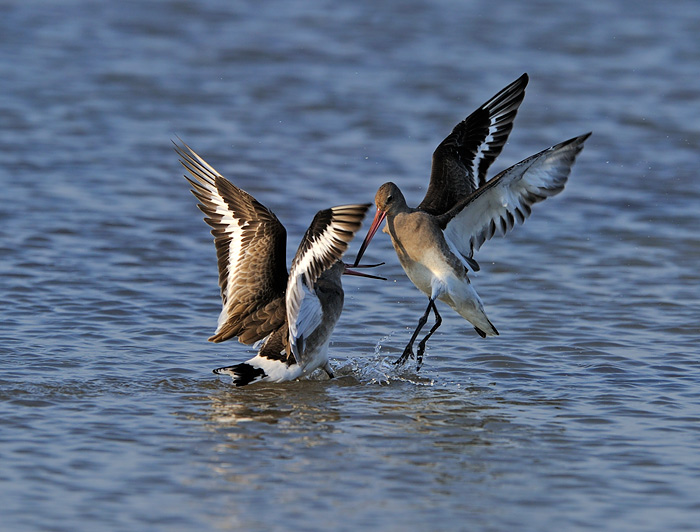
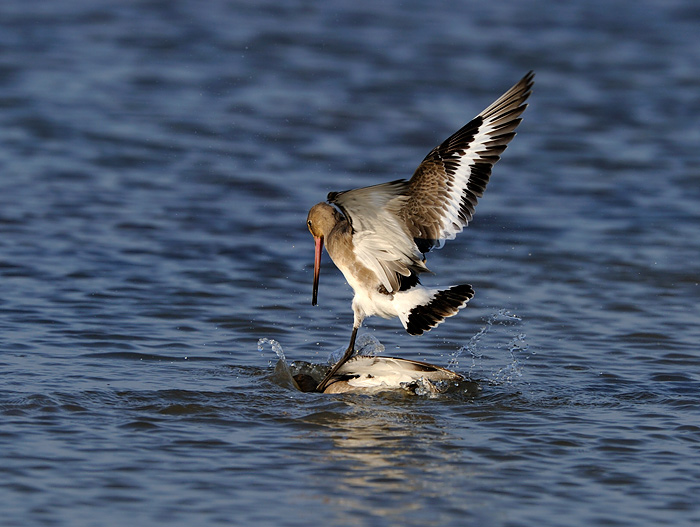
After our time on the beach we leave and head around the many places I know around this stretch of North Norfolk’s coastline.  From my first visit on the Sunday I had witnessed some amazing behaviour while watching some Black Tailed Godwits. From a hide we watched as different adults would be feeding one minute then the next warn each other off, or away from the food source they were feeding on. Most went their own ways and there was peace, but a few times that peace was shattered with some of the most violent behaviour I have seen in birds.

Each bird would try to drown the other, forcing their heads under the water, the bird that submitted would then escape as quickly as possible. It was difficult to witness as we all watched on the three days we were there, with each client being amazed at this action at the same time a little taken aback such was the level of aggression.

The following series of images will hopefully show you what happened during these hard to watch moments. Nature is so beautiful, but at times so cruel too, where only the strong survive, this was a perfect example.

Truly breathtaking behaviour to see and capture this was, the bird seen being moved off was unhurt be the ordeal of being drown so everything was ok in the end. On these spring tide or Norfolk days I run we always finish the days at one of the Barn owls sites I know there hoping to capture this most beautiful on birds at work, hunting.  The owls showed up for all my clients which was nice as the sun set and once in the morning light,showing just what a master they are at hunting and flying silently.

Know matter how many times I visit an area I never fail to be inspired but something I witness, there’s always a different take on what I may have already witness. Many different images to be taken because you just do not know whats around the corner when you photography wild animals, this has been and always will be my greatest enjoyment while observing nature.

A big thanks you to all my clients over the last week, thank you for your company and I wish you all the best within your own wildlife photography.


Read full post

The Beauty Of Wildlife-Calumet Manchester

Filed in Wildlife, Workshops on Oct.17, 2011

Where did the time go I asked myself as yesterday came to an end?  Two wonderful days showing eight clients ‘The Beauty of Wildlife’, firstly at Calumet Manchester in their brilliant studio/classroom and the second day out on the moors of the Peak District, Derbyshire, on my wildlife workshop in conjunction with Calumet. The aim of this workshop is to demonstrate the simple techniques that I apply to my own photography and to then share these with the group.

I demonstrated to the group how to approach their subject using fieldcraft skills without causing any distress to the animal, this in turn lets them relax, which will present you with the best opportunities to photograph their beauty, expressions and behaviour.

The first day was a mixture of talks, slideshow presentations and photographic tips and advice, followed by a cup of tea and biscuits.  After which I went through each clients camera showing how to get the best from each make and model in readiness for the second day out on the moors, where those tips could make all the difference to a well composed image while at the same time learning more from the wildlife that live in this part of the world. All the information and advice we discussed was contained in a handout I’d prepared for each client as seen above, this would help once the group had gone home to use as a reference guide.

Photographing wildlife in ‘the wild’ is the only real and true way of learning about behaviour and fieldcraft, so it was very important for me to show the group on the second day how I work and go about getting the images that I achieve, while working with subjects that are free to come and go as they please and have fear for humans, where you have to work the land and the environment to try and obtain an image, straight from the wild so to speak. The group was a great mix of people, from all over the UK at varying levels of competencies and were really good company.

We had some amazing light on the second morning of the workshop.  We met at 5am in the pitch black of the morning and there was a low lying mist, but above I could see the world’s atlas as I call it, the stars, so I knew this would clear as we made our accent. I had gone through some key elements to wildlife photography the previous day in my presentation to the group. One of those elements was ‘light’. Find it, work with, and create your image alongside what light you have.  So after a 40 minute accent in total darkness, guided by our small tourches we reached the area in which the grouse, hare and other wildlife of the Peak District make their home in.

Straight away over to the east the sun was just beginning to force its way up, burning off that surrounding mist and exposing a warm, wonderful glow to the area. I quickly saw a silhouette of a Red Grouse, let the whole group know and watched as they all used fieldcraft, slow movements and got themselves into place, went through the settings, checking shutter speed and so forth, using the key skills and elements I’d touched on the previous day.

The images above show that wonderful moment and all of the group had at least one image, capturing several elements that came together during the few minutes this grouse allowed us into his life. Light, colour, silhouette, composition and exposures all working together to produce a lovely and different image, what a great start to the day.  I couldn’t have asked for more for the clients. I wanted to try and capture some of the colours and shapes of the clouds during this amazing moment so I used a wide angle to try and focus on the bird while showing the colours.  He took off not long after and you can just make him out over to the left, very small in the frame with blurred wings. It gives you an idea though of the wonderful site the group had that morning.

During the morning we were all treated to many different encounters as the heathland and moors came to life. Grouse flying, landing, settling down on rocks to call and state their claim to a given area, wondering who these shadowy figures were at that time of the morning, moving around this beautiful and unique environment. Rain and mist came in afterwards, so we all took shelter and waited for the visibility to improve and for the mist to go away, which it did sometime later and the sun shined all day there afterwards.

The group followed the advice I’d given the day before on another real key element within wildlife photography, fieldcraft!  Approach with care, stay low, and see and read the signs on the ground in front of you, look for light and above all respect the subject more than any photograph. All the group were brilliant and got some amazing encounters and images through their hard work , ‘you only get out what you put in’.  This is the key.

After lunch the group were free to explore for themselves, put into practice skills and tips I embedded throughout those two days and it was really good to see them all going about their own work and capturing some lovely images with strong composition, good use of natural light and above all listening and watching wildlife to build a picture of whats happening around you.

Being in the wild really showed the guys how to capture images using fieldcraft and watching and listening to wild animals in their own environments.  This is the only true and real way people will learn this key skill I believe. When I met up with the bosses at  Calumet Photographic I stressed that I would only like to work among nature, showing people key elements you must learn and use to be able to photograph wildlife. After the two days I think the whole group enjoyed those two days, learning and benefiting so much this way, which is my main aim when delivering this beauty of wildlife workshop to the public.

A big thank you to all the clients for your time and efforts during the two days.  I really hope you got a lot from the days and learned something new. You were all great on the second day and looking back now you can see through the images you captured why the early start was so important to capturing lovely images of wildlife.

I have another two wildlife workshops planned in conjunction with Calumet Photographic, Saturday 21st & Sunday 22nd January and Saturday 10th & Sunday 11th March, with other ideas for the spring including a 2 day workshop in the beautiful county of Norfolk, photographing the spring coming alive with wildlife. More details will be posted on Calumets events site very soon and I will update my blog when they are finalized.

Also many of the workshop participants hired camera equipment on the day from Calumet which worked really well for the clients, so if you’d like to attend and hire your equipment then just speak to Calumet, Manchester and it can all be arranged for you when you turn up as their service is excellent. The same goes with the many wonderful workshops I run here in the UK and abroad where you can hire from your nearest Calumet dealer before you come on any of my workshops should you wish to hire. For details of prices and rates contact your nearest branch on the link here.

Calumet,  Manchester have a Autumn open day on the 9th November where I will be in attendance to help or answer any queries or questions about wildlife photography, they have lots of other things going on that day including a free camera sensor clean, special offers along with some brilliant companies offering advice and help. So if you are in the area pop in to say hello.

These workshops have been included in this months BBC Wildlife magazine as part of their photographic tours/trips, again for the second year running along with one of my favourite images of a Barn Owl hoovering and hunting as their main image, covering two pages 112-113 of the October issue, it looks amazing, or you can view online here and last years, where have the last 12 months gone.  Many thanks again to all the clients who booked, it was nice to meet you all and thanks for a great two days.


Read full post

Changing Times

Filed in Places Of Interest, Workshops on Oct.06, 2011

With temperatures touching nearly 30c over the last 7 days little more proof is needed of the fact our weather is/has changed over the last two decades. And over the last two years I have noticed a warm April and May then the so called summer months of June, July and August seem never to reach their target with regards to temperatures and sunshine. During the summer months when I was in Mull the locals told me of a real wet May, washing away a lot of the birds’ nests, both ground nesting and higher nesting birds having water logged nests.  Fast forward, the warmest September for many years, with the start of October being brought in with sun worshipers wearing swimwear around our coasts.

Many experts have their own ideas to what is causing this but there can be no more firmer proof than in the Polar Regions. Climate change is having a greater and faster impact on the Arctic than previously thought, air temperatures in the region have on average increased by about 5c over the last 100 years.  Change to the way humans live their lives is needed, with population growth worldwide exceeding beyond space.

During the last 7 -10 days the number of items of clothing you apply when working outdoors in the cold at this time of year has slightly been put on hold, instead the summer order as I call it has remained way pass its purposed shelf life within the natural seasonal calendar.  Visits to Norfolk were bathed in sunshine and felt more like a Spanish holiday resort.

Closer to home in the glorious sunshine I have been working on a few subjects, the Short Eared Owls have arrived, coming down from altitude to feed during the winter months around low lying moorland and marshland. I have been lucky enough to have some good sighting over the last couple of weeks of this beautiful owl within the habitat.

With the harvest now having been collected and gathered in by the farmers its left the fields slightly exposed, which helps when trying to find Brown Hares, as the low height affords these mammals no or little cover once they leave the safety of the hedgerows and small pockets of woodland they use as cover. I spent a couple of mornings, dressed head to toe in camo gear stalking, covered in sweat once the sun had risen due to the temperatures. A couple of lovely encounters here from the different days.

The deer rut is an event really just starting now around the country with Autumn upon us.  I have already been out a couple of times, once with a client on a one to one and the other on my own, and its still not really started in great earnest, almost like the calm before the storm.  This year I will, like last year visit the different places around the country, finishing in Scotland hoping to capture different images and angles to this wonderful event in the natural world.  I am also hoping to do a short film for Phototraining4U covering my day from dawn till dusk on this event, so lots going on.

Hopefully over the next several weeks I am able to capture a few images of this event and post them at a later date. I am looking forward to meeting the folks who have booked onto my Beauty of Wildlife two day workshop in conjunction with Calumet Photographic. I will be presenting a few slide shows, talking about some key elements to wildlife photography, then going through peoples cameras and settings in readiness for day two out on the moors of the Peak District.

The second day we will be capturing the wildlife that live in this area, at the same time helping each person to improve their own wildlife photography. Learning fieldcraft in a wild environment, which is the only way people can truly see what skills are needed to approach an animal that’s not use to humans.  I will update my blog after this event which I am really looking forward to.

I am just testing out some new and amazing slideshow software I have for talks and presentations and thought I’d share this first example with you.  I’m still working on different things but it gives you a flavour of what I plan on doing, hope you enjoy this short film.


Read full post

Wildlife Photography-Helping Others

Filed in Advice On Wildlife, Photography Tips, Workshops on Sep.30, 2011

I have just returned from the Welsh capital, Cardiff after two wonderful days filming for the online training company PhotoTraining4U. The site offers quality training for all photographers at an affordable price. The site is based on streaming video that capture photographers at work. PhotoTraining4U is aimed at both professional and amateur photographers alike and is structured into bite size learning films, over 800 at present, each around 20 minutes.

On the first day we went through where and how my love of wildlife, nature and photography began, forming the great passion I have for the natural world today which is the foundation to my work and images. The second day I was out among nature, my office as I call it, watching and looking at the beauty of nature all around. The beauty of photographing wildlife is that it is always changing and evolving, encountering the unexpected and in this environment the photographer must learn to work with these changing environmental conditions and behaviours.  The result cannot always be predicted, which makes fieldcraft one of the most important skills you have to learn to be fully connected to wildlife.

I always try where possible to work the land as I put it, and stay away from staged or set up shots where bait is placed out while you wait, preferring the more natural image, as seen or shot when I encountered the subject, not changing an animal’s behaviour to obtain an image. You just never know what will turn up working in this manner, so being ready to capture what you see is key through composition, fieldcraft and the correct camera settings.

I have always loved helping people and when I first started in wildlife photography this carried through. I know how hard it is to get help or advice when you are first beginning to take photos of wildlife, what works?  What bag to buy?  Is this lens any good? What camera settings? the list goes on.  Emailing professional wildlife photographers asking for help or advice most of which never return your email,  so because of this I like to show others the techniques I have taught myself, what works and what doesn’t while on the ground, in the theatre of wildlife.

During the first day Mark Cleghorn, Director and founder of PhotoTraining4U went through several interviews with me on film, going back to the beginning, where it all started which was fun.  As I was talking I was reliving some of the funny moments I could recall, the tiny things that made all the difference, which all set me onto the path today.  We went through some of my images where I explained the motivation behind each shot, how and why I captured the images on show while being filmed, which was very new to me as I am normally behind the camera a lot of the time, when not working with clients on various workshops and trips.
That evening we went to a local marshland area not far from Cardiff town centre, this for me was perfect to go through some basics within wildlife photography.  I had not visited this area before and upon arriving to a new site I wanted to demonstrate that you can always witness something within wildlife.  A saying I have said from the beginning of my own work is that there is always an image to be taken no matter where you are.

When I arrive somewhere new I always look for the light and get a feel of the place, where the wildlife is or may turn up, direction of light, possible different images and so on, I find my brain is almost scanning around and presenting me with choices in an almost automatic way, if that makes sense?  While the photography was going on, Jay the cameramen was filming and I was explaining what I was doing and looking for, giving useful tips and advice. Both Mark and Jay where brilliant in helping me to relax in front of camera and I think my sheer passion and true love of wildlife carried me through.

That evening we all went for a lovely meal and I got to see the passion and resolve behind the company and I was very impressed with all of the team and their future plans. Then it was back to my hotel in readiness for the early start and the amazing light I was hoping for.  Mark had found a place not to far again from the town centre which was surrounding by housing, a little oasis within the urban environment which supports many different species of wildlife.

We wanted to show and demonstrate that when you are just starting out or have started out that wildlife is everywhere, lakes and marshland/grasslands are everywhere around the UK, ‘green lungs’ as I have called them in an early blog posted a while back now. These areas have often been left to their own devices, brimming with wildlife which makes a great addition to the urban habitat surrounding them, which can be photographed in close proximity to where you live, capturing those moments with your camera.

Both Mark and Jay came with me on that early morning start, after the first days interviews I had told mark of my affection with cold toast,so it was a nice surprise to see two slices prepared and wrapped up in foil as I was picked up, which was really funny and made me laugh in the darkness of that morning. When I arrive in a new place that I have no knowledge of, I always find myself looking around, smelling the air and really trying to build a picture in my own head of what’s going on around me and tell tale signs or clues to what wildlife may or may not be around.

I always find east with my compass, knowing where the light will come from will really help in capturing images in the morning light. I had a look around the lake, worked out where I’d like to settle and got myself into place and all set up for the rising sun, which had slowly started to creep up before me. Jay and Mark set up their cameras and again just left me to it and started to film and photograph me while at work, as I explained all the time what I was doing, looking for ,camera settings and so on.  The light was amazing, calm water with no ripples giving you that affect that the birds, in this case Mute Swans were floating in space.

Swans are big and powerful birds that are really beautiful when you take a closer look. They have a calmness about them if left alone which shows off their great elegance and beauty.  I wanted to capture that beauty within these images as they calmly drifted effortlessly around where I witnessed at times them closing their eyes and sleeping. Such gentleness and calmness I saw and that I hope I have captured with these images.

These Swans kept me company throughout that morning coming in close to see if they would be fed, then retiring to a safe distance should I present some bread or other food for them. I didn’t use any food as I just wanted the birds to come and go as they wished, even though they had a slight tolerance to humans they were still wild animals and free to come and go. As it happened I captured some wonderful moments using my trusted long lens and much loved wide angled lens which is perfect for wildlife and getting those wider shots I love seeing and photographing.

I spent a good several hours around the lake and surrounding area that morning and had some wonderful moments, making several short films, all explaining my craft for PhotoTraining4U. I will be going live on the site in January 2012 when I will officially join the site as one of their masters, covering my passion of wildlife photography for them.  The films I’ll be shooting with the team will follow me as I work the land, from dawn to dusk.  I will showing members how I work, photographing wild animals within their habitat, showing their different behaviours and characters within photography.

I had a really good time, big thanks to Mark, Jay and the rest of the team.  Thank you all for your hospitality and warm welcome, and I look forward to working with you guys. As I mentioned I will be going live on the site in January 2012, becoming their master on wildlife photography. Where all the films I will be making can be seen on there website, so if you’d like to know more information then visit PhotoTraining4U’s website or email me direct here.

And just before I go I heard back from the British Wildlife Photographic Awards – BWPA last week and my short-listed Red Grouse image in the Habitat category was beaten by a Red Grouse wide angled shot, almost the same as mine, without the light, so I was a little gutted there, the winning image there was amazing. I entered some amazing images captured in the wild but they didn’t get anywhere, with alot of images doing well from set up sights which aren’t the same as finding the image through your own hard work in my eyes.

It really puzzles me to what judges are looking for within a wildlife photograph for a competition, where it comes down in the end to the photographers integrity to disclose the facts of the shots, that can be judged alongside the image. Good luck to all those who won or where commended. Here is the image, 15 minutes crawling forward to capture this male Red Grouse calling down the valley which was covered in morning mist, shot with a 24-70mm wide angled lens

And one of my favorite images entered into the same competition, two Great Crested Grebes going about their courtship, captured here swimming alongside each other in a show of affection towards each other.


Read full post