Entries Tagged ‘Craig Jones Wildlife Photography’:

Snowy Spring

Filed in Spring, Wildlife, Workshops on Apr.10, 2012

Spring time for me is the best time of year.  Wildlife is everywhere and bird song fills the air, even more so over the last several days, waking up to several inches of thick snow on the moors of the Peak District.  I thought this maybe an April fools too far. During the last ten days or so I have enjoyed the very warm temperatures of spring whilst in Norfolk and other places around the UK running my one to ones and also my own project work.

Great Crested Grebes, Brown Hares, Barn owls and many more species all settling down, starting to pair up and begin a family at this wonderful time of year. I had a one to one in Norfolk and really enjoyed showing my client around. We captured some wonderful images of Barn Owls, Brown Hares and waders during the day and Ben wrote a lovely blog post with some great images which can be seen by clicking here

“You couldn’t make it up if you tried” first came to mind, as I had two one to ones booked in to photograph Red Grouse on the moors, the heavens opened and inches of snow fell. Some roads in and out of Buxton where closed so it was really touch and go on whether the days went ahead. I made contact with both clients as a blanket of thick snow in early April really is unheard of.  Also very worrying for the wildlife sitting on eggs and trying to breed/mate while the weather was plunged into freezing, wintery conditions.

Both of my Red Grouse one to one clients where great sports and both days went ahead as planned. The first day was a little tougher due to the snow being at its highest from the previous day’s downfall. We had to walk in places knee deep in snow as we ascended in darkness to where the grouse live and play out their lives among the higher regions of the Peak District.

Walking through thick snow with heavy kit bags does get you warm. Full credit to Steve though who knuckled down and was rewarded for his efforts with some amazing encounters of both male and female Red Grouse, the words “you only get out what you put in” ringing around the place as we sat down and drank our cups of tea some 600 meters up above sea level.

I always tell clients that the best way to see and in turn take your photographs is just sit and watch, read and listen to nature, she will tell you what’s around and what is happening. Never force anything and never go with a shopping list of shots you wish to capture. Adopt this approach along with care and respect for your subject and you get some wonderful moments into a wild animals life. On both days both clients did just so and had some lovely encounters with this iconic moorland bird that is so at home within this sometimes unforgiving habitat.

Rival males posing to each other and fighting over their females, trying their luck. We even witnessed a grouse having a snow bath. Cleaning his feathers among the deep snow. Animal behaviour is amazing to see and capture and I showed some key techniques and fieldcraft which enabled both clients to read a little more into what was happening, in turn resulting in lovely moments where we came close to these birds on so many occasions, peering into their world through their eyes. This always has a deep and long lasting impact on me, making that contact with nature is priceless.

The weather on both days started well but became foggy on the second day but again the grouse came close and carried on with their lives around us which was magic and true, real wildlife photography for me. Blending in, using what’s around you and just watching and working the land. Thank you Steve,Nigel also Ben for your company over the last several days and I wish you well in your photography.


Read full post

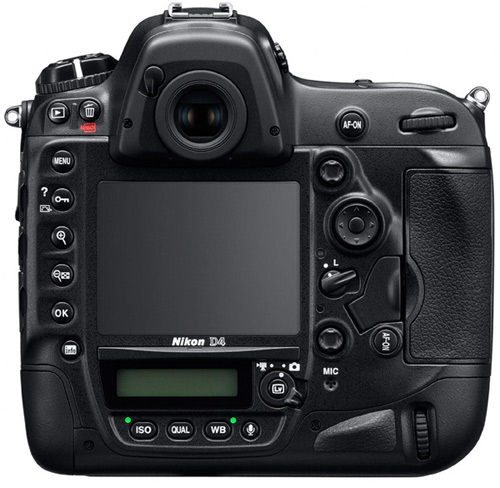
Nikon D4:Just Brilliant

Filed in In the Press, Spring, Workshops on Mar.27, 2012

I’ve now had the Nikon D4 for just over a week and in that short time I’ve used the camera photographing my own work and also on one to ones, and I have to say the camera has performed very well.  Having had the Nikon D3s now for two years, it was always going to be a hard act to follow. The improved ISO and added megapixels are nice, but what’s even better is the improved ergonomics, controls, speed, autofocus, metering, illuminated buttons, processing -EXPEED 3, and video capabilities with the full HD-SLR which are all improved from the D3S.

The overall shape of the camera has not changed much from the D3s, however, the controls and ergonomics are a bit different. The Nikon D4 now provides better control when the camera is used in the portrait orientation which is great if you shoot in this orientation a lot like me. The joystick and auto focus control is closer and easier to manage now when held vertically, with the D3s you had to really reach over with your thumb to get to the joystick. The Nikon D4 is about 5% lighter than the previous D3s and placed alongside each other this difference is clear to see.

Nikon has improved the auto focus system drastically. It can now operate in much lower light; this is a huge advantage, especially for wildlife and where I am depending on my auto focus system in low-light situations to capture what I’m witnessing. The D4’s auto focus has faster accuracy over the D3s from my first findings, performing brilliantly in poor or testing light.  The image below of two Canada Geese taking off in the first rays off dawn light demonstrates this perfectly in very testing light conditions.

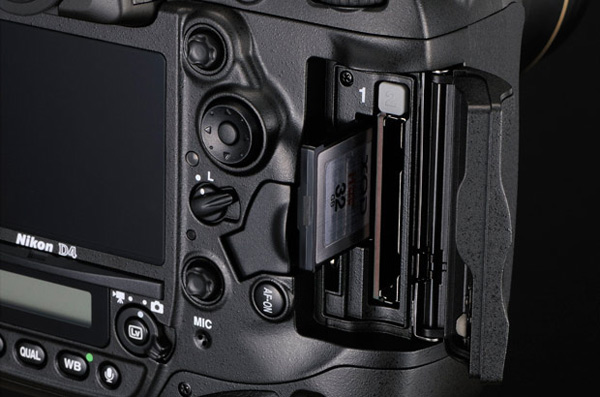
Clean, smooth and quick is how I’d best describe the auto focusing on the D4. The buffer is very big too compared to the D3S and starts to fill up while shooting in 14 bit Tiffs around 90-100 images when auto focus is engaged. But when using the new Sony XQD memory cards they fill back up very quickly and your able to carry on shooting. I have never been one to blast and hope for the best. I prefer to let a couple of shots go, recompose and see, always watching what the camera noise does to the subject, as I hate making the wildlife jump and scaring it into next week.  The quiet mode as in the D3S has been retained on the D4 and seems more improved.

The D4 has two slots, one for the XQD card and one for the Compact Flash which is something I don’t like. For me they should have chosen two XQD cards as I believe this card from what you read is the future. Having two card readers is a pain, once your home you have to use two card readers to download your images which could have been averted by just picking one card for the camera only. Downloading is quick and I use Nikon software all the way- Nikon transfer, View NX then I do my processing in Nikon Capture NX2. All of which have a new version to accommodate the D4.

From my first images at higher ISO’s there does seem a more improved image from the D4, more so at the higher ranges. I don’t really push the ISO past 4000 alot of the time as I want to try and retain as much quality in the image as possible. But even at 4000 the performance of the D4 is better than the D3S at the same time there’s not a massive difference and I wouldn’t be selling my D3S as that camera has not missed a heart beat in over two years and has earned its brilliant reputation. The two images below from my Great Crested Grebes project were taken with my D3S clearly showing the quality of this camera.

The following images of Red Grouse were taken at high ISO’s, the sun’s light had started to warm the moors here, making conditions for auto focus tricky normally but here again the D4’s AF system locked on in tough and challenging light.

The D4 all round is a vast improvement on the D3S camera, it wont make you a better photographer though but what it will do is give you more options in various testing conditions that you may find yourself among while shooting wildlife. I am still learning about this brilliant camera as in just over a week does not do the camera justice. From what I have seen on the back of the camera and later on my large screen the improvements are good, very good. The auto focusing is one of its biggest pluses from the D3S and I cannot praise Nikon enough for the improvement they’ve done here. The video is good quality and I will be doing a separate blog post on that soon.

I am still learning about the D4 each time I take it out, but from these early stages all I can say is its “just brilliant”. The Internet will be a wash with reviews about this camera by more qualified people than myself all calming many different things. All I can say is make your own mind up like I have, the camera is a marked improvement on the D3S I know I have shot with the aforementioned camera for two years and still do.  This post is not meant to be a whats right or wrong, its just about how this camera has worked for me on the ground, in the theatre of wildlife a place I live and breath.

Thank you to my clients over the last week or so who have seen me test out my new camera, really nice to meet you all. Steven from Ipswich sent me some lovely words below that can be seen on my testimonials page –

Hi Craig I would just like to thank you for my two days one to one with you, it was fantastic on both days and I did really enjoy all of it. I love the way you had so much respect for the wildlife and how you put all this into your photography skills in which you was so kind to pass on to me. It has give me a better insight into the way I need to work , approach and take the final shot simply just by watching and listening to what was around me, like when you told me about the geese were going to take off before they even beat their wings, brilliant. Once again a big thanks and I would highly recommend anyone for your one to one it was agreat pleasure. Regards Steven

Before I go I would like to thank Adam from my press agent for getting my Owl images out into the papers over the last week. Many months of hard work were put into these images, capturing moments I’ll never forget. Barn Owls flying towards me, Short-eared Owls flying feet away from where I was hidden, diving for food right in front of me, all just amazing moments.  You can see the story and how much work and the lengths I went to here in the Daily Mail and also here in the Sun. I also made the Telegraph newspaper all the same week so again many thanks Adam as it’s always very nice when you see your work in print.

Also in April’s issue of Nikon’s N Photo magazine my Dartford Warbler image made their “In pictures :Inspirational Nikon photography from around the world” section. Click here to see the article and see one of my favourite photos of a male Dartford Warbler singing in the morning light, stunning birds.

Its an amazing time of year now with Spring well and truly awoken and the start of British Summer time at the weekend. Make sure you enjoy her beauty and capture it with your cameras, good luck.


Read full post

Bird Watching Magazine

Filed in In the Press on Feb.23, 2012

I make no secret on my website of my great passion and love for owls, they are so beautiful to watch as they go about their lives. From the days when I was made to wear my knitted woolly hat that my mum had made for me, before I ventured out.  Owls have always fascinated me.  I cannot put into words why I love this species of bird so much, I’ve grown up with them, consider them an integral part of my life.

Over the last four months there has been a great number of Short-eared Owls around the country, giving many people close encounters into their normally secret moorland lifestyles during the breeding season. Where there are Short-eared Owls you will often find Barn Owls sharing the same area and also many other raptors, none more so than at the Dee Estuary.

I have visited this area for many years and if you get lucky on your visit you can be treated to a bounty of raptors. The best days are at high tides where alot if not most of this reed bed and marshland can be covered with the approaching sea water. You can have some wonderful views of all these birds, but I have also been many times and seen very little. When things come together though its one of the best places to see all of these raptors in one given area.

In March’s issue of the Bird Watching magazine there are several pages of my images and wording describing this powerful event in nature’s calendar, one that often leaves me shocked and upset at the things I witness, but at the same time I realise this is Mother Nature at her best and worst all rolled into one.

If you would like to read the article then click here, and my thoughts are expressed in the text and through the images printed in one of my favourite magazines.  I hope you enjoy the article. Thank you to the guys at the Bird Watching magazine for doing such a great job on the article and layout.


Read full post

Take Nothing For Granted

Filed in Animal Behaviour, Spring, Wildlife on Feb.12, 2012

What a difference a few weeks makes and always be careful what you wish for. In my last blog I was only just saying how mild it was for this time of year and how wildlife has almost started making a home in readiness to rear their young. Cold temperatures and snow with freezing fog and frost all mixed in over the last several days, giving nature the worst kind of wake up call.  You must never take anything for granted more so nature as this just may come back and bite you when you least expect it.

Grabbing my camera on one such day I captured a few images of the birds from my local park , looking for a different angle in which to capture the bird’s spirit.

Once the roads had cleared a little I did manage to visit the Peak District with Paul my client where we were hoping to see Red Grouse.  The snow was also a wonderful bonus, as it had fallen covering the whole area in a beautiful blanket of snow. Thank you Paul for being a great sport in such testing conditions when walking up to where the grouse were.

I have just spent a couple of days in Norfolk photographing a much loved event in nature’s calendar, the Spring Tides. I’ve written so much about these days and had articles published showing my images. It was nice to be back and witness this event over the last couple of days having not been to Norfolk since November due to work commitments. Little did I know what was waiting for me in Norfolk, as I set off for this event from my Staffordshire home in the early hours of the morning, with the weather changing constantly as I passed through the different counties on route to Nelsons County, Norfolk.

You park up and get dressed ready for any event the weather may throw at you.  Snettisham and the surrounding areas are open and very bleak where great care must be exercised in poor weather. Once in place depending on the tide times your normally greeted with a fanfare of calls, sometimes if your timings are spot on the sky can be awash with actively too as flocks seem to wiz by you, feet above your head, drowning you in a vast chorus of noise and calls as they whistle past.  It’s a truly remarkable feeling and one you just never tire of witnessing in whatever weather or conditions.

A mixture of different light conditions and weather gave me a chance to play around with compositions and shutter speeds, giving a different effect and feel to my images. The slow shutter speed images are something I have always loved to do when photographing wildlife.  I like to refer to this practise that I am so fond of within my work as capturing the animals but in slow motion. Freezing a moment in time, giving the image a sense of movement in the absence of any sound is what I hope to achieve by using this technique.

I mentioned their sound and if you could hear the noise generated by these birds during these spring tides it would mesmerize you, it’s so uplifting to hear.  A bird adding a different key or note, I always like to try and listen then listen again to hear those individual bird calls because if you view the flock as a whole it’s hard to make out which birds are there and which aren’t.

This part of Norfolk is always bleak and remote offering you a great platform in which to view this amazing spectacle. Different days offer different images for me, where I am always trying to capture something different, learning from the past visits here. On the whole it was a good few days with many lovely images, once the peace returns and the tide begins to retreat the waders start their return back to the mudflats. When it gets to this point there’s always the queue to leave and I go back to my transport for a warm drink and often to dry off.

There are several areas in Norfolk I have regularly visited over the years to watch and hopefully photograph Barn Owls, and I was lucky enough during my recent time there to have seen two pairs at two of the four locations I know of. The others maybe there but the weather may have played a part in them staying in rather than venturing out. Again as previously mentioned I am always looking to push my own photography when I am alone and not with clients. Seeing something different and then trying to capture that idea with my camera.

This is one of the main parts of photography that always excites me, as my arty streak in me comes out and working alongside your cameras abilities you can often capture something different. With the few sightings I witnessed of the Barn Owls I tried different compositions, manual focusing, and extreme positioning of the subject in the corners of my viewfinder, creating lots of blank and open spaces to the front of the main subject.

Norfolk’s also a great place to for Brown Hares and I came across a few during my time there, wonderful mammals to spend time with and watch.

Many different images from the various different weather conditions that I’ve endured and as I write this blog there are still areas of the country where snow is around, but in the coming week the temperatures are set to rise so maybe nature has seen the last of winter now but I don’t want to speak to soon as before. On a serious note I do hope wildlife hasn’t suffered to much during the recent cold spell and fingers crossed spring is just around the corner.

Tigers around the world need help, they are crucially endangered, with their numbers in the wild at a dangerous level. Upon first seeing these animals in the wild it reddened me speechless because of their amazing beauty. They cannot just be left to die out with just a few remaining in zoos and parks. A world devoid of wild Tigers would be a very sad place indeed.

Through 3 limited edition prints I raise money to help these beautiful animals, where 50% of the profits from the sale of these images goes directly to 21st Century Tiger. They spend every penny on saving this most beautiful of animals we have roaming the earth at present.  In several weeks I return to India once more hoping to share my passion for these animals with my clients booked onto my Tigers of India photo tour. Each one has a dream of seeing these animals and along with the brilliant guides I work with there I hope to show and help each person capture some wonderful images of this amazing animal.

I am donating one of my 2010 Year of the Tiger images as the first prize in a photography competition for another UK Tiger charity called TIGERS4EVER.org. It hopes to raise awareness of the plight of the Tiger in the wild. The print is only 1 of 100 ever printed and will be the first prize in this competition. Calumet UK  are very kindly supporting Tigers4Ever’s 11-16 age category photographic competition also with a 1st prize of £100 Calumet gift vouchers.

If you are interested in entering and helping this charity where all monies raises through this competition goes towards helping Tigers then please click on this link http://www.tigers4ever.org/ many thanks and the best of luck.


Read full post

The Power Of Nature

Filed in Wildlife, Workshops on Feb.02, 2012

There is a real air of spring around at the moment among the UK countryside, with the odd spell of frost or even snow on the higher grounds, just to add to the confusion for nature. 2011 was one of the warmest years on record with lengthy periods of warm weather each month right up until the end of the year. In with the New Year and again those mild, warm temperatures seem to be still with us with little promise of the cold spells we’ve had in previous years.

On the ground nature is confused, the sudden warming temperatures for this time of year is playing a cruel game with nature, one minute warm the next an overnight frost. You can see and hear the birds singing to attract a mate, defending their territories with great cause. Dippers displaying and starting to gather nesting material, the countryside really feels like it should be much later than it really is due to the influence of the warmer weather.

Mother Nature is powerful though and animals and plants will overcome and survive.  I believe as nothings is as powerful as nature. While being among wildlife you get the impression that you’ve missed something or they have, what I mean is by watching the behaviours of the wildlife its seems that winter has been by-passed and were heading straight into the season of spring. I really hope that the cold spells of weather that nature has endured in 2010 and 2011 wont now come along and catch the wildlife out as that would be one of the cruelest lessons in which to learn from.  However, I fear that this could happen quite soon.

As each year passes and we hear that a warming record has been broken, or nearly broken again, it provides further evidence that unfortunately we are not just seeing a natural cycle of global warming, but instead humans are having an effect on the climate. I am not qualified on paper to start debating what is right or wrong I just know on the ground among wildlife things are changing and I do hope nature won’t be caught in between these warming temperatures and strange happening among the seasons.

Over the last three months though there has been one bird that seems to be doing really well within the warming temperatures and that is the beautiful Short-eared Owl that seems to have invaded many areas of the UK feeding on the bountiful supply of rodents. The internet is awash with brilliant images showing this often rarely seen owl outside of the breeding season. Recently I have spent back to back days there trying to capture different angles and images of these stunning owls.

Over that time the owls are late risers and rarely come out before the early afternoon but I go there at dawn and wait as you never know what may happen, as the site has other birds of prey. Fortune often rewards me and I was lucky enough to see a lone Shot-eared owl hunting in the morning light. I’d located an area in which these ground dwelling birds roost overnight and then just suddenly appear in the afternoon. I set my gear up overlooking this area, not to close to disturb them, placing my converter on my long lens as I waited.

Often the periods of waiting were greater than the time I’d see them but for me it’s just the enjoyment of being around wildlife.  That’s enough for me anything else is always a bonus. I often say I could sell all my camera equipment tomorrow and still be happy sitting and watching with my binoculars.

I have witnessed them diving for prey, perched in the morning light, and hunting in the pouring rain, which is very rare to see.  This is a costly exercise for owls as they don’t do well in rain. As I witnessed this it does pull on my heart strings as you just know that owl is hungry and gathering enough food to stay alive.  It was tough viewing this.

I also have had some lovely encounters with a pair of Barn Owls that have lived in this area for some time now. They appear when they want to and unlike some Barn Owls I photograph in Norfolk they are rarely seen in the day. They don’t have any routine here and this Barn Owl came out as the sun was setting and gave the whole area a lovely warming glow and feel, which is a welcome relief if you have been there since before dawn. You have to use fieldcraft skills and patience when photographing owls as they sometimes fly past you, and in this case straight at me.  Another amazing encounter as the sun was setting.  I am really lucky to see and witness this.

Their hearing is one of the best in the animal kingdom so great care when you start to shoot is needed otherwise they will bank off from where they hear that noise, in this case the camera shutter, so hold your nerve and wait and then press when you’re happy.  I’ve seen some wonderful behaviour in both the Short-eared owls and this pair of Barn Owls recently that I have tried to capture within these images.

After the success of my previous wildlife workshops with Calumet Photographic I have several others now lined up on their seminars page. Two dates for the amazing Spring/Summer Tides in Norfolk covering this event which has captivated me for many years and Sping Time on the Moors in the Peak District. For those that live in and around the capital, London, I will be doing a two day Beauty of Wildlife workshop at Calumets Drummond Street branch on April 14th and 15th. These workshops are open to all skill levels and backgrounds within wildlife photography.

The workshops are designed to give you the best opportunities to take the best images from your day in the field whatever nature throws up. To ensure that everyone’s needs are met the workshops are limited to 8 participants. You’ll be in good company, sharing your ideas, images and love of photography amongst the beauty of wildlife.

You’ll take your photography to the next level and in the process you’ll immerse yourself in your photography and I will be right there giving you a personal photography lesson. For more details click here to be taken to Calumets seminars page, then either click on the Drummond Street branch in London or the Manchester branch to see the full list of wildlife workshops that I am doing in conjunction Calumet Photographic.

Many thanks and I look forward to seeing you.


Read full post

Magical Moments

Filed in Wildlife, Workshops on Jan.20, 2012

During the last several days I have been busy working in my office, the great outdoors, as I call it, amongst nature which is a place I find great peace in, capturing more magical moments. With a couple of one to ones in the Peak District, and a visit to the SWPP conference alongside PhotoTraining4U who had a stand there, my other free time has been put to good use watching and looking at the several subjects I am hoping to photograph this year.  It’s always enjoyable at the same time very time consuming setting up your own work from scratch.  But when it works and you see the subject(s) and capture them going about their lives it’s the best feeling you can possibly have as wildlife photographer.

I have been lucky enough over this time to have had some wonderful close encounters once again with different wildlife, the Short eared Owls are still very much around, hunting in the late afternoon sunlight.  They normally stay at sea level until around late February to early March, but with the warmer temperatures they may just disappear at anytime. They are also very nomadic out of the breeding season and once a food source has dried up in the area that they are staying in they just leave without warning and find another vole rich habitat in which to spend their winter months before returning to their spring breeding grounds.

A Kestrel hovering right above me in the first rays of dawn light was one such magical moment. I got into place just before dawn, hid myself away along a natural gully and waited, as the sun’s rays began to warm me I heard Magpies and Crows calling which can give you your first clue wildlife is around. In most cases they call when there’s a bird of prey around hoping their calls and mobbing behavior will somehow move that bird on. I watched this Kestrel, hunt, then back track on itself, covering the ground in a sweeping motion, doubling back on himself to cover every inch.

He carried on coming forward, searching in vain the grasses and reeds below him, those same reeds that were sheltering me. He then hovered right about me, and in the still of the morning I could just make out his faint wing beats as I watched and captured that moment with my camera. We made eye contact, watching each other which always has a deep impact on me, a powerful feeling I cannot explain. Those briefest of moments are captured here with these images shot with my 1.4 converter on. He stayed for around 15-20 seconds then went. He’d heard me and as I am writing this blog I can see him looking down at me, remembering that moment as though it was seconds ago, that’s the power of nature.

Barn Owls are without doubt though one if not my favourite UK birds, and I have enjoyed lovely moments too over the last several days with these beautiful owls. Only recently I have read with great interest a report on how they hunt. Having been fascinated with this bird from childhood I’ve learned a lot about them and their feather structures having taken them home with great interest having found them on the ground. The way in which they hunt or quarter and their heart shaped faces have always amazed me, the heart-shaped face works in a similar way to humans outer ear , collecting and directing sound toward the inner ears which helps this amazing hunter do what it does best, slightly glide over land hunting in almost pure silence.

The report has found that each of a Barn Owls ears is a slightly different size and shape, and one is higher on the bird’s head than the other. The owls can analyse the differences in the sound received by each ear to automatically calculate the exact position of that sound-source. Which means that they can detect prey below them in pure darkness and hunt with great effectiveness and stealth. In most parts Barn Owls hunt in the dark so visual information is not possible, so their hearing really is their lifeline. Flying in silence helps them listen for movement, prey that’s moving.

Most if not all of the owls plumage is covered in a dense covering of feathers, those feathers produce more lift with each beat due to their shape and design, having a high curvature. This design allows the air to pass through and they offer little turbulence, reducing friction noise between the feathers. The end result is one of the most prolific hunters within the natural world. And the report suggests in time the structure of the Barn Owls wing may provide a guide for the design of quieter and more efficient airfoils for the aviation industry. Proving yet again that so many designs of man-made products are derived from the wonderful world of Mother Nature.

Barn Owls are amazing and they are just so wonderful to watch and photograph, the following slide show shows images taken over the last three years, from several different sites, showing these amazing birds of prey hunting and flying on the wing, I hope you enjoy it as much as I did putting these images together.


Thank you to my two clients, Mike and John for your company on your one to ones within the beautiful Peak District. I will continue working on my subjects and fingers crossed I’ll have some wonderful images to post on my blog in the coming months.


Read full post

Wildlife Master-Photo Training4U

Filed in Events, Photography Tips, Workshops on Jan.10, 2012

I have officially joined PhotoTraining4U today as one of their masters, covering my passion of wildlife photography. The films I’ll be shooting over the next 12 months with the team will follow me as I work the land, from dawn to dusk. I will be showing members how I work, photographing wild animals within their habitat, showing their different behaviours and characters within photography. Going through the camera settings and what skills I employ myself in order to try and work with the wildlife I encounter out in the field.

Their website offers quality training for all photographers at an affordable price. The site is based on streaming video that capture photographers at work. PhotoTraining4U is aimed at both professional and amateur photographers alike and is structured into bite size learning films, over 800 at present, each around 20 minutes.

I have always loved helping people throughout my life and when I first started in wildlife photography this carried through. I know how hard it is to get help or advice when you are first beginning to take photos of wildlife – What works? What bag to buy? Is this lens any good? What camera settings? the list goes on. I like to show others the techniques that I have taught myself, what works and what doesn’t while on the ground, in the theatre of wildlife.

In this first film we go through where and how my love of wildlife, nature and photography began, forming the great passion I have for the natural world today which is the foundation to my work and images. The beauty of photographing wildlife is that it is always changing and evolving, encountering the unexpected and in this environment the photographer must learn to work with these changing environmental conditions and behaviours. The result cannot always be predicted, which makes fieldcraft one of the most important skills you have to learn to be fully connected to wildlife.

I always try where possible to ‘work the land’ as I put it, and stay away from staged or set up shots preferring the more natural image, as seen or shot when I encountered the subject, not changing an animal’s behaviour to obtain an image is so important to my work. You just never know what will turn up working in this manner, so being ready to capture what you see is key through composition, fieldcraft and the correct and simple camera settings.

I am not from the techie camera settings background, glued to the histogram strangled with numerous settings and different buttons and functions.  I show simply and real techniques in camera that work.  I know they work because they are what I use within my own work. An image should come from the heart via the human eye, the camera only captures what the person behind it sees most of the time. This interview in February’s Practical Photography illustrates perfectly how I work and where my true love and passion comes from for wildlife, in this case waders and spring tides in Norfolk. Click here to see the interview in PDF format or you can buy the magazine which is out now.

It’s important to me that in every image I take it represents an event that occurred in the wild, something that I witnessed and recorded with my camera. My skill lies in interpreting and presenting this in a way that invokes the beauty, mood and emotion of that special moment I captured.

The first interview on their site can be viewed here. If you’d like to join this site and see the amazing advice, videos, and help from many different masters not just myself then there is £100 pounds off the marked price of £229 per year.  Please quote JONES which is the discount code. This then will give full access to the site and all the help and advice. I will be filming several short films in the wild over the next 12 months, going through different advice and help that will offer you the best chances to capture those beautiful images of wildlife you want, at the same time learning more about the habitats and behaviours of the subjects your watching.

I really do hope the films and advice I will be offering here will be helpful, twinned with the help I have always given on my blog, facebook and twitter pages, which all form a strong base in which to show the beauty of wildlife and help and inspire you all into seeing just how beautiful wildlife is. Its been a great start to the year for myself, with a full page image in the BBC Wildlife magazine, a 6 page interview and images in Practical Photography, click here to see the article.

Thanks to all the people who have booked onto my 2012 photo tours and workshops. My India trip is now full, this will be the third year in a row now I’ve visited this magical place in search of one of the most beautiful animals on the planet, the Tiger. My Magical Mull June trip is full with a few places left for my October trip. I do have places left for my Madagascar trip which you can view here, Masia Mara trip, view the itinerary here and a few others. I’m really looking forward to 2012 and all the trips, plans and filming I have got in store. I hope you all make the best of your time within nature and capture those wonderful moments you witness yourselves, good luck.

And just before I go wanted to say there were some great winning images in the WWT photo comp for autumn, I had two category’s to judge which was nice with a very good standard all round so well done to all that entered. I have been asked back to judge the remaining 3 rounds where the overall winner will be announced later in the year, so good luck to all those that enter.


Read full post

Merry Christmas

Filed in In the Press, Projects, Wildlife on Dec.19, 2011

As the year draws to an end now and my favourite time of year is just around the corner; Christmas, I would just like to wish you all a very Merry Christmas. Many thanks to all the wonderful people I have met this year on my workshops and trips and I do really hope I have helped you all, inspired you all in seeing the wonderful and amazing world of wildlife around us at the same time getting the very best from your kit to use on the ground in the simplest of ways. I look forward to welcoming all my clients booked on my many trips for next year and one to ones.

With all my Christmas shopping done early this year I spent the least amount of time within the urban jungle I live in, fighting my way through this habitat in which I am least equipped for, I just have the last dash before Christmas to get the cream for my trifle, which I do each year, a family recipe from my late mum which I still make each Christmas as a form of comfort in more ways than one.

Having done this all early this has allowed me more time to carry on my work with the amazing and graceful Short eared Owls on the north west coast of the UK. Having spent many days and hours at these owl sites I have got use to alot of their patterns, their larders in which they store their catch while the going is good. They are beautiful birds and often I have this place to myself as I watch for the slightest movement on the ground.  They are normally late risers and their liking for a lie in sometimes catches you off guard and one minute nothing.

Then once you make a cup of tea or do something else and look up there before you is the flapping of their wings and the faint call or hiss as they awaken and start gliding through the air with those large wings, a mixture of beats and flaps followed by a graceful soar then this routine is repeated as they hunt. I am always greatly touched upon seeing wildlife go about their lives around me and this spurs me on to hide away more, not wanting to break that trust you build up over time.

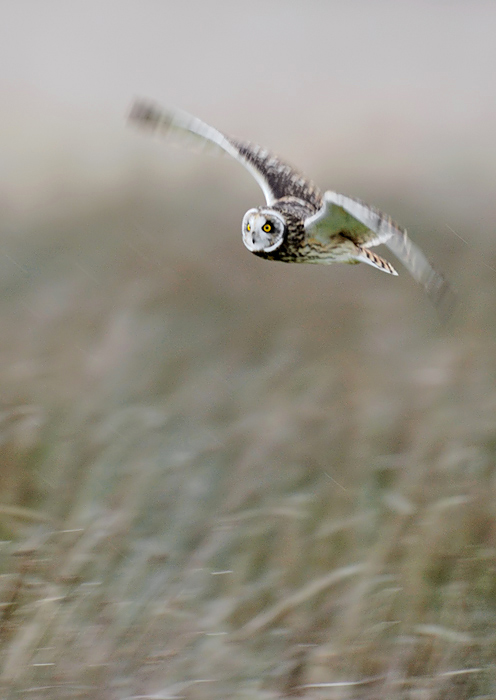
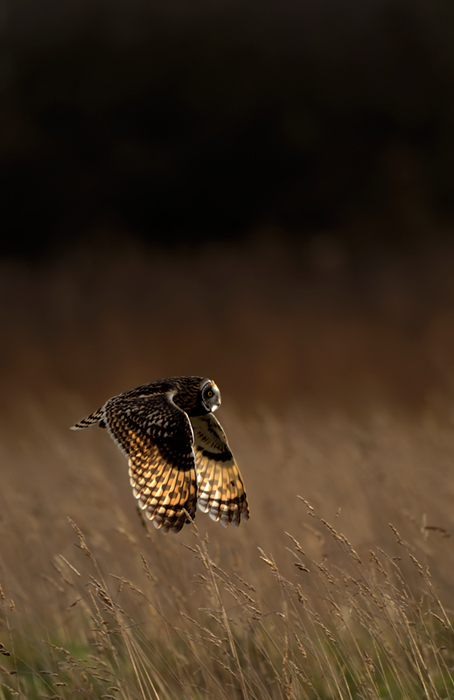
These images I have been processing took me back to my recent time spent with these owls, where I relived every moment as I was processing each special moment captured. Some I shot into the natural light, some I under-exposed and over-exposed creating a hi key effect which I love. I also used the blurring effect to create movement with some, this gives the image a sense of movement and when shot in portrait composition it gives a dramatic effect which brings my creative side to the surface. You pick up the subject as early as possible then with your camera and lens firmly attached to your tripod follow or pan keeping your focus on the subject the best you can.

Hidden away having watched these owls now for some time I got alot of information about their ways and patterns and I chose to hide away, low to the ground hidden and camouflaged with the wind in my face to take any noise away from the approaching owl, no fast movements, nothing that would make these owls jump or be scared in his pursuit of food.

I saw him coming towards me so here I waited, waited and then once he was so close he almost filled my viewfinder and I pressed my shutter capturing several amazing close ups, this is one I love with the sense of movement captured in the wings by the slow shutter speed while I nailed the focus on his face, giving that sense of impending movement to the image. Every moment I spend with nature is special to me and everyday my life is enriched with its beauty and time spent with these owls of late was no exception, a wonderful, close, special moment with this owl as he went about his business and I watched and marvelled at his skills in hunting and catching prey, his flight patterns, his calls, his ability to fly and turn without warning, just amazing!

For me wildlife photography is about using your skills and knowledge of wildlife together in the pursuit of capturing an image from the wild where nothing has been changed by man. As a professional I think I have a duty of care to not only the subject but also to the general public to show an image as seen on the ground. This approach is the whole foundation to my work. In an age when there are lovely images everywhere you look I think images should be judged today on the amount of effort and knowledge and fieldcraft used in order to capture an image as personally I don’t like anything that is to contrived or set up where the animal is made to do something in order to get an image almost like a master and servant, where if you do something you get a prize for that, it has to be unplanned, unscripted and true for me.

My passion for wildlife goes alot deeper than just an image, I watch, study, listen and spend time in watching their behaviour, trying to work with the animals and sometimes when I get an image I feel I have cheated the subject by using my skills in capturing that given image by laying in weight having studied them I hope that makes sense. When I watch an animal I have that connection and I shoot with my heart and eye and I build that trust and care for the subject and when I have taken the image and captured that priceless moment I worry if I have betrayed that trust built up through patience, fieldcraft and care.

I care about every image I take and what I do, I love wildlife and nature means the world to me, it has helped me in life and instilled a great peace from an early age, nature helps in many ways, its beauty brings joy in so many ways and its presence in people lives helps them to live and breathe and at this special time of year it’s even more important I feel to embrace what we have around us all. A few of my favorite images from the last twelve months are in the following slideshow, showing the true beauty of wildlife.

One of my Barn Owl images graces January’s issue of the much respected BBC Wildlife magazine which is on sale now, its always lovely to see your work in print. I spent two months watching and photographing this male Barn Owl during one of the countries coldest spells of weather for decades. At times it was hard to watch as he was hunting in all weathers and times of the day in a desperate attempt to feed in order to survive, how cruel nature can be to its own sometimes. he did survive though and all ending well for this fellow. Thank you to Wanda for requesting the image and Sophie Stafford, the editor, for having this image in your magazine.

Photography Training for Photographers

And just before I go I wanted to just update you all as I go live in the new year as PhotoTraining4U’s Wildlife Master. I will be doing a series of short films following me through some of my work in the field, tips and advice when working with animals in the wild and much more. You will see how I work, get a chance to ask questions relating to my work or questions, advice and help in regard to your own work. If you wish to join then quote the following affiliate code: 7816 when joining. Click on the small icon above and this will take you to this site which is an online site for all your photography needs.

It just leaves me to say I hope you all have a wonderful Christmas and new year and I wish you all the best for 2012, many thanks.


Read full post